

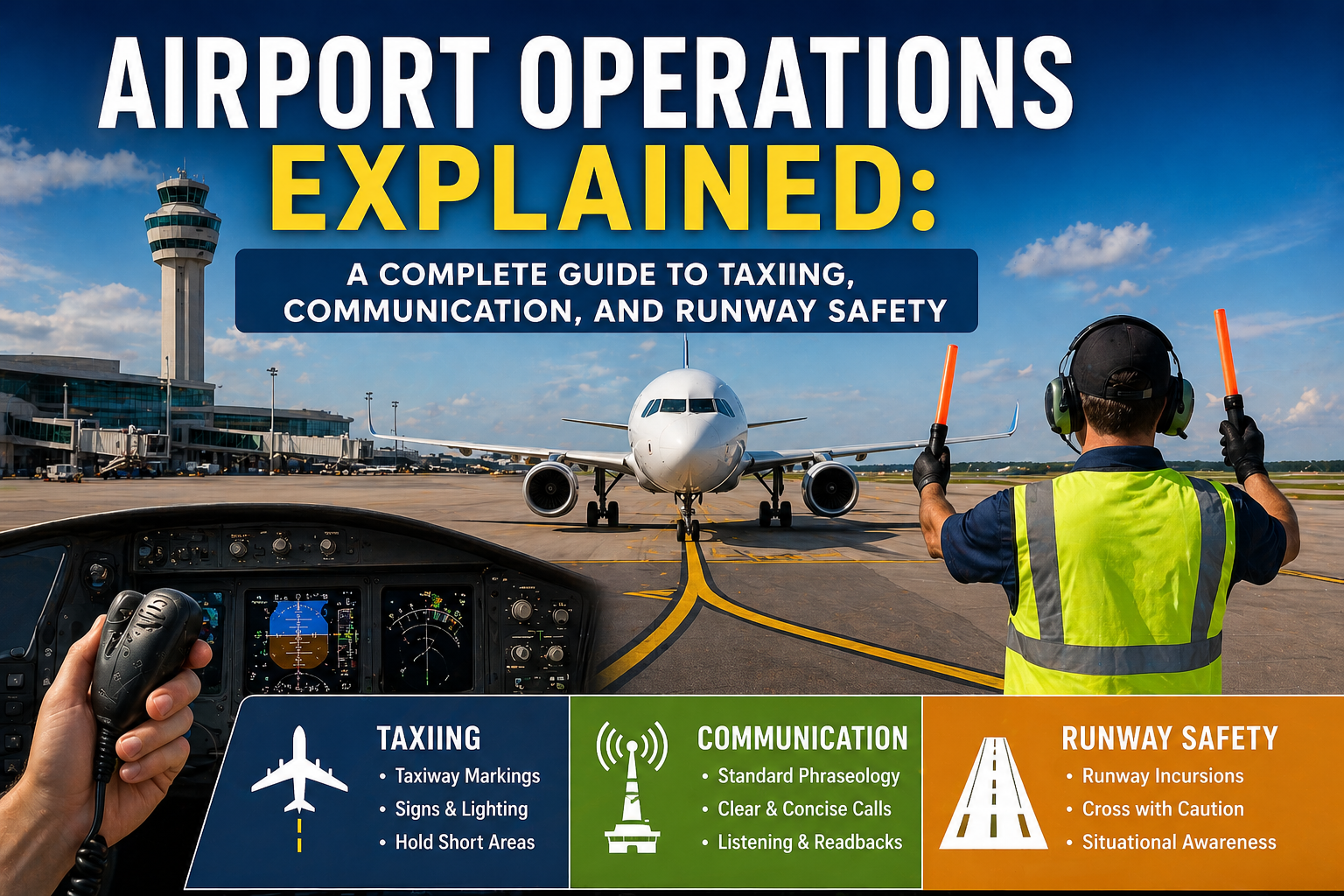
Airports are complex, dynamic environments where safety depends on every pilot understanding exactly what’s expected of them on the ground as well as in the air. A staggering proportion of aviation accidents occur not during flight, but during takeoff, landing, and ground operations. Runway incursions—incidents where an aircraft, vehicle, or person enters an active runway without clearance—kill people every year and cost the aviation industry millions. Understanding airport operations isn’t just bureaucratic checkbox-ticking; it’s life-saving knowledge. This guide walks you through everything you need to know about operating safely at airports, from decoding ATC communications to reading pavement markings and preventing runway incursions.
Towered vs. Non-Towered Airports: The Key Differences
The first distinction every pilot must understand is the difference between controlled (towered) airports and uncontrolled (non-towered) airports.
At towered airports, an FAA Air Traffic Control tower is in operation during published hours. Pilots must establish two-way radio communication with the tower and receive explicit clearance to taxi, take off, land, or operate on the movement area. Instructions from ATC are mandatory, not advisory. Even if a clearance sounds wrong, pilots must query ATC rather than simply disregarding it—though they retain Pilot-in-Command authority to deviate from any clearance to avoid an imminent hazard.
At non-towered airports, no ATC is present. Pilots self-announce their intentions on the Common Traffic Advisory Frequency (CTAF)—typically the UNICOM frequency—and exercise see-and-avoid collision avoidance. Non-towered airports often have more informal operations, but they’re not necessarily safer. Mid-air collisions and runway conflicts occur at non-towered airports, often because pilots fail to communicate effectively or assume they have the runway to themselves.
When towers close (many Class D towers have night hours after which they close), the airport reverts to non-towered procedures. Always check NOTAMs and Chart Supplement information for tower operating hours before arriving at an unfamiliar airport, especially at night.
Ground Communication: Reading, Hearing, and Responding
Clear, standardized radio communication is one of aviation’s most critical safety tools. Poor communication—misheard callsigns, ambiguous instructions, non-standard phraseology—is a factor in a significant number of aviation accidents.
When first contacting Ground Control at a towered airport, a standard callup includes: the facility you’re calling, your aircraft type and tail number, your location on the airport (FBO name, hangar, parking area), and your request (taxi to runway, fuel, parking). For example: “Denver Ground, Cessna 172 November 4 5 6 Papa Tango, at Signature Aviation, request taxi to Runway 17 Left with information Bravo.”
ATC will respond with a taxi clearance that specifies which taxiways to use, runway assignment, and any hold-short instructions. Readback requirements are critical: any runway crossing or hold-short instruction must be read back verbatim. This is not optional—it’s a regulatory requirement and the final safety check before a potentially conflicting clearance is executed.
The phonetic alphabet (Alpha, Bravo, Charlie…) and number pronunciation (niner instead of nine, to prevent confusion with German “nein”) are standardized internationally. Using non-standard language or speaking too quickly contributes to communication breakdowns. When in doubt, slow down, be precise, and ask for clarification.
Taxiway and Runway Markings: Decoding the Pavement
Airport pavement markings are a language unto themselves—and fluency in that language prevents runway incursions.
Runway markings are white. They include threshold markings (the broad white stripes at the runway beginning), centerline stripes, aiming point markings (two white rectangles 1,000 feet from the threshold, used as visual aiming points during approach), touchdown zone markings, and runway designation numbers. Runway numbers correspond to the magnetic heading rounded to the nearest 10 degrees—Runway 18 points approximately south (180 degrees).
Taxiway markings are yellow. Yellow centerlines guide aircraft along taxiways, while yellow edge markings define taxiway edges. Geographic position markings (enhanced centerlines with enhanced dashes approaching an active runway) warn pilots that a runway intersection is ahead.
The most critical taxiway marking is the runway hold-short line—two solid yellow lines parallel to each other, followed by two dashed yellow lines. This is the boundary of the active runway environment. Aircraft must never cross this line without explicit ATC clearance (at towered airports) or visual confirmation that the runway is clear (at non-towered airports). More pilots violate this marking than any other, and runway incursion fatalities are the consequence.
Pavement signs supplement markings. Mandatory instruction signs (red background, white text) include runway designations and hold-short instructions and require ATC clearance to proceed. Location signs (black background, yellow text) identify your current location. Direction signs (yellow background, black text with arrows) indicate turning directions.
Runway Incursion Prevention: Staying Safe on the Ground
Runway incursions are among the most preventable and yet most persistent hazards in aviation. The FAA categorizes them by severity from Category D (little or no chance of collision) to Category A (separation decreases and participants take extreme action to narrowly avoid collision). Category A and B incursions have caused fatal accidents at major airports around the world.
The most common causes of runway incursions are: failure to comply with hold-short instructions, crossing an incorrect taxiway, distraction or task saturation in the cockpit, difficulty navigating complex airport layouts, poor visibility conditions (fog, night operations, rain), and misidentification of clearances.
FAA’s Runway Incursion Mitigation (RIM) program has introduced multiple safety enhancements: enhanced centerline lighting with in-pavement lights leading to runway intersections, Runway Status Lights (RWSL) that provide automated red light warnings when runways are unsafe to enter, and Final Approach Runway Occupancy Signal (FAROS) systems that flash PAPI lights to signal approaching aircraft when the runway is occupied.
Pilots can prevent incursions by always briefing taxiway routes before starting up, using airport diagrams (available in the Chart Supplement or via cockpit EFB apps like ForeFlight), never crossing a hold-short line without a clearance and readback, maintaining sterile cockpit procedures during taxi (no non-essential communication or phone use), and requesting progressive taxi instructions when unfamiliar with the airport layout.
Special Airport Operations: Night Flying, Noise Abatement, and TFRs
Beyond everyday operations, pilots must be aware of special considerations that apply in specific circumstances.
Night operations amplify every challenge on the ground. The familiar visual cues that make daytime taxiing intuitive—pavement color contrasts, distance estimation, taxiway edges—all degrade significantly at night. Blue taxiway edge lights and green taxiway centerline lights become your primary guide. Red stop bar lights at controlled intersections must never be crossed when illuminated. FAA recommends that night operations at unfamiliar airports include a request for progressive taxi from ATC and extra vigilance at all intersections.
Noise Abatement Procedures exist at many airports to limit the impact of aviation noise on surrounding communities. These procedures—published in the Chart Supplement—may restrict hours of operation, require specific departure paths, prohibit run-up procedures at certain times, or mandate reduced power settings after takeoff. While PIC authority allows deviation for safety, noise abatement compliance is important for good community relations and sometimes for continued airport operation itself.
Temporary Flight Restrictions (TFRs) can pop up without warning around major sporting events, presidential movements, natural disasters, and security events. Busting a TFR—especially a presidential TFR—triggers an immediate intercept by military fighters and potential certificate action. Always check NOTAMs within the last hour of flight, use apps like ForeFlight or Garmin Pilot that display active TFRs in real time, and file flight plans so ATC can verify your position relative to restricted areas.
Airport operations mastery separates proficient pilots from merely licensed ones. The ground environment demands the same attention, skill, and discipline as the airspace above. Respect it accordingly.
 Anshum Raj