

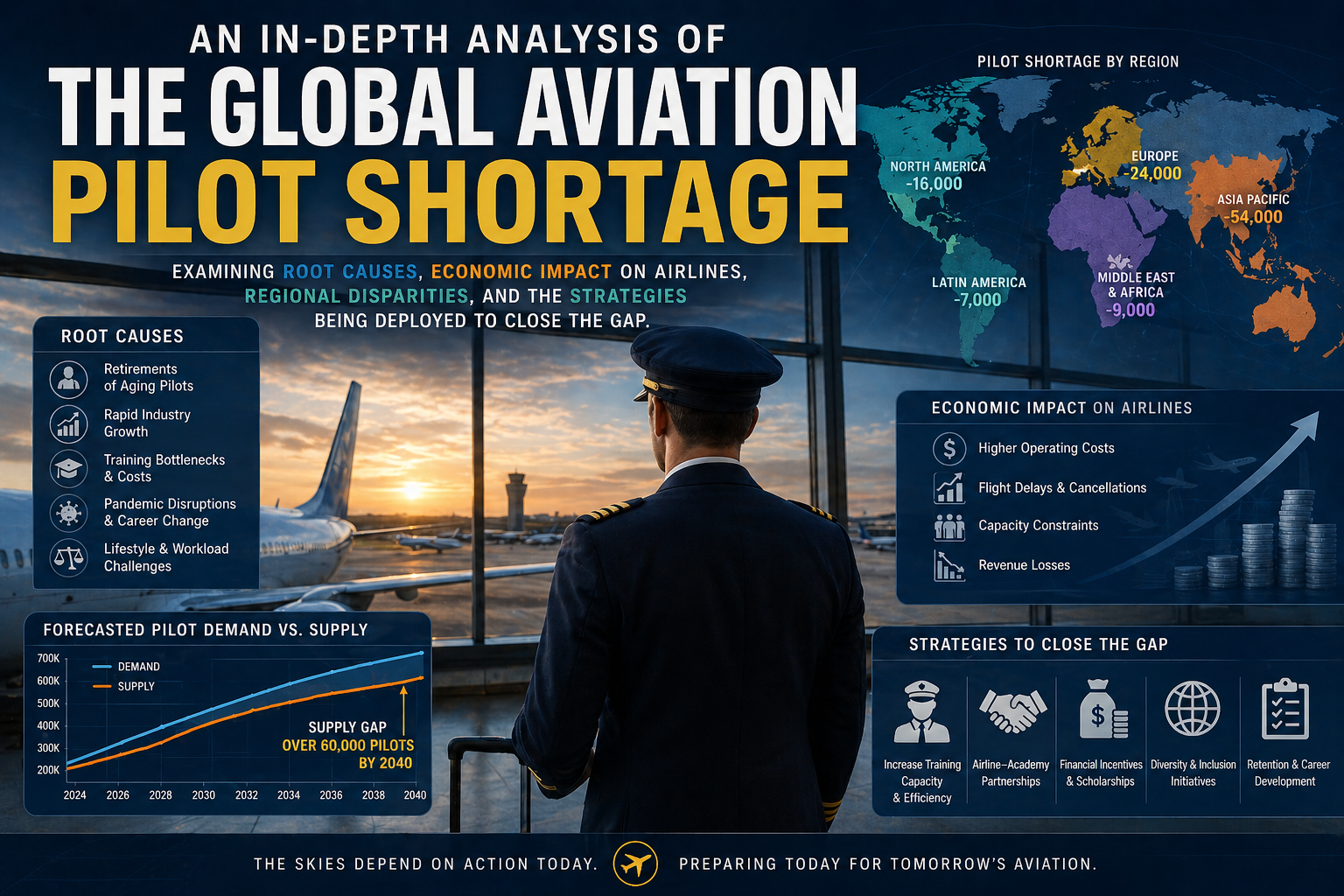
Aviation is facing one of its most pressing structural challenges in modern history: a deepening, global shortage of qualified pilots. Long simmering beneath the surface, this crisis has broken into full view since the post-pandemic travel recovery overwhelmed airline capacity planning. Flights are being cancelled not because of mechanical failures or weather, but because there is simply no one left to fly the planes. The implications stretch far beyond inconvenienced passengers — they reach into airline profitability, regional connectivity, national security, and the long-term architecture of global air travel. This analysis examines the root causes of the pilot shortage, quantifies its economic consequences, explores regional disparities, and evaluates the effectiveness of the solutions currently being deployed by airlines, regulators, and training institutions worldwide.
The Scale and Scope of the Shortage
Boeing’s 2023 Pilot & Technician Outlook projects that the global aviation industry will need approximately 602,000 new commercial pilots over the next 20 years to meet demand growth and replace retiring pilots. Airbus estimates a comparable figure, while regional aviation consultancies suggest the shortage could reach crisis levels in key markets within the next five years if current training pipeline rates don’t accelerate significantly.
The shortage is not evenly distributed. In the United States, regional airlines have been hit hardest, losing junior first officers to major carriers offering dramatically higher pay and better quality of life. Routes connecting small cities to hub airports — services that many communities depend on for access to healthcare, commerce, and opportunity — have seen frequency reductions and outright cancellations. In 2023 and 2024, several U.S. regional carriers returned aircraft to lessors or restructured route networks specifically because they lacked the crews to operate them.
Asia-Pacific is experiencing perhaps the most acute growth pressure. Chinese carriers alone are projected to need over 100,000 new pilots in the coming two decades, against a domestic training infrastructure that cannot currently supply them. The region’s aviation boom — driven by an expanding middle class and surging leisure and business travel — is colliding directly with a pipeline that has not kept pace with ambition.
In Europe, the picture is complicated by demographic patterns. A large cohort of experienced captains who entered the industry during the late 1980s and 1990s expansion is now approaching mandatory retirement age (65 under EASA regulations). Their departure creates a double pressure: not only must airlines replace retiring numbers, but they lose institutional knowledge, mentorship capacity, and the experienced command cadre that underpins airline safety culture.
Root Causes: Why Didn’t the Industry See This Coming?
The pilot shortage has multiple, compounding origins, and honesty requires acknowledging that the industry had clear warning. Aviation economists flagged demographic retirement waves as early as the 2000s. The 2008 financial crisis temporarily suppressed demand and obscured the looming gap. The COVID-19 pandemic further distorted the picture: airlines furloughed and retired thousands of pilots, many of whom left the industry permanently or aged out of currency, creating a sudden skills gap when demand roared back in 2022 and 2023.
The economics of pilot training have long been a structural barrier. Unlike other professions where employers fund training (law, medicine, engineering), commercial aviation historically required aspiring pilots to self-fund their training at enormous personal cost. In the United States, the path from zero flight experience to a regional airline First Officer position typically costs between $80,000 and $150,000 — a burden that disproportionately filters out candidates from lower-income backgrounds and narrows the talent pool to those who can access significant financing or family support.
The 1,500-hour rule, introduced in the United States following the 2009 Colgan Air accident, raised the minimum flight hours required for airline employment from 250 to 1,500 hours for most applicants. While well-intentioned and genuinely safety-motivated, the rule dramatically lengthened the time between training completion and airline employment, raising costs and deterring candidates who might otherwise have entered the profession. Other regulatory jurisdictions — EASA, CAAC, CASA — have their own hour requirements that similarly constrain pipeline throughput.
Lifestyle factors are increasingly influential in recruitment and retention. Pilot schedules are demanding: irregular hours, frequent time away from home, holiday and weekend work, and the psychological weight of responsibility for passenger safety take a measurable toll. As competing professional fields offer comparable or superior compensation with more predictable work patterns, aviation’s appeal as a career destination has weakened, particularly among younger generations evaluating work-life balance as a primary criterion.
Economic Consequences for Airlines and Consumers
The economic consequences of the pilot shortage are significant and multi-layered. For airlines, the immediate cost is in compensation inflation. Pilot salaries at major U.S. carriers have surged dramatically following landmark contract negotiations in 2022 and 2023, with United, Delta, and American all reaching agreements that increased total pilot compensation by 30 to 40 percent over contract terms. While these agreements were necessary to retain talent, they represent a permanent structural increase in the cost base of airline operations.
Route network rationalization has become a strategic necessity for many carriers. Airlines are quietly retiring thinner routes — those with lower load factors, smaller aircraft gauge, or weaker revenue yields — to concentrate available pilot resources on higher-margin operations. This is economically rational at the airline level but represents a significant reduction in regional connectivity, with downstream effects on local economies, tourism, and business investment in affected communities.
Consumer fares have felt the pressure, though causality is difficult to isolate in an environment where fuel costs, airport charges, and general inflation are also rising. The capacity constraints created by crew shortages contribute to tighter supply in the seat market, reducing the competitive downward pressure on fares that excess capacity would otherwise provide. For budget-sensitive travelers — particularly those in underserved regional markets — this translates into real access limitations.
Aviation MRO (Maintenance, Repair, and Overhaul) operations and charter sectors face parallel shortages of aircraft maintenance engineers and technicians, compounding operational disruption. The interconnected nature of aviation workforce constraints means that solving the pilot shortage in isolation is insufficient; the entire skilled-labor ecosystem of the industry requires coordinated investment.
Industry Responses: Training Reform, Technology, and New Pathways
The industry’s response to the pilot shortage has been multifaceted, and some initiatives are beginning to show genuine promise. Airlines and training organizations have invested heavily in simulator capacity and ab initio programs — structured pathways that take cadets from zero experience to airline First Officer with employer funding, removing the personal financial barrier that has historically suppressed applications.
In the United States, the FAA’s Aviation Workforce Development grants program has channeled federal funding into high school and collegiate aviation programs, with the aim of broadening the pipeline at its source. Several major carriers have established cadet academies in partnership with universities, offering conditional job offers contingent on successful training completion — dramatically reducing the career risk for aspiring pilots and improving the economics of entry.
The military pipeline, historically a significant source of experienced commercial pilots, has tightened as defense departments compete to retain their own aviators. In response, some airlines have launched direct partnerships with military services, offering transition programs specifically designed to convert military aviators into commercial first officers with streamlined pathway credit for relevant training and experience.
Technological solutions are being explored with increasing seriousness. Single-Pilot Operations (SPO) — the concept of certifying certain aircraft types for commercial operation with one pilot instead of two — has moved from theoretical discussion to active regulatory study at both EASA and the FAA. Proponents argue that automation advances, particularly in auto-land, traffic conflict avoidance, and autonomous emergency management systems, can replicate the safety functions historically provided by a second human pilot. Critics, including pilot unions and safety advocacy organizations, argue that the redundancy provided by two pilots is precisely what has made modern commercial aviation so remarkably safe, and that degrading that redundancy for economic convenience is ethically indefensible. This debate will define a crucial boundary in aviation’s future.
Analysis: Will the Gap Close, and at What Cost?
Synthesizing the available evidence, several conclusions emerge. First, the pilot shortage is structural, not cyclical. It will not resolve itself through a demand downturn or a single policy intervention. Meaningful alleviation requires simultaneous action on training pipeline capacity, financing accessibility, regulatory adaptation, and lifestyle attractiveness — a long-lead-time, multi-actor challenge.
Second, the geographic distribution of the shortage will increasingly influence geopolitical dimensions of aviation. Nations that develop strong domestic training ecosystems and pilot supply chains will enjoy strategic advantages in the development of their aviation sectors. Nations that fail to invest — or that rely on imported foreign pilot labor without building domestic capacity — will find themselves vulnerable to external labor market shocks.
Third, the resolution of this shortage will inevitably involve some combination of higher fares, reduced regional connectivity, and technological substitution. Consumers, regulators, and communities should engage critically with the trade-offs each pathway involves rather than treating the problem as a purely technocratic matter for industry to solve internally.
The pilot shortage is ultimately a mirror held up to aviation’s systemic investment failures — in workforce development, in training financing, in regulatory agility, and in the human factors of a demanding profession. The industry’s response over the next decade will determine whether aviation in 2040 looks like an expanded, democratized global network, or a premium service increasingly concentrated in high-density corridors while smaller communities are left behind.
 Martin hope