

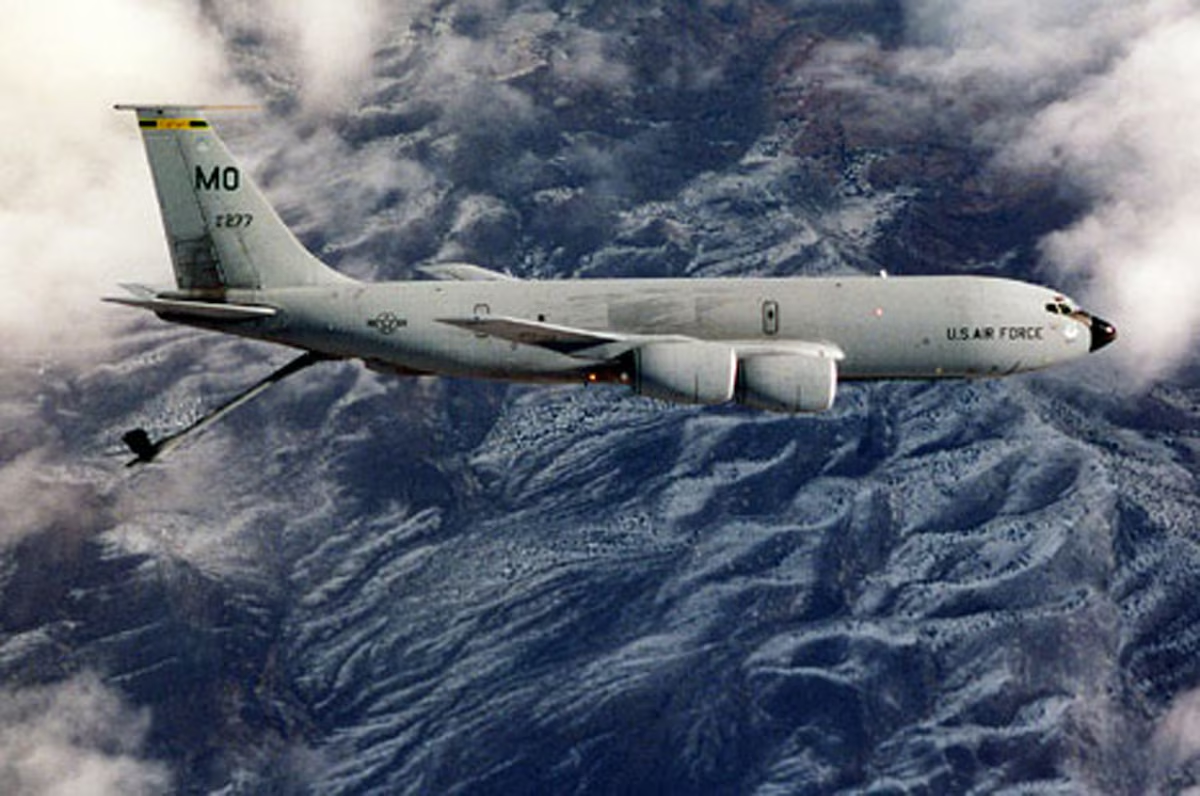
A United States Air Force KC-135 Stratotanker crashed in Iraq’s Al-Anbar province during the early hours of Thursday, resulting in the deaths of all four crew members on board.
The aircraft was supporting Operation Epic Fury, a coordinated multi-national campaign targeting insurgent logistical hubs. Preliminary reports from the theater commander indicate the aircraft disappeared from radar during a high-altitude refueling orbit, with no distress signal recorded prior to the incident.
The KC-135 Stratotanker has served as the backbone of United States aerial refueling capabilities for over six decades. Derived from the Boeing 367-80 prototype, this specific airframe has seen continuous deployment across multiple Middle Eastern conflicts. In the context of Operation Epic Fury, these tankers provide the necessary range for strike packages operating from regional bases.
The fleet is currently undergoing a phased replacement, yet the aging airframes remain a constant presence in high-intensity combat zones.
1. Fatalities: 4 (2 Pilots, 1 Navigator, 1 Boom Operator).
2. Airframe Age: 61 years (Manufactured 1963).
3. Mission Profile: Tactical Aerial Refueling Orbit (TARO).
4. Location: Al-Anbar Province, 45 miles west of Ramadi.
5. Fuel Load: Approximately 120,000 lbs at time of departure.
The loss of this airframe suggests a critical failure in the primary flight control surfaces or a sudden decompression event. While the KC-135 has a robust safety record, the maintenance-to-flight hour ratio has ballooned to over 30 hours of ground work for every hour in the air.
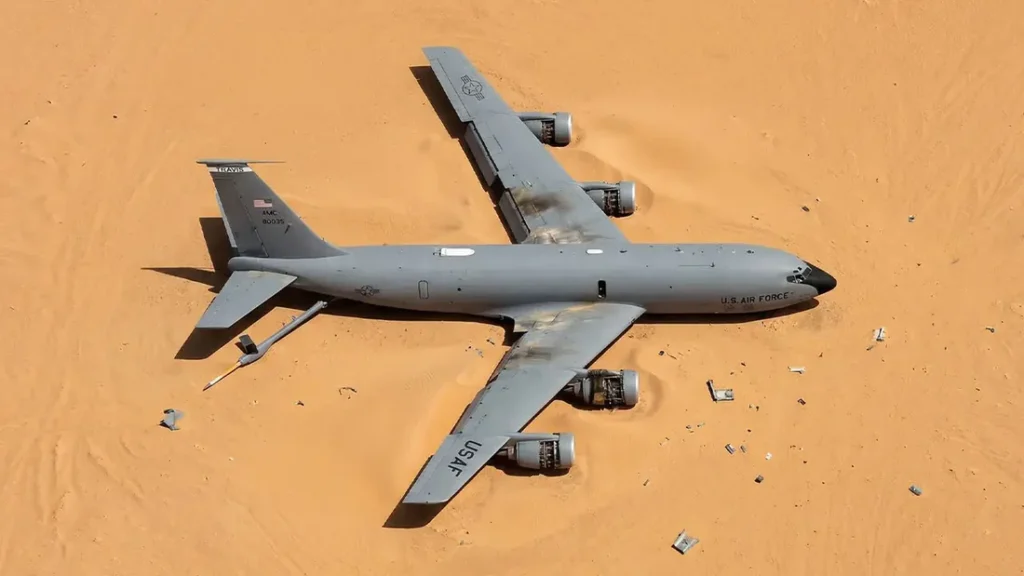
The operational implication is an immediate grounding of the local squadron for safety inspections, potentially stalling the momentum of Operation Epic Fury. The KC-135 remains an essential asset despite its age. The aircraft utilizes four CFM56 (F108) engines, which have improved reliability over the original J57 turbojets. However, the airframe itself is subject to chronic metal fatigue and corrosion in the wing boxes. During Operation Epic Fury, tankers are required to fly at lower altitudes than standard transoceanic crossings to facilitate rapid rendezvous with short-range fighters.
These lower altitudes expose the aircraft to higher turbulence and increased thermal stress. Analysts are focusing on the wing-to-fuselage attachment points. Recent inspections across the fleet have identified micro-cracks in several units. If a catastrophic structural failure occurred during a fuel transfer, the result would be an immediate loss of control. The absence of a distress call points toward a rapid, high-energy event. This is consistent with a structural break-up or an uncontained engine failure.
The Al-Anbar region presents specific environmental challenges for heavy aircraft. Sand ingestion and extreme temperature fluctuations accelerate wear on turbine blades and hydraulic seals. While these factors are managed through rigorous maintenance schedules, the high sortie rate of Operation Epic Fury may have compressed the window for deep-tier inspections.
The four crew members were highly experienced, with the lead pilot having over 2,500 hours in type. This suggests that pilot error is a less likely factor than mechanical or structural failure. Recovery teams reached the crash site within three hours. The site was secured by elements of the 101st Airborne Division to prevent the compromise of sensitive communication equipment.
Investigators from the Air Force Safety Center are now on-site. They will prioritize the recovery of the Flight Data Recorder and the Cockpit Voice Recorder. These devices are critical for determining the final moments of the flight. The impact on the broader campaign is significant. Without reliable tanker support, strike aircraft are limited to their internal fuel capacity, drastically reducing their loiter time over target areas. This creates a bottleneck in the intelligence, surveillance, and reconnaissance (ISR) loop. The Pentagon must now decide whether to deploy additional KC-10 or KC-46 assets to fill the gap. Each of these alternatives brings its own set of logistical hurdles.
The KC-10 is also an aging platform, while the KC-46 is still overcoming early operational deficiencies. The loss of four airmen is a sobering reminder of the risks inherent in support roles. Tanker crews often fly in predictable orbits, making them potential targets, though there is currently no evidence of hostile fire in this incident.
The investigation will also look at the fuel manifold system. A leak in the high-pressure lines during a boom extension could lead to a fuel-air explosion. Such an event would explain the sudden loss of radar contact.
The KC-135R variant used in Iraq is equipped with advanced avionics, but the core structural components remain original. This creates a disparity between what the sensors can track and what the physical wings can endure.
Future missions under Operation Epic Fury will likely see revised flight envelopes. This includes reduced fuel loads to minimize wing stress and increased spacing between refueling cycles. Such measures, while safer, reduce the overall efficiency of the air campaign. The strategic necessity of the region ensures that operations will continue, albeit with heightened caution. For additional operational briefings and the latest Defense News, monitor our dedicated aviation & Defence intelligence category.
 Priyanshu Gautam
  Olive Arthur