


SAN DIEGO, GE Aerospace and Kratos Defense & Security Solutions have secured a $12.4 million contract from the US Air Force to execute the preliminary design of the GEK1500 engine. This agreement marks a critical pivot in the propulsion supply chain for Collaborative Combat Aircraft (CCA), prioritizing the adaptation of cruise missile architecture for reusable, high-performance unmanned systems. The initiative focuses on scaling the existing GEK800 platform to a 1,500-lb thrust class, addressing the acute requirement for “affordable mass” in contested airspaces.
The US Air Force’s operational doctrine has shifted rapidly toward distributed lethality, necessitating fleets of unmanned systems capable of flying alongside manned fighters.
This strategy, centered on CCAs, faces a primary logistical bottleneck: propulsion cost and production velocity. Traditional turbofan engines utilized in manned aviation are over-engineered for attritable platforms, possessing lifecycles and price points incompatible with the concept of expendable or limited-life assets.
In response, the industry has sought to bridge the gap between short-duration cruise missile engines and enduring tactical aircraft propulsion. The GE Aerospace and Kratos partnership, formalized via a teaming agreement in June 2025 and a preceding 2024 Memorandum of Understanding, leverages Kratos’ agility in low-cost system design and GE’s massive industrial production capacity. The GEK1500 program represents the next logical step in this trajectory, upsizing proven technology to support larger, more sensor-dense UAS platforms.
- Contract Value: $12.4 Million (Initial Phase).
- Engine Model: GEK1500 (1,500 lb-thrust class).
- Base Architecture: GEK800 (Cruise missile derivative).
- Lead Entities: GE Aerospace (Edison Works) / Kratos (Turbine Technologies Division).
- Key Performance Indicators: Increased electrical power generation, extended range, aggressive cost reduction.
- Production Heritage: GE installed base of 29,000 military engines; Kratos experience spanning 25+ years in small turbojets.
OUR ANALYSIS
The decision to scale the GEK800 architecture rather than initiate a clean-sheet design indicates a risk-averse, schedule-driven acquisition strategy by the US Air Force.
Unlike the Adaptive Engine Transition Program (AETP) for manned fighters, which pushed the boundaries of thermodynamic efficiency, the GEK1500 prioritizes manufacturing velocity and cost-per-flight-hour over absolute peak performance.
This contract signals that the “attritable” engine market is maturing into a tiered system, where propulsion units are treated as modular, rapidly replaceable commodities rather than depot-maintained assets.
THE GEK ARCHITECTURE
The GEK1500 is not merely a larger engine; it is a strategic adaptation of the GEK800 cruise missile architecture. This distinction is vital for understanding operational viability. Cruise missile engines are typically designed for a single flight profile: launch, cruise, and terminate. However, CCAs require a wider operating envelope, including taxi, takeoff, loitering, and recovery.
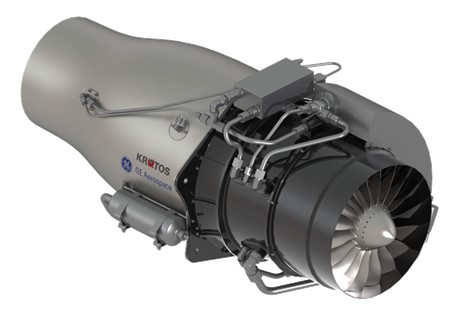
The technical challenge lies in modifying a limited-life core to handle the thermal cycles associated with reusable flight without inflating the cost to match manned aviation standards. The press release notes that lessons from recent GEK800 altitude testing are directly informing the GEK1500 design. This suggests that the core geometry and compressor aerodynamics are stable, allowing engineers to focus on scaling the fan and low-pressure turbine sections to handle increased mass flow.
Electrical power generation remains a critical subplot in this design phase. As CCAs are tasked with carrying advanced Electronic Warfare (EW) pods or active radar arrays, the engine must extract significant horsepower from the high-pressure spool to drive generators. The GEK1500’s design brief specifically highlights “increased electrical power,” confirming that the US Air Force envisions these small platforms as energy-intensive sensor nodes, not just kinetic delivery trucks.
The partnership between GE Aerospace and Kratos addresses the most significant hurdle in the CCA program: industrial surge capacity. Kratos has historically operated in the niche of target drones and small tactical systems, mastering the art of “design for manufacturability.” Their approach minimizes part counts and utilizes non-exotic materials where possible to reduce lead times.
GE Aerospace brings the supply chain heft required to move from dozens of units to thousands. The infrastructure required to cast turbine blades, machine disks, and assemble cores at the rate demanded by a major conflict does not currently exist in the lower-tier defense base. By integrating Kratos’ design philosophy with GE’s production lines, the US Air Force attempts to inoculate the CCA program against supply chain fragility.
This contract effectively serves as a validation of the “commercial-off-the-shelf” mentality applied to kinetic hardware. The $12.4 million award for preliminary design is relatively modest in defense acquisition terms, yet it carries outsized importance. It funds the engineering required to prove that a high-performance engine can be built at a price point that makes the loss of a CCA operationally acceptable.
OPERATIONAL IMPLICATIONS FOR THE FLEET
The introduction of the 1,500-lb thrust class engine creates a new category of logistics for air wings. Engines in this class support aircraft that are likely too large to be runway-independent (requiring catapults or catch nets) but too small to require the massive ground support equipment of an F-35.
Dispatch reliability for the GEK1500 will likely differ from manned standards. The maintenance concept will probably shift from “repair and return” to “remove and replace.” If a GEK1500 fails or reaches its hour limit, the operational model suggests the entire engine would be swapped out and the old unit potentially discarded or recycled, rather than undergoing a complex overhaul. This drastically reduces the footprint of forward-deployed maintenance units.
Furthermore, the “option” mentioned in the contract to assess flight and installation conditions points toward a rapid prototyping schedule. The US Air Force is not waiting for a decade-long development cycle. They need propulsion units that can be integrated into airframes currently on the drawing board or in early flight testing. The timeline reduction achieved by leveraging the GEK800 maturation is the primary operational dividend here.
MARKET POSITIONING AND STRATEGIC FORECAST
This award consolidates the GE-Kratos team’s position against competitors like Williams International or Pratt & Whitney in the sub-2,000 lb thrust market. As the CCA program solidifies, the propulsion sector is bifurcating. The high end remains the domain of the F135 and XA100, while the volume market shifts to these compact, high-output turbojets.
From a strategic infrastructure perspective, we are witnessing the commoditization of jet propulsion. The GEK1500 represents a move away from “bleeding edge” technology—a phrase Kratos explicitly rejects in their corporate philosophy—toward “leading edge” technology that is reproducible.
The ability to scale designs into high-rate production is the defining metric for the next decade of aerospace defense. If the GEK1500 meets its cost targets, it validates the entire CCA concept. If the cost creeps up toward traditional engine prices, the economic model of “affordable mass” collapses. Therefore, this preliminary design phase is not just an engineering exercise; it is a stress test of the Air Force’s future force structure economics.
Looking forward, the success of the GEK1500 will likely spawn a family of engines sharing a common core but optimized for different flight profiles—some for high-subsonic dash speeds, others for long-endurance loitering. The GEK800 to GEK1500 scaling is the first iteration of this modular approach.
The operational reality is that the US Air Force and its allies require thousands of autonomous systems to saturate adversary air defenses. Those systems cannot fly without engines. The GE-Kratos alliance is effectively laying the industrial rails to supply that demand. The focus on altitude testing and risk characterization now, rather than later, indicates a program managed with an eye toward immediate fielding rather than perpetual research.
In the broader scope of aviation dispatch and fleet management, the GEK1500 signifies the arrival of the “disposable” high-performance era. Aviation analysts must now account for a fleet segment where attrition is a feature, not a failure, and where engine life is measured in missions rather than decades.
 Anshum Raj
  Olive Arthur