


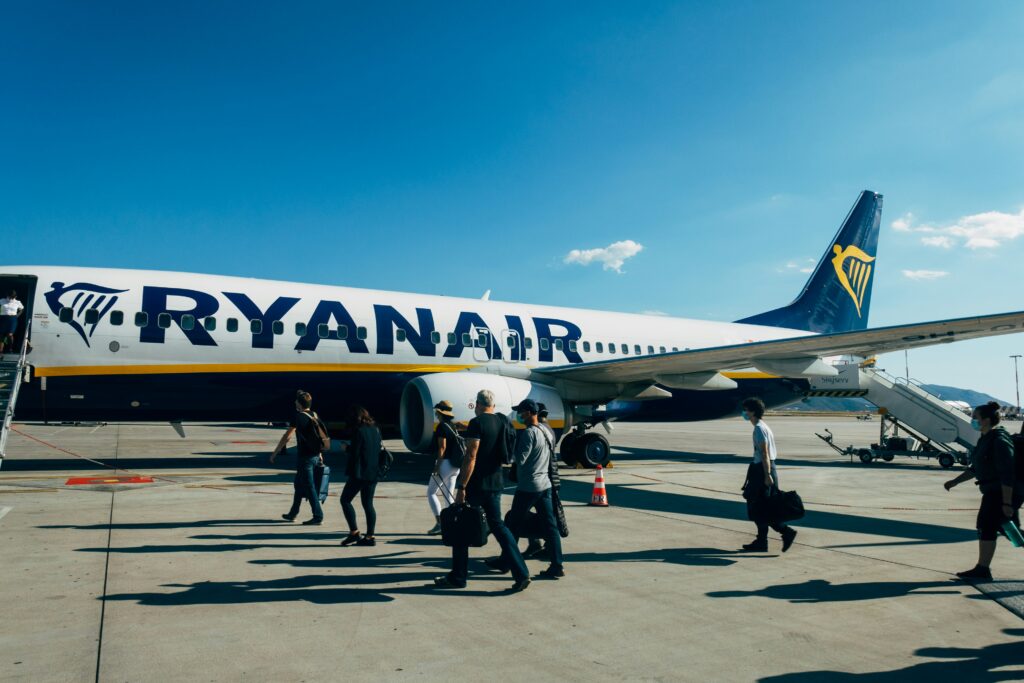
Picture the scene. A Ryanair Boeing 737 is sitting on the stand at Linz Airport, Austria, engines cooling down, ground crew moving around it, passengers boarding for a London flight. Routine turnaround. Except this time, a bailiff is walking up the airstairs with a court order — and a sticker that could, technically, put a €50 million aircraft up for public auction.
This isn’t a scene from a TV show. It happened on March 9, 2026. And the debt that triggered the whole thing? A grand total of €892.87 — roughly the price of a budget weekend in the city Ryanair was flying to.
This is the story of how one Austrian woman, a 13-hour flight delay, and Ryanair’s stubborn refusal to pay a court-ordered sum ended with an official seizure notice stuck to the cabin wall of a commercial aircraft — while passengers filed past it on their way to their seats.
The Key Facts at a Glance
| Detail | What happened |
| Aircraft | Boeing 737-8AS, registration EI-EXE |
| Airport | Linz Airport (LNZ), Austria |
| Date of seizure | March 9, 2026 |
| Debt amount | €892.87 (~$1,022 / ~₹85,000) |
| Original delay | 13 hours — Linz to Palma de Mallorca, July 2024 |
| Seizure method | “Cuckoo sticker” (Pfändungsmarke) affixed to cabin wall |
| Court authority | District Court of Traun, near Linz, Austria |
| Legal basis | EU Regulation EC-261/2004 — passenger compensation rights |
| Ryanair’s response | Denied aircraft was ‘seized’, refused further comment |
| Outcome | Ryanair paid the outstanding debt within 3 days |
| Flight status | Departed for London on schedule — sticker still attached |
How a 13-Hour Delay in 2024 Led to a 2026 Aircraft Seizure
The story begins in July 2024, when an unnamed Austrian woman and two companions boarded a Ryanair flight from Linz to Palma de Mallorca. The flight was delayed by 13 hours. When an airline delays a flight by more than 3 hours in European airspace, EU Regulation EC-261/2004 kicks in — passengers are legally entitled to compensation of up to €600 per person, plus reimbursement of any out-of-pocket expenses caused by the disruption.

The woman did what any reasonable person would do. She booked an alternative flight to get to her destination and filed a claim with Ryanair for the costs and the statutory EU compensation. Ryanair refunded the original ticket price. So far, so normal. Then it stopped. The airline refused to pay the EC-261 compensation and declined to reimburse the cost of the replacement flight she had booked.
The total claim: €250 in statutory EC-261 compensation, plus reimbursement for the alternative flight, interest, legal costs, and enforcement costs. By the time the case reached court, the total had grown to €892.87 — a figure that would barely cover a night at a decent hotel in London.
She took Ryanair to court. She won. The Austrian court ordered Ryanair to pay. Ryanair didn’t respond. So in March 2026, the passenger and her lawyer decided it was time to escalate. They asked Austrian enforcement authorities to take action. The district court of Traun instructed a bailiff to carry out an official act at Linz Airport.
The Moment the Bailiff Walked Onboard
On March 9, 2026, as a Ryanair Boeing 737 sat at the gate preparing for its London departure, the bailiff arrived at Linz Airport. Airport staff — notified in advance by the district court — escorted him to the aircraft. He walked onboard.
His first move was to ask the crew to hand over the €890 debt on the spot. This is standard bailiff procedure — pay now and it ends here. Except Ryanair operates cashless flights. The crew had no cash. The pilot, apparently willing to resolve the situation personally, offered to pay by card. The bailiff would only accept cash. Impasse.
“We were informed that there was a pending claim against Ryanair in court and that a bailiff has been instructed by the district court of the city of Traun to carry out an official act.” — Linz Airport spokesperson
With no cash available and no way to settle the debt on the spot, the bailiff did the only thing left available to him under Austrian law. He took out the Pfändungsmarke — the seizure sticker, known colloquially in Austrian courts as a “Kuckuck” or cuckoo sticker — and pressed it to the cabin wall.
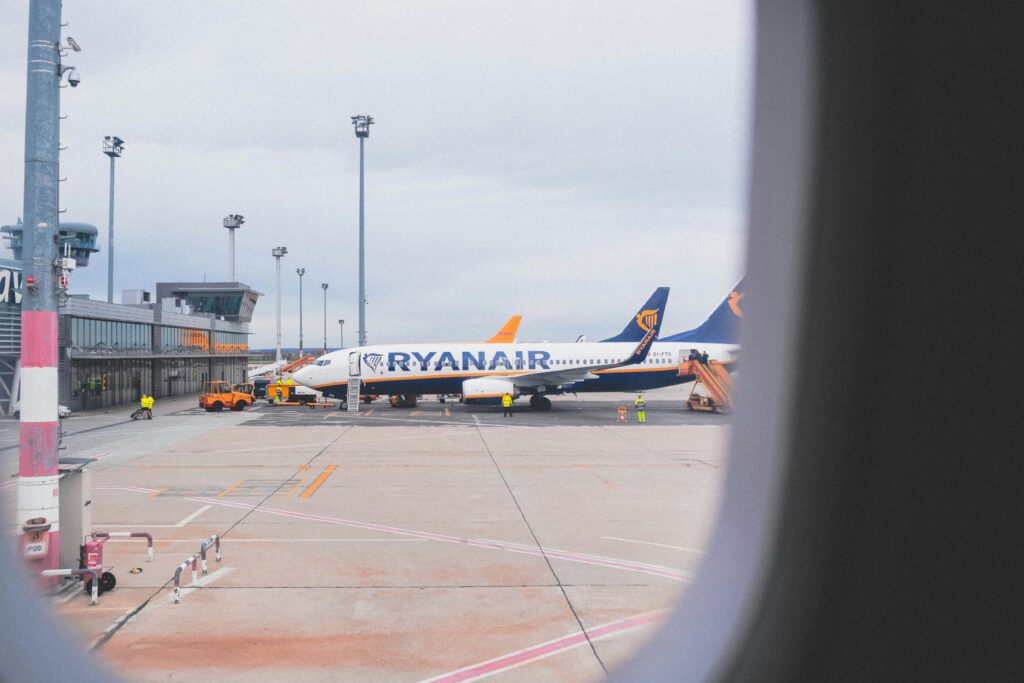
The sticker is not decorative. It is a legal instrument. By affixing it, the bailiff placed the aircraft under the authority of the District Court of Traun. The court now had legal control of the Boeing 737. It could permit the aircraft to continue operating under set conditions — which it did — but if the debt remained unpaid by the court’s deadline, the court could move to sell the aircraft at public auction.
The flight to London departed. The sticker was still on the cabin wall. Passengers either didn’t notice it, didn’t understand what it meant, or both.
What Is a ‘Cuckoo Sticker’ and Why Does It Matter?
The Kuckuck — cuckoo sticker — is a piece of Austrian legal folklore that most people only encounter in debt enforcement dramas and, apparently, on the cabin walls of budget airline aircraft.
In Austrian law, when a bailiff executes a court-ordered seizure on a physical asset, they affix a Pfändungsmarke to that asset. This sticker does several things simultaneously. It marks the asset as legally claimed by the court. It notifies anyone who sees it that the asset is under judicial attachment. And it triggers a legal process that can ultimately result in the asset being sold to satisfy the debt.
Here’s the asymmetry that makes this story remarkable: a €892 debt. A Boeing 737-8AS aircraft worth approximately €50 million on the open market. Austrian law doesn’t care about proportionality — if the debt is unpaid and the bailiff has authority, any asset of the debtor present at the location can be seized and marked.
The sticker wouldn’t have grounded the plane immediately. Austrian courts move deliberately. The aircraft could continue to operate while the legal process played out. But the court’s deadline was real, and if Ryanair had continued to ignore it, a public auction notice for a commercial Boeing 737 would not have been the strangest thing Austrian legal history has seen.
Ryanair’s Response: Deny, Deflect, Then Quietly Pay
Ryanair’s public position was characteristically defiant. A spokesperson told The Guardian the airline denied that its aircraft had been ‘seized’ — technically accurate in the physical sense, since the jet wasn’t chained to the tarmac — but declined to comment on whether a seizure notice had been applied or whether the €892 had since been paid.
“Ryanair denied the aircraft had been seized but refused to comment on whether bailiffs had applied a seizure notice or whether the debt had since been paid.” — The Irish Times
Within three days of the sticker going up, Ryanair had quietly settled the debt. No announcement. No acknowledgement that the court order had been correct all along. No word on how many similar outstanding claims might be sitting unaddressed in the airline’s legal queue. Just a payment, and silence.
This response tells you everything about Ryanair’s compensation philosophy. The airline routinely denies, delays, and deflects on EU261 claims — not because it always wins, but because most passengers give up before getting this far. The legal system worked exactly as it was designed to. The passenger didn’t give up. She got paid.
This Isn’t the First Time Airlines Have Been Seized Over Debt
Bizarre as it sounds, aircraft seizures over unpaid compensation are not without precedent. They are extremely rare — but they happen, and when they do, they tend to happen to the same airlines.
2018 — France impounds Ryanair: French authorities seized a Ryanair aircraft carrying 149 passengers after a years-long legal battle over illegal subsidies. The bill was €525,000. Ryanair paid it immediately.
2020 — Delta at London Heathrow: Bailiffs arrived at Heathrow to seize Delta’s check-in desks over an unpaid $3,400 refund owed to a passenger. Delta’s manager resolved it on the spot — with their personal credit card.
Wizz Air at London Luton: Bailiffs showed up at Luton Airport to collect an unpaid refund from Wizz Air. The disruption caused a flight delay — which triggered fresh EU261 compensation obligations for all passengers on board. Wizz Air paid twice.
1990s — Northwest Airlines, chain on the nose gear: A flight attendant owed money by Northwest Airlines had her lawyer file the paperwork. Authorities wrapped a chain around the aircraft’s nose landing gear. She got paid the same day.
The pattern is consistent. Airlines ignore small claims because most passengers abandon them. When passengers persist — and especially when they engage lawyers willing to pursue enforcement — the airline pays, quickly, every single time.
What This Means for Every Passenger Who’s Owed EU261 Compensation
This story isn’t just entertaining airport drama. It’s a reminder of something genuinely important for anyone who flies in or out of Europe: your EU261 rights are real, they are legally enforceable, and airlines that refuse to honour them can have their multi-million-euro assets attached by a court bailiff wielding a sticker that costs less than a postage stamp.
Under EU Regulation EC-261/2004, passengers on flights departing from or arriving at EU airports are entitled to compensation of €250 for delays over 3 hours on short flights, €400 for medium-haul, and €600 for long-haul — on top of any out-of-pocket expenses caused by the disruption. The regulation covers flights on any airline departing the EU, and EU-based airlines arriving into the EU from anywhere in the world.
Ryanair’s own refund record: Passenger rights groups have consistently criticised low-cost carriers, and Ryanair in particular, for their approach to EC-261 claims. The airline’s standard playbook — refund the ticket price, deny the statutory compensation, ignore the court — works on most passengers. It didn’t work here.
If you are owed EU261 compensation and the airline isn’t paying, small claims courts in Austria, Germany, France, and other EU states have proven enforcement mechanisms. It took this passenger nearly two years. But she got every euro — plus interest, plus legal costs, plus enforcement costs. And she got a story that will be told in aviation circles for years.
The Bigger Picture: What Ryanair’s Behaviour Reveals
Ryanair is Europe’s largest airline by passenger numbers. It flies over 180 million people a year. It generates billions in profit. And it couldn’t — or wouldn’t — find €892 to pay a court-ordered debt for nearly two years, until a bailiff walked onto one of its planes in front of passengers, the airport staff, and eventually, every aviation news outlet on the planet.
This incident isn’t really about €892. It’s about a business model that treats compensation claims as a cost-benefit calculation. Pay up early, or wait and see how many claimants give up. Most do. The ones who don’t represent a very small fraction of total liability. So the model works — right up to the moment it doesn’t.
A Boeing 737 with a cuckoo sticker on its cabin wall is not a good look for any airline. But for an airline that has built its brand on telling passengers exactly what they’re getting — cheap fares, no frills, no surprises — being caught stiffing a single passenger on €892 while flying 180 million people a year might be the most Ryanair story ever told.
© 2026 AeroMantra Airline Desk — All rights reserved.