


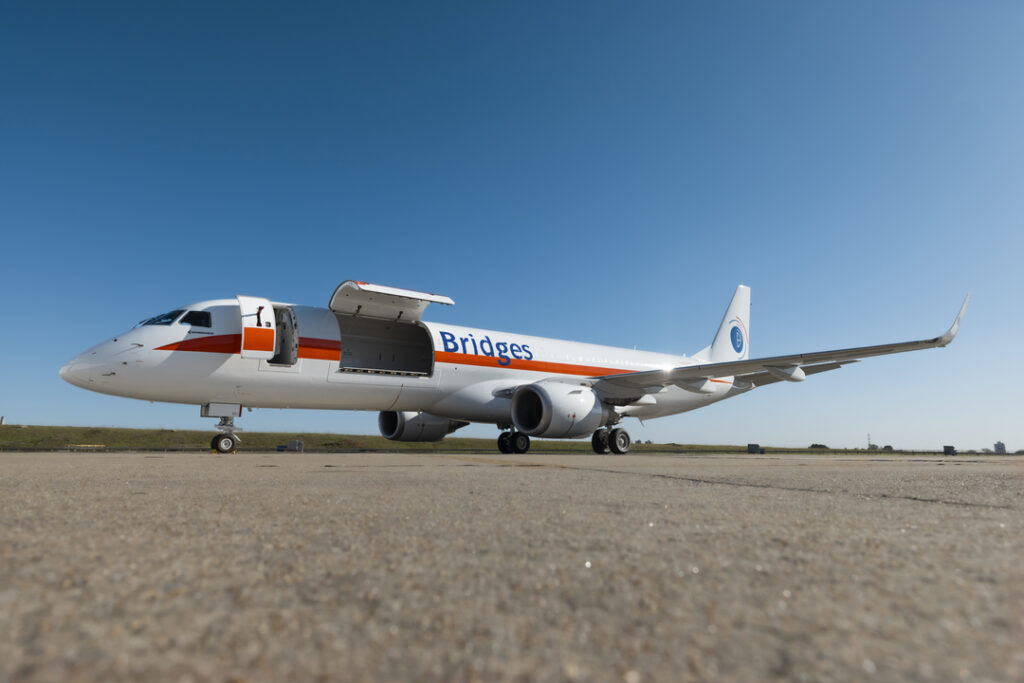
The first Embraer E190F has officially entered commercial service, marking a structural evolution in the regional cargo sector as logistics providers move toward optimized middle-mile solutions. This deployment addresses a critical capacity gap between high-frequency turboprop operations and larger, volume-heavy narrow-body freighters that often underutilise floor space on secondary routes.
Embraer launched the Passenger-to-Freighter (P2F) program in 2022 to capitalise on the surplus of first-generation E-Jets reaching the secondary market. By converting mid-life E190 and E195 airframes, the manufacturer provides a second life for assets that remain structurally sound but face stiff competition in the passenger market from the E2 and A220 series.
OPERATIONAL SPECIFICATIONS
- E190F Maximum Structural Payload: 10,700 kg (23,600 lbs)
- E195F Maximum Structural Payload: 12,300 kg (27,100 lbs)
- Range at Full Payload: 2,300 nautical miles
- Trip Cost Advantage: 25% to 30% reduction vs. 737-300SF
- Cargo Volume: Up to 3,500 cubic feet (E195F)
Analysis suggests that the E-Freighter provides a 20% increase in speed over turboprops while maintaining lower landing fees than larger narrowbodies. The strategic integration of this platform allows carriers to increase frequency on routes where a Boeing 737-800BCF would operate with significant empty weight. This transition is a frequent topic in Airline News as operators seek to balance fuel burn with the rapid delivery requirements of e-commerce.

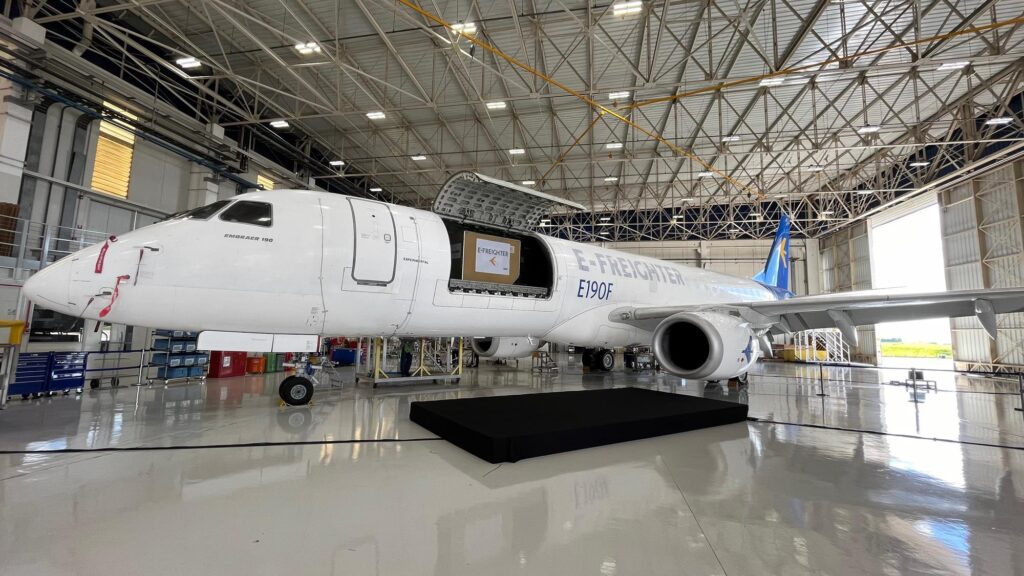
The engineering behind the conversion involves a new main deck cargo door, a reinforced floor, and a Class E cargo compartment. These modifications enable the aircraft to handle standard industry pallets and containers, ensuring seamless integration into existing ground handling ecosystems. The aircraft serves as a bridge, allowing logistics companies to scale operations without the capital intensity of larger platforms.
Operational viability depends heavily on the resurgence of regional hub-and-spoke cargo models. As major hubs face congestion, secondary airports are becoming vital for e-commerce distribution centers. The E-Freighter is uniquely positioned to serve these smaller runways where larger jets face weight or length restrictions, providing a consistent flow of goods to underserved markets.
Fleet commonality remains a primary driver for existing E-Jet operators. Many airlines already possess the maintenance infrastructure and flight crew certifications required for the E190 platform. This drastically reduces the entry-to-service costs and simplifies the training curve for technical personnel tasked with maintaining the freighter variant.
Strategic forecasting indicates a market demand for approximately 700 aircraft in this size category over the next two decades. This demand is fuelled by the decommissioning of older MD-80 and Boeing 737 Classic freighters that no longer meet modern noise or emission standards. The E190F offers a cleaner, quieter alternative that aligns with increasingly stringent environmental regulations at European and North American airports.
Infrastructure trends also favour the Embraer E-Freighter. Many tier-2 cities are expanding their cargo handling facilities to attract logistics firms away from overcrowded primary hubs. The E190F allows these cities to offer competitive turnaround times due to its smaller footprint and reduced ground time compared to widebody or large narrowbody operations.
The economics of the E-Freighter are particularly compelling for