

From Blueprint to Runway: A Defense Industry Comes of Age
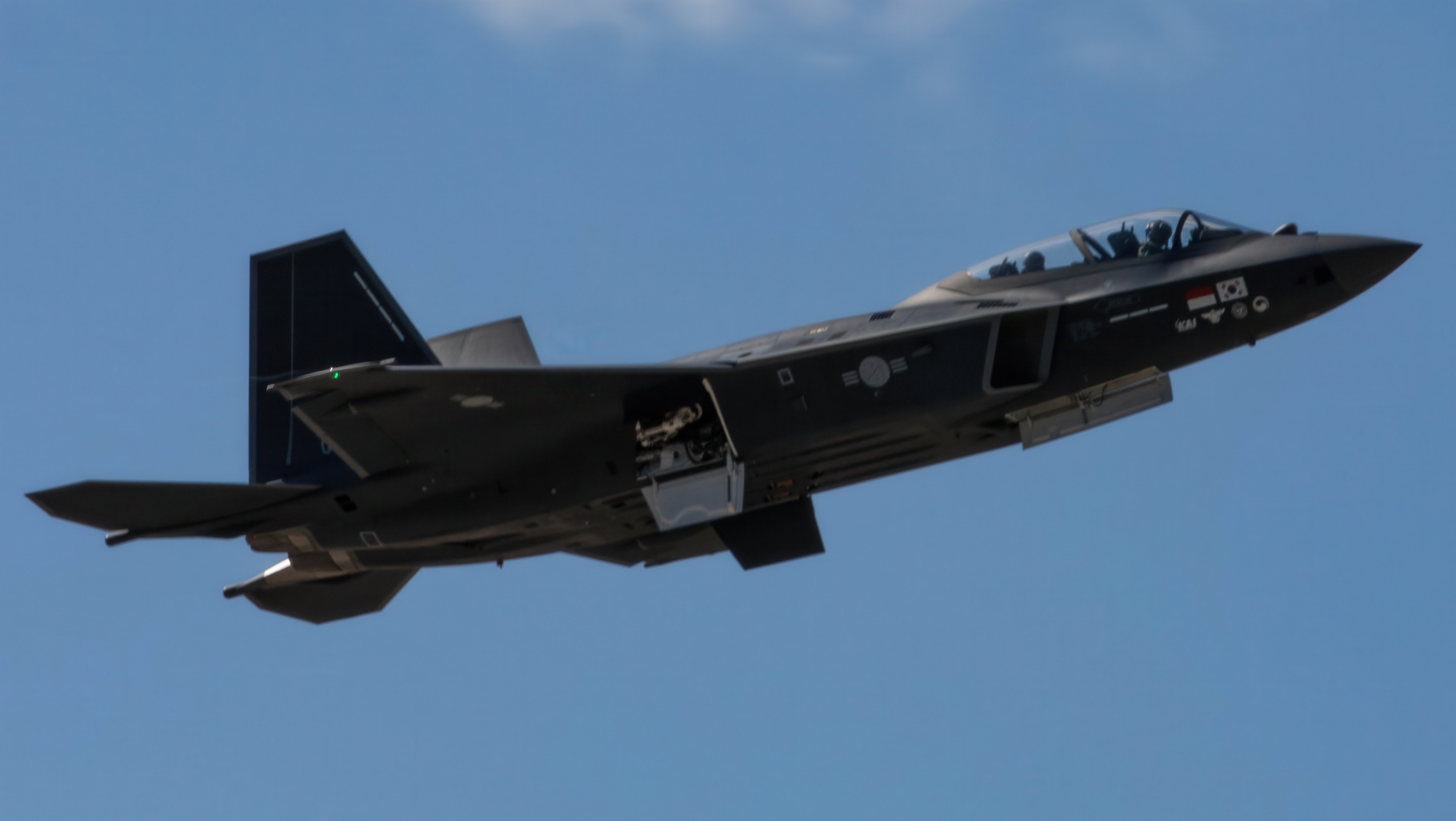
The Republic of Korea Air Force (ROKAF) has officially commenced its next era of aerial dominance following the delivery of the first series-produced KF-21 Boramae fighter jet. This delivery marks the transition of the KF-X program from a multi-year development cycle into a high-rate production reality. Korea Aerospace Industries (KAI) delivered the unit after exhaustive flight testing, signaling a definitive shift in South Korea’s defense procurement strategy — from foreign reliance toward indigenous self-sufficiency.
This first production model represents a watershed moment for the South Korean aerospace sector. It validates the nation’s ability to design, test, and manufacture a 4.5-generation multirole fighter on an accelerated timeline. The KF-21 is intended to replace the aging fleet of F-4 Phantom IIs and F-5 Tiger IIs, airframes that have reached the outer limits of their structural fatigue lives and can no longer meet the demands of a modernizing threat environment.
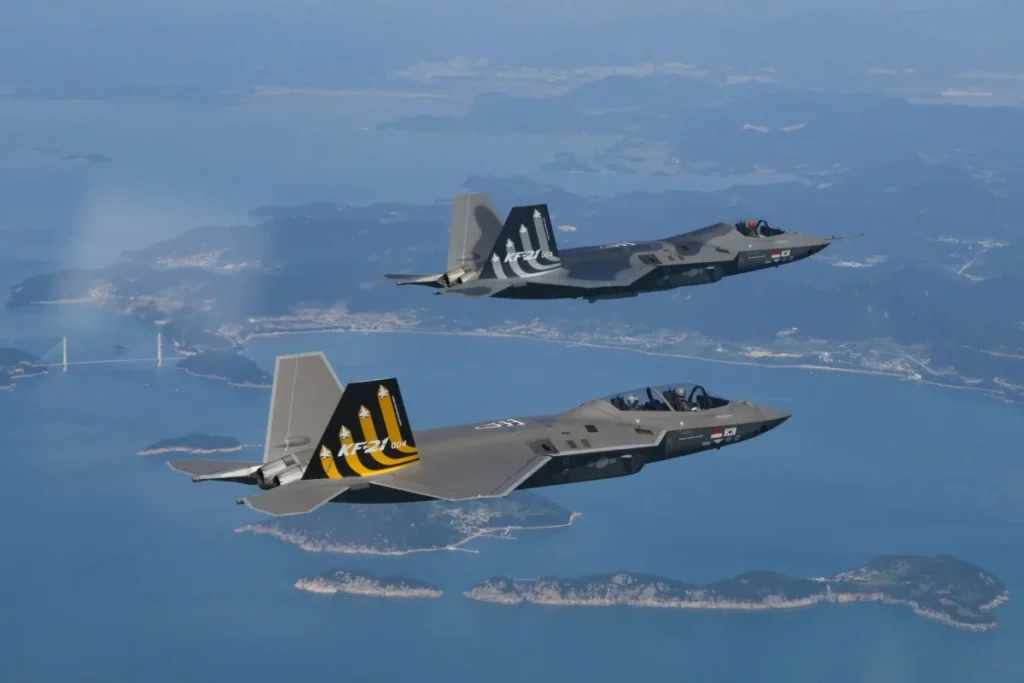
The development of the Boramae was not born out of ambition alone — it was born out of necessity. As North Korea accelerates its missile capabilities and neighboring powers modernize their fleets at pace, South Korea required an indigenous platform capable of deep integration with existing Western systems. The KF-21 serves as the technological bridge between legacy 4th-generation fighters and high-end 5th-generation assets like the F-35 Lightning II.
Under the Hood: What Makes the Boramae Fly
Core Specifications at a Glance
| Specification | Detail |
|---|---|
| Manufacturer | Korea Aerospace Industries (KAI) |
| Powerplant | Twin GE F414-GE-400K engines (Hanwha Aerospace assembled) |
| Max Speed | Mach 1.81 (~2,200 km/h) |
| Payload Capacity | 7,700 kg across 10 hardpoints |
| Avionics | Indigenous AESA radar, IRST, EOTGP |
| Block I Production | 40 units by 2028 |
| Indigenous Content | ~65% domestic components |
These figures alone tell a compelling story. But the true significance of the KF-21 lies not in raw numbers — it lies in who built them, and how.
The Radar No One Thought Korea Could Build
The KF-21’s most critical technical achievement is the integration of an Active Electronically Scanned Array (AESA) radar developed entirely by Hanwha Systems. This component was once considered the program’s greatest vulnerability — the United States declined to transfer core radar technologies in 2015, leaving South Korean engineers to develop the system from scratch.
They did exactly that.
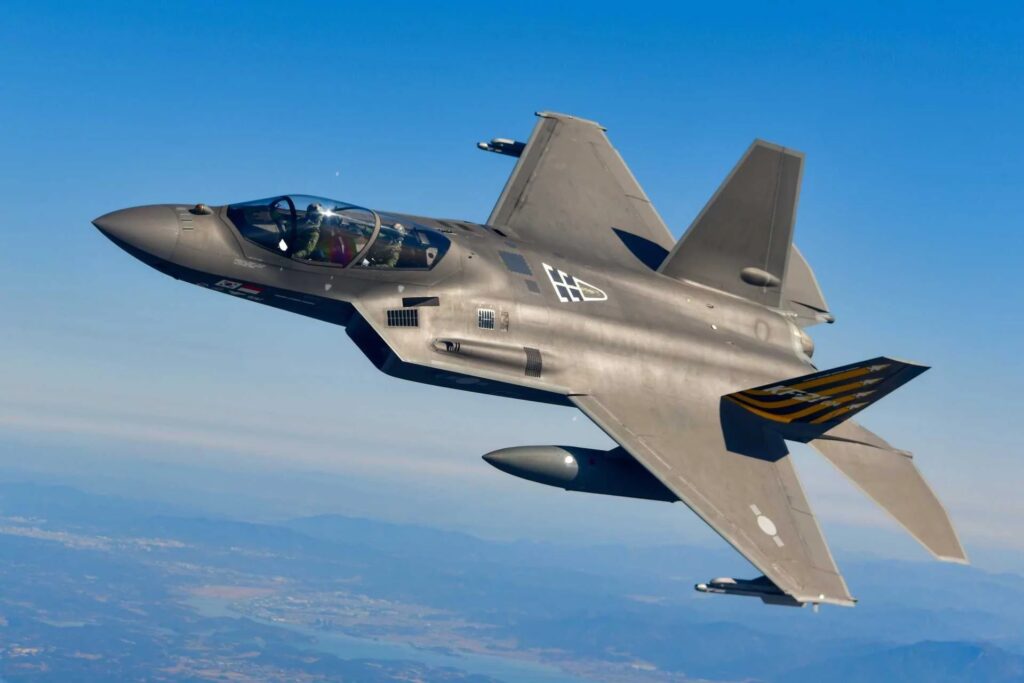
The AESA radar enables simultaneous multi-target tracking and delivers enhanced resistance to electronic jamming. Crucially, because ROKAF controls the source code and hardware architecture outright, the air force can implement rapid software updates without seeking foreign export licenses. This creates a closed-loop development cycle that is vital for maintaining a technological edge over regional adversaries in an era of fast-moving electronic warfare.
Eyes That Don’t Broadcast: Passive Sensor Fusion
Beyond radar, the KF-21 features a sophisticated sensor fusion suite that sets it apart from conventional 4th-generation platforms. The Infrared Search and Track system and the Electro-Optical Targeting Pod allow pilots to detect and engage targets passively — without emitting radar signals that could betray the aircraft’s position.
While the Block I variant relies on external weapon hardpoints, the airframe was deliberately designed with internal volume to accommodate a future stealth-optimized configuration. The Boramae is, in many respects, already dressed for its next upgrade.
The Factory Behind the Fighter: Korea’s Aerospace Industrial Revolution
Sacheon and the Supply Chain That Cannot Be Grounded
Series production of the KF-21 has catalyzed a sweeping expansion of South Korea’s aerospace industrial base. The Sacheon aerospace cluster has attracted significant investment in automated assembly lines, specialized composite manufacturing, and advanced testing infrastructure. This is not a temporary wartime surge — it is a permanent architectural shift in the nation’s industrial capacity.
The logistical ecosystem required to sustain a fleet of KF-21s draws on hundreds of domestic subcontractors. This deliberate localization strategy is designed to prevent the operational grounding of aircraft during global supply disruptions — a lesson painfully learned by multiple nations during recent decades of geopolitical turbulence. By localizing F414 engine production through Hanwha Aerospace, South Korea has ensured that propulsion maintenance remains entirely within its borders.
Beyond the Military: A Boost for Commercial Aviation
The ripple effects of KF-21 production extend well beyond defense. Maintenance, repair, and overhaul facilities built to service high-performance composite airframes and advanced jet engines are increasingly relevant to the commercial aviation sector. South Korea is rapidly positioning itself as a leading aerospace MRO hub for the Asia-Pacific region — serving not just its own military, but regional carriers that demand world-class technical infrastructure.
The same workforce trained to maintain the Boramae’s sensor systems and engine components is the workforce that will service the next generation of commercial widebodies operating across East Asia’s booming travel corridors. Defense investment, in this case, is directly accelerating civilian aviation capability.
A New Power Equation: Deterrence, Diplomacy, and Export Ambition
Reshaping the Korean Peninsula’s Balance of Power
The induction of the KF-21 into active ROKAF service fundamentally alters the strategic calculus on the Korean Peninsula. Unlike its predecessors, the Boramae is engineered for high-intensity conflict environments where electronic warfare survivability and stealth-lite performance are prerequisites — not optional extras. Operating alongside the F-35 in a sophisticated “high-low” mixed fleet, the KF-21 gives ROKAF unprecedented operational flexibility across the full spectrum of aerial combat.
The Export Play: A Fighter for the World’s Middle Tier
South Korea is not building the KF-21 for itself alone. KAI is actively positioning the Boramae as a cost-effective, politically accessible alternative to the F-35 — and a decisively more capable successor to the aging F-16 fleets operated by dozens of nations worldwide.
Countries seeking advanced 4.5-generation performance without the stringent political conditions or eye-watering acquisition costs associated with U.S. fifth-generation programs have taken notice. Poland and several Middle Eastern nations are reportedly tracking Block I deployment with considerable interest. The successful delivery of the first series-produced unit functions as a live proof of concept for every potential buyer watching from abroad.
If KAI can sustain competitive pricing while delivering consistent 4.5-generation performance, the KF-21 is credibly positioned to dominate the mid-tier fighter export market for the next two decades.
Block by Block: How South Korea Plans to Build the Future
Block I — Air Superiority First
The current Block I configuration prioritizes air-to-air superiority. This deliberate sequencing allows ROKAF to rapidly retire its oldest F-4 and F-5 airframes while pilots begin accumulating critical hours on the new platform. Speed of transition matters — and phasing capability introduction reduces the developmental risk of trying to field a fully multirole aircraft from day one.
Block II — Going Deep Strike
Once the initial 40 Block I units are integrated into active squadrons, production shifts to Block II — introducing full air-to-ground strike capabilities and enhanced multirole mission software. This is where the Boramae transforms from a capable interceptor into a genuine deep-strike asset.
Block III — The Stealth Leap
Future Block III iterations are expected to feature internal weapons bays, elevating the KF-21 from a 4.5-generation fighter to a credible 5th-generation stealth platform. The airframe’s modular internal architecture was designed from the outset with this evolution in mind, ensuring the aircraft remains operationally relevant well into the 2050s.
Sustaining the Fleet: Maintenance, Data, and Strategic Longevity
The long-term viability of any fighter program ultimately rests on its sustainment economics. Here, the KF-21 holds a structural advantage over the aging foreign fleets it replaces. Indigenous production dramatically reduces lifecycle costs and eliminates the dependency on foreign spare parts pipelines that can be delayed, restricted, or priced at political will.
ROKAF and KAI have established a real-time data-sharing architecture between the manufacturer and operational squadrons, enabling predictive maintenance cycles that maximize fleet availability and reduce unscheduled downtime. Aircraft that are in the air are worth infinitely more than aircraft sitting in a hangar awaiting foreign parts.
From a longer strategic horizon, the KF-21 program functions as a technology demonstrator for South Korea’s ambitious next-generation unmanned aerial vehicle initiatives. The engineering competencies, manufacturing infrastructure, and systems integration experience accumulated through Boramae production will directly seed the nation’s future autonomous platforms — ensuring that the investment made today continues paying strategic dividends for generations to come.
The Bottom Line
The KF-21 Boramae is more than a fighter jet. It is a declaration — that South Korea has permanently exited the era of strategic dependency and entered one defined by self-determination in defense. From the AESA radar that no foreign partner would supply, to the engine assemblies now built on Korean soil, to the export ambitions targeting markets from Warsaw to the Gulf, every aspect of this program signals the arrival of a serious aerospace power.
The first series-produced unit is on the tarmac. The next forty are in production. And the nations watching from a distance — both allies and adversaries — are taking careful note.
South Korea didn’t just build a fighter. It built leverage.
Production of the KF-21 Block I is scheduled to deliver 40 units to ROKAF by 2028. Block II development is ongoing, with Block III stealth configuration upgrades projected for the following decade.
 Aastha Choudhary