


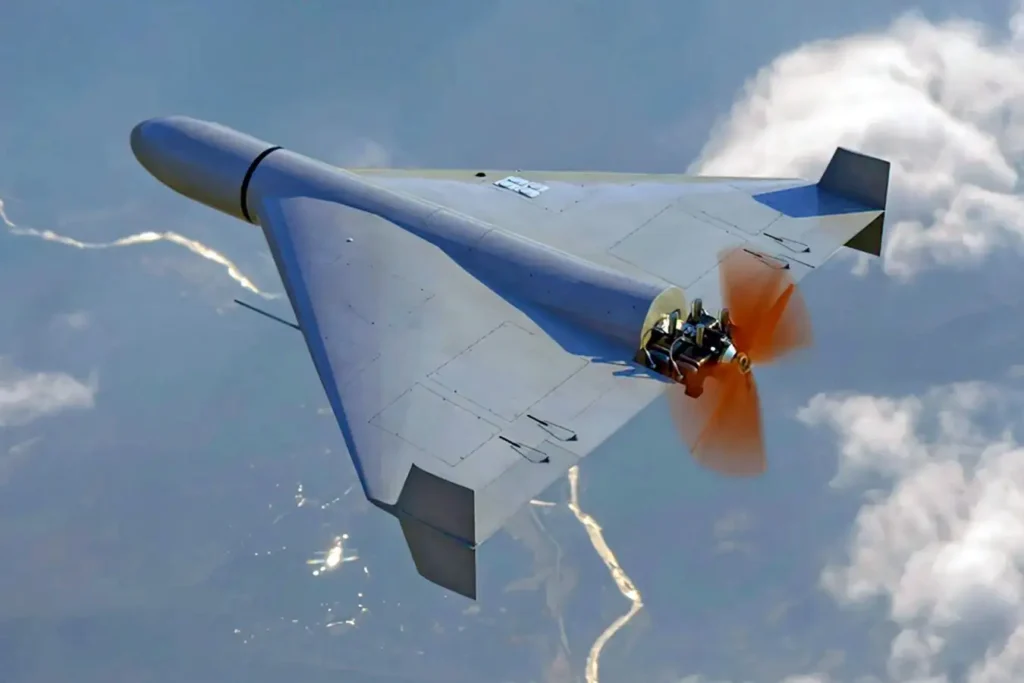
A missile system that cost the United States taxpayer $4 million to develop — fired to destroy a drone(Shahed-136) that Iran built for under $4,000. That’s not a typo. That’s the new math of modern warfare. And right now, in the skies over the Gulf, it’s playing out in real time.
Iran’s Shahed-136 drone — a delta-winged, propeller-driven, GPS-guided kamikaze weapon — has become the most consequential defense news story of 2026. Not because it’s the most sophisticated weapon ever built. Quite the opposite. It’s cheap, it’s simple, and when launched in waves of hundreds, it is breaking the back of the most expensive air defense networks ever assembled.
What Exactly Is the Shahed-136 And Why Does It Matter?
The Shahed-136 is what defense analysts call a “one-way attack drone” or loitering munition — essentially a flying bomb. Manufactured by Iran’s HESA (Iran Aircraft Manufacturing Industrial Company) under the Shahed Aviation Industries division, it was designed from the start to be expendable.

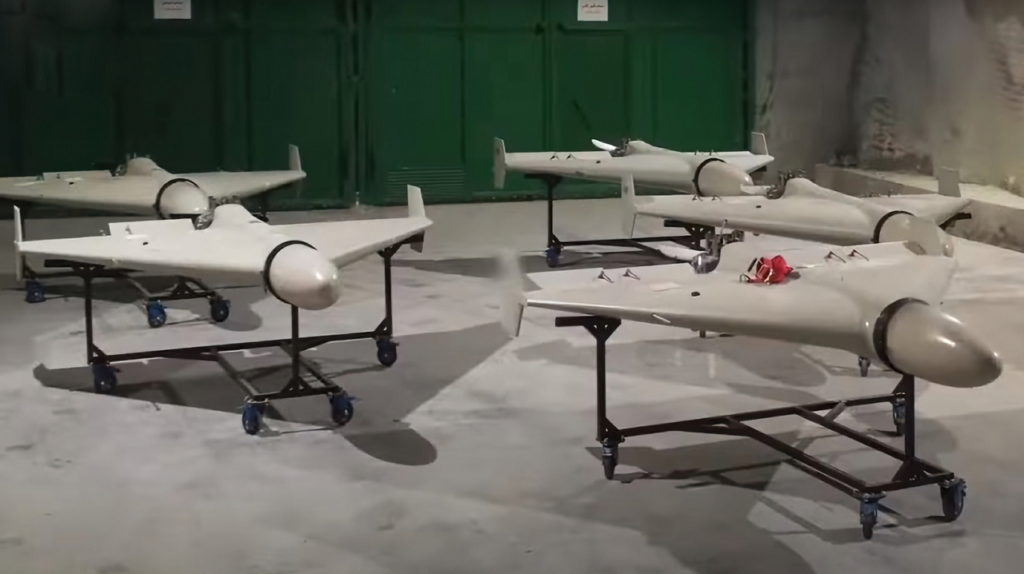
Here’s what makes it tick: a 3.5-meter airframe with a distinctive delta wing configuration, a rear-mounted Mado MD-550 pusher propeller engine (reverse-engineered from a German Limbach unit), GPS and inertial navigation guidance, and a 36-to-50 kilogram high-explosive warhead on its nose. Fly it into a target at 185 km/h, and the result is catastrophic.
Militarily, the Shahed-136 sits at the intersection of two categories — it’s part drone, part cruise missile. That classification overlap is exactly what makes it so difficult to counter for conventional defense news-worthy systems built around Cold War threat models.
Specifications at a glance: range of 970 to 2,500 kilometers, cruising altitude of 60 to 4,000 meters, total weight approximately 200 kilograms, and a unit cost that Iran itself has pegged as low as $4,000 domestically — though Western analysts estimate export or production variants at $20,000 to $50,000 per unit. Either way, it’s pocket change against a Patriot interceptor missile that runs $3–4 million per shot.
The Core Defense News Story: An Asymmetric Cost Problem With No Easy Solution
The Shahed-136 isn’t winning because it’s fast. It flies at roughly 185 km/h — slower than many commercial aircraft. It isn’t winning because it’s invisible to radar either. Modern radar networks can detect it. It’s winning because the economics of defeating it are completely unsustainable.
Think about it from a defense budget perspective. Iran launches a wave of 200 Shahed drones at military and civilian infrastructure. Even a 90% intercept rate — which is extraordinary by any defense standard — lets 20 drones through. Those 20 drones hit power grids, fuel depots, ports, or airports. The intercepting nation has just fired 180 missiles costing anywhere from $300,000 to $4 million each. The math doesn’t work.
“You can’t keep shooting million-dollar missiles at thousand-dollar drones forever,” one NATO defense analyst put it bluntly in a recent defense news briefing. “Iran doesn’t need to break your jets. It needs to drain your magazine.”
This is the Shahed-136’s strategic genius — not its warhead, but its wallet. It is the ultimate tool of asymmetric warfare, purpose-built to exploit the cost disparity between Western air defense doctrine and the reality of mass, cheap, expendable munitions.
Iran’s Shahed Drones in Combat: The 2026 Gulf Conflict
The world got the most extensive real-world demonstration of the Shahed-136’s battlefield impact in March 2026. Following U.S.-Israeli strikes that killed senior Iranian leadership under Operation Epic Fury, Iran unleashed what defense news analysts are calling the largest sustained drone campaign ever recorded in the Middle East.
In under two weeks, Iran expended over 3,500 Shahed weapons across the Gulf theater. The UAE Ministry of Defence confirmed detecting 941 Iranian drones, with 65 causing damage to ports, airports, hotels, and critical data infrastructure. In Kuwait, two of nine drones evaded air defenses — one striking a residential building, another damaging Kuwait International Airport.
Those aren’t spectacular numbers individually. But multiply the cost to intercept each one. Add up the strain on radar operators running 24-hour shifts. Factor in the psychological weight on civilian populations waking up to drone alerts every morning. The Shahed-136 isn’t just a kinetic weapon — it’s a pressure campaign delivered in slow, buzzing waves.
What this defense news cycle has also revealed: Iran isn’t running out of drones. Analysts with access to satellite imagery and SIGINT estimate Iran retains the industrial capacity to manufacture hundreds of additional Shahed units per week. This is not a one-punch strategy. It is a sustained siege.
Why U.S. and Israeli Air Defense Systems Are Struggling to Keep Up
Israel’s Iron Dome is rightly celebrated as one of the most effective short-range air defense systems ever deployed. The Patriot missile battery — America’s go-to intercept platform — has an impressive combat record. The David’s Sling system bridges the gap between short and medium-range threats. On paper, the U.S.-Israeli combined air defense architecture should be handling this.

But the Shahed-136 exposes three critical gaps that no amount of procurement spending has adequately addressed in the defense news era of the last decade.
Air defense interceptors are designed around the assumption of limited inbound threats. A missile battery has a finite number of ready interceptors. Reload takes time. Launching swarms of 100+ Shaheds simultaneously saturates the firing solutions of even the most advanced systems. When every launcher on the network is targeting simultaneously, some drones get through — by design.
The Iron Dome’s Tamir interceptor costs roughly $40,000–$50,000 per missile. The Patriot PAC-3 runs $3–4 million per round. The David’s Sling interceptor is in the same league. Using any of these against a $4,000–$50,000 drone is financially corrosive at scale.
Radar and tracking bandwidth. The Shahed-136 flies low, slow, and quiet — often below 100 meters in terminal approach phases. Low radar cross-section and terrain masking make detection windows narrow. By the time some systems achieve a clean firing solution, the drone is already in its terminal dive.
Israel’s Iron Beam directed-energy laser system offers a potential solution — each “shot” costs under a dollar in electricity. But it’s still in limited deployment, with effective range constraints that make it unsuitable for long-range intercept. The defense news community is watching Iron Beam’s scalability closely, but it isn’t yet the silver bullet the headlines suggest.
The Russia Factor: When the Shahed-136 Got a Software Upgrade
Iran’s Shahed-136 story doesn’t exist in isolation. Russia’s use of the drone — rebranded the Geran-2 — in Ukraine gave the weapon its first large-scale combat proving ground. And crucially, it gave Russia the data to improve it.
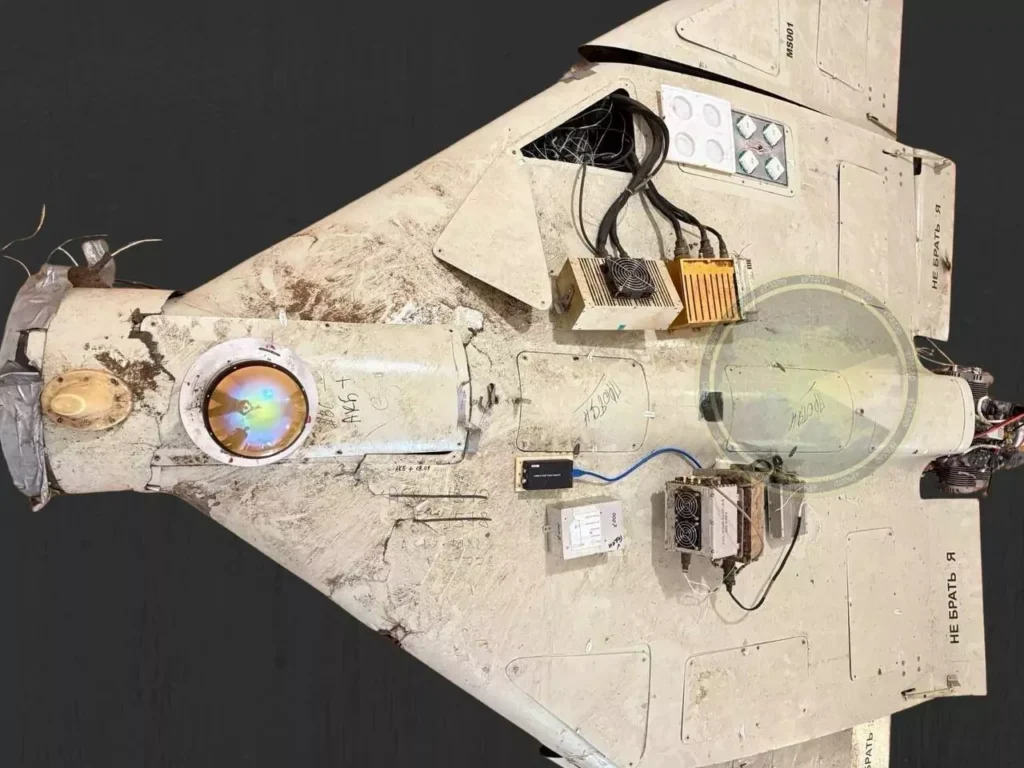
Open-source analysis of drone debris recovered in the UAE in early March 2026 suggests that Geran-2 variants featuring Russia’s Kometa-M jam-resistant navigation system may have appeared in Iran’s own Gulf campaign. That’s significant. It means Iran may now have access to electronic warfare upgrades it didn’t develop itself — making its Shaheds harder to spoof with GPS jamming, one of the most cost-effective countermeasures available to Gulf states.
What was a one-directional arms transfer — Iran supplying Russia — now appears to be evolving into a genuine technology exchange. For defense news watchers, this represents a qualitative leap. A $4,000 drone with jam-resistant navigation is a fundamentally more dangerous threat than the same drone relying on standard GPS.
America Responds: The LUCAS Program and the Rise of Counter-Drone Warfare
The U.S. military didn’t just study the Shahed-136 — it reverse-engineered and replicated it. The Low-Cost Uncrewed Combat Attack System, or LUCAS, was developed by Spektraworks of Phoenix under a $30 million contract. Within 18 months, the program produced an autonomously coordinated attack drone at approximately $43,000 per unit, now fielded to U.S. Central Command’s Task Force Scorpion Strike.
LUCAS can be launched via catapult, rocket-assisted takeoff, and mobile ground vehicles. It’s not identical to the Shahed-136, but it borrows the same operational philosophy: swarm, saturate, and overwhelm at a price point that is tactically sustainable.
The emergence of LUCAS signals a broader shift in U.S. defense doctrine. For years, Pentagon procurement has emphasized exquisite, expensive, low-volume platforms. The Shahed-136 has forced a rethink. Defense news out of Washington increasingly reflects a pivot toward high-volume, attritable unmanned systems — cheap enough to lose, capable enough to matter.
Alongside LUCAS, the Pentagon is accelerating investment in directed-energy weapons, high-powered microwave systems, and network-based electronic warfare platforms designed specifically to counter drone swarms at a sustainable cost per engagement.
What Comes Next: The Future of Drone Warfare and Air Defense
The Shahed-136 is already spawning a new generation of Iranian drone designs. The jet-powered Shahed-238 extends the range and speed envelope significantly. The Shahed-107, with its loitering reconnaissance capability, adds an intelligence-gathering layer to the drone swarm. Iran’s drone program is not a dead end — it is a roadmap.
For U.S. and Israeli defense planners, the lesson of 2026 is uncomfortable but clear: the air defense paradigm built around high-cost interceptors facing low-volume threats is broken. The future of air defense in the drone age requires layered, cost-competitive responses — lasers, electronic warfare, swarming counter-drones, and yes, the kind of cheap attritable systems that Iran itself pioneered.
The $4,000 drone didn’t beat the $4 million missile because the drone was better. It beat it because there were enough drones to make the math impossible. That is the real defense news of 2026.
© 2026 AeroMantra Defense Desk — All rights reserved.