

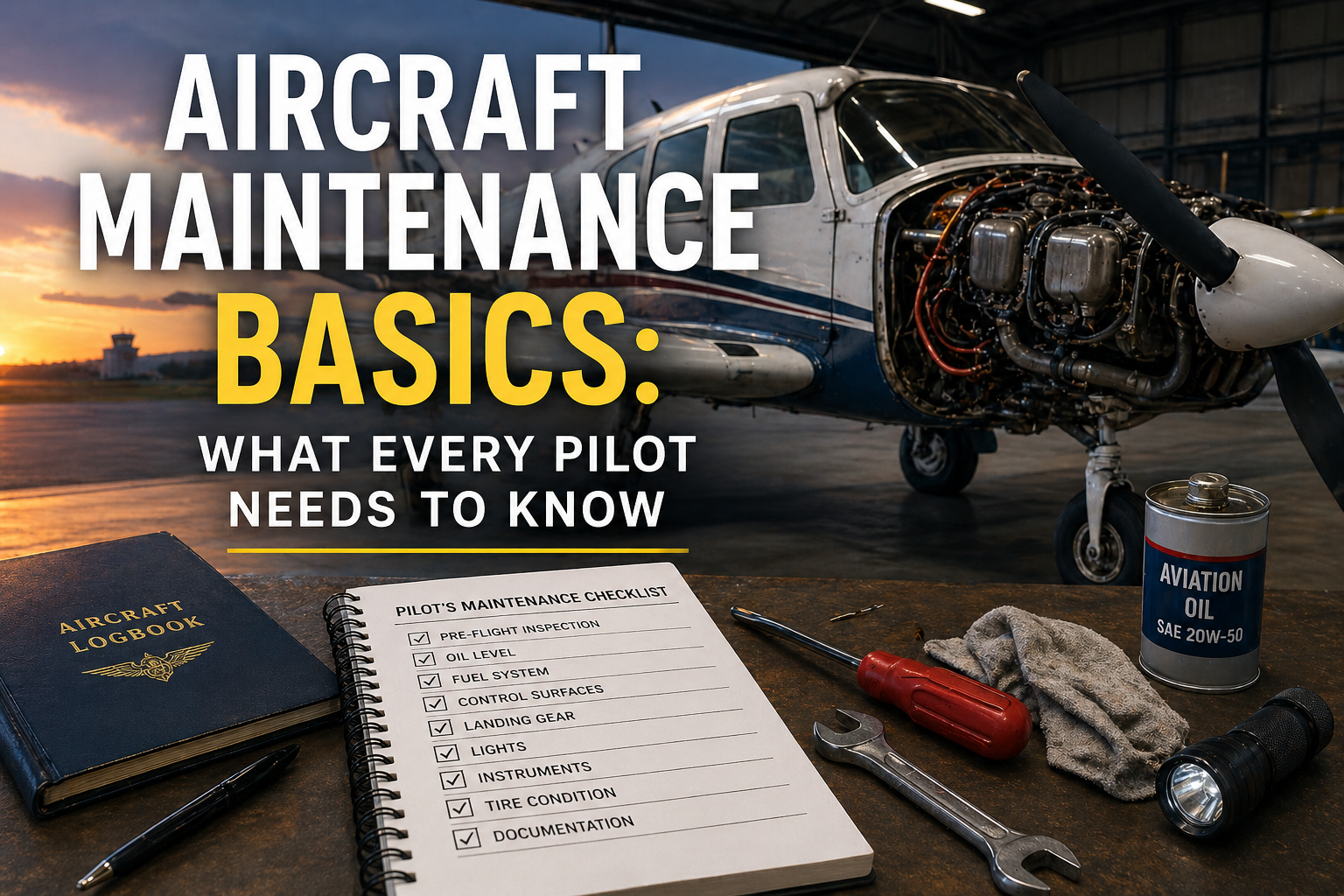
When it comes to aviation safety, maintenance is not just a regulatory requirement—it’s a life-or-death responsibility. Every flight begins long before the engine starts, with a thorough preflight inspection. Understanding your aircraft’s systems, maintenance requirements, and airworthiness regulations gives you the knowledge to catch problems before they become emergencies. Whether you own an aircraft, rent one from a flight school, or simply want to fly more safely and intelligently, this guide covers everything a pilot needs to know about aircraft maintenance.
The Preflight Inspection: Your First Line of Defense
The preflight inspection is the pilot’s most important maintenance task, performed before every single flight. It’s your opportunity to catch mechanical defects, fluid leaks, damage, and airworthiness concerns before they endanger you and your passengers.
A thorough preflight follows the aircraft’s Pilot’s Operating Handbook (POH) or Airplane Flight Manual (AFM) checklist, and covers the exterior walk-around, fuel and oil checks, control surface inspection, and systems verification. While checklists vary by aircraft type, the general flow typically includes checking the logbooks and airworthiness documents (using the AROW acronym—Airworthiness certificate, Registration, Operating limitations, Weight-and-balance), inspecting the fuselage and empennage for damage, verifying control surface freedom of movement, checking tires and landing gear, sumping fuel from all drain points to check for contamination or water, inspecting the engine compartment for oil level, leaks, and general security, and testing flight controls from the cockpit.
Never rush the preflight. Even if you’re behind schedule or the weather is perfect, a missed defect discovered during preflight could save your life. Some of the most catastrophic accidents in general aviation history resulted from defects that would have been obvious on a careful preflight—loose flight control connections, fuel caps left off, pitot tube covers still installed.
Required Inspections: Annual, 100-Hour, and Beyond
FAA regulations mandate a series of recurring inspections to ensure aircraft remain airworthy. Understanding these requirements is essential for both aircraft owners and renters.
The Annual Inspection is required for all U.S.-registered civil aircraft and must be performed by an FAA-certified Airframe and Powerplant (A&P) mechanic holding an Inspection Authorization (IA). An annual is a comprehensive examination of every system, structure, and component according to the manufacturer’s maintenance manual and FAA standards. Annuals must be completed within the previous 12 calendar months, not 12 months from the actual date—meaning a January annual is due by January 31 of the following year, even if done on January 1.
The 100-Hour Inspection is required for aircraft operated for hire or flight instruction (rental fleets, charter operations). It’s identical in scope to an annual and can be performed by any A&P mechanic (no IA required), but does not reset the annual due date. If an aircraft exceeds the 100-hour by up to 10 hours for the purpose of reaching a maintenance facility, those hours are deducted from the next interval.
Altimeter, Transponder, and Static System Tests are required every 24 calendar months for IFR flight operations. These ensure the accuracy of critical flight instruments. ELT (Emergency Locator Transmitter) batteries must be replaced after cumulative use of one hour, after more than 50% of their useful life, or every 12 months for rechargeable batteries.
Airworthiness Directives: Mandatory Safety Fixes
Airworthiness Directives (ADs) are legally enforceable regulations issued by the FAA to correct unsafe conditions in aircraft, engines, propellers, or appliances. When a manufacturer or the FAA discovers a recurring or potentially catastrophic defect, an AD mandates corrective action within a specified timeframe.
ADs come in two types. Emergency ADs require immediate action before further flight. Non-Emergency (routine) ADs specify a compliance window—often a certain number of flight hours, calendar time, or at the next annual inspection. All applicable ADs must be addressed and documented in the aircraft logbooks.
Aircraft owners and operators are responsible for knowing which ADs apply to their aircraft. The FAA maintains a searchable AD database at rgl.faa.gov, and services like ADs4GA (Airworthiness Directives for General Aviation) help owners track applicable ADs by N-number. Failure to comply with an AD renders the aircraft unairworthy and the owner liable for FAA enforcement action—potentially including certificate suspension and substantial fines.
Checking ADs before purchasing a used aircraft is critical. A comprehensive logbook review should verify that every applicable AD has been complied with, and an independent pre-purchase inspection by a trusted A&P mechanic can uncover unreported maintenance issues.
Preventive Maintenance: What Pilots Can Do Themselves
Under FAR 43 Appendix A, certificated pilots (private and above) are permitted to perform a defined list of preventive maintenance tasks on aircraft they own or operate. This doesn’t require an A&P certificate, but the work must be documented in the aircraft logbook.
Permitted preventive maintenance tasks include changing engine oil and filter, replacing safety belts, replacing seats or seat parts (not structural members), replacing bulbs, reflectors, and lenses, changing tires and tubes (but not landing gear components), replenishing hydraulic fluid, cleaning and replacing landing gear struts, replacing defective instruments, replacing or cleaning spark plugs, lubricating landing gear and wheel bearings, replacing prefabricated fuel lines, applying preservative compounds, and replacing cowling fasteners and access panel fasteners.
Pilots performing preventive maintenance must sign and log each task with a description of the work performed, the date, their name, certificate number, and kind of certificate held. Documentation is not optional—improperly documented maintenance can affect airworthiness status and insurance coverage.
Knowing how to perform basic preventive maintenance saves money and builds a deeper understanding of your aircraft. However, always know your limits. When in doubt, defer to a qualified A&P.
Understanding MELs and Aircraft Airworthiness
Can you legally fly with an inoperative instrument or equipment? The answer depends on the type of operation, the equipment involved, and whether a Minimum Equipment List (MEL) is available.
For small general aviation aircraft without an approved MEL, inoperative equipment must be evaluated against four criteria (the FAR 91.213 standard): Is the equipment required by the airworthiness certificate? Is it required by the VFR Day type certificate data sheet? Is it required by FAR 91? Is it required for the type of operation being conducted? If not required by any of these, the item can be placarded inoperative and the flight can proceed.
Larger aircraft operating under FAR 121 (airlines) or FAR 135 (charter) use FAA-approved MELs that specify which items can be inoperative, for how long, and under what conditions. MELs are incredibly complex documents developed by manufacturers and approved by the FAA that allow revenue operations to continue despite known equipment issues, within defined safety margins.
Always consult the POH, AFM, and your A&P mechanic before flying with any inoperative equipment. When uncertain, the answer is simple: don’t fly until it’s fixed. Airworthiness is non-negotiable.
 Martin hope