


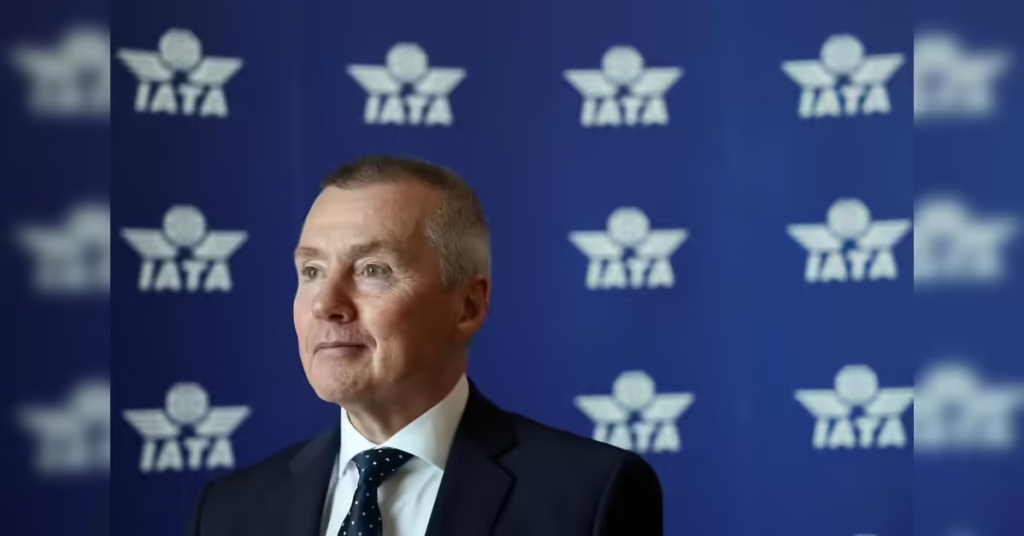
Some corporate announcements are formal polished press releases drafted by communications teams and forgotten within the news cycle. And then there are announcements that carry the unmistakable weight of a genuine strategic shift. When Rahul Bhatia, the co-founder and driving force behind IndiGo, sent an internal note to the entire organisation confirming that William Walsh would become the airline’s next Chief Executive Officer, it wasn’t merely a staffing update. It was a declaration about what IndiGo intends to become and the timeline for getting there.
The handover is scheduled for August 3, 2026, subject to regulatory approval. Between now and then, the Indian aviation industry will have plenty of time to absorb the full implications of what this appointment represents. Those implications are considerable.
A Name That Needs No Introduction — But Deserves One Anyway
Willie Walsh is, without exaggeration, one of the most accomplished aviation executives of the past three decades. His career reads less like a résumé and more like a masterclass in airline leadership across every possible context: low-cost turnarounds, legacy carrier management, cross-border mega-mergers, and global industry governance.


He began as a pilot with Aer Lingus, which already sets him apart from the generation of airline CEOs who arrived via finance or consulting. He knows what an aircraft actually is, not just what it represents on a balance sheet. From the cockpit he moved into operations, becoming COO and eventually CEO of Aer Lingus between 2001 and 2005:- a tenure defined by a restructuring so thorough and so difficult that it reshaped the Irish carrier’s identity entirely, pulling it back from near-collapse and repositioning it as a competitive transatlantic operator.
British Airways came next, where he served as CEO from 2005 to 2011. Those were not easy years for any airline. The 2008 financial crisis alone would have broken lesser executives. Walsh held the line on cost discipline, fought through bruising union negotiations, and had the strategic vision to see what others had missed that European aviation’s fragmented legacy carriers needed to consolidate or face slow decline. The merger with Iberia, completed in 2011, was his answer to that problem. It created International Airlines Group, which he then led until 2020, adding Vueling and reacquiring Aer Lingus as subsidiaries along the way.From IAG he moved to the International Air Transport Association as Director General the moment the industry effectively said, “this is the person who speaks for all of us.” During the Covid-19 pandemic, when commercial aviation faced the most severe contraction in its history, Walsh became the industry’s most visible and credible voice, pushing governments on testing regimes, travel corridors, and the pace of recovery.
That is the man now walking through IndiGo’s door.
IndiGo Doesn’t Need Saving. It Needs a Different Kind of Leader.
It would be a misreading of this appointment to frame it as a rescue mission. IndiGo is not broken. It is, by nearly every available metric, the most successful airline story to emerge from one of the world’s fastest-growing aviation markets. It holds a domestic market share that exceeds 60 percent, operates one of the youngest and most fuel-efficient fleets on the continent, and has placed aircraft orders of a scale that signals confidence measured not in quarters but in decades.
The question IndiGo’s board was asking was not “who can fix us?” It was something harder and more interesting: “who can take everything we’ve built and turn it into something the world has never seen from an Indian carrier?”
Bhatia’s announcement letter makes the ambition explicit. He speaks of expanding IndiGo’s presence within India certainly but the language that carries the real strategic freight is the reference to building a global footprint through two specific aircraft: the Airbus A321XLR and the Airbus A350-900. These are not instruments of a domestic low-cost operation. The A321XLR is a single-aisle jet capable of flying thin long-haul routes that were previously uneconomical. The A350-900 is a wide-body aircraft designed for intercontinental range. Together, they represent IndiGo’s stated intention to operate as a genuine global carrier, not merely a dominant regional one.
Executing that transformation requires a very specific kind of leadership. You need someone who understands the low-cost discipline that made IndiGo what it is, who won’t casually erode the cost structure in pursuit of a premium image that doesn’t suit the brand. But you also need someone who has run international networks, negotiated slot rights at congested global hubs, managed the political complexity of bilateral air service agreements, and built alliances that open doors rather than close them. Walsh has done all of it. There is arguably no one alive with a more complete set of experiences for this exact assignment.
The Significance of Bhatia Stepping Back
Any serious reading of this moment has to reckon with what it means that Rahul Bhatia is the one making this announcement. He signed his letter with a self-deprecating Hindustani phrase calling himself “alas Kuchh Hee Dinon Kaa Mehmaan,” a guest for only a few remaining days. It was written lightly, but it landed heavily.
Bhatia is IndiGo. He co-founded the airline in 2006 alongside Rakesh Gangwal, and through every turbulence the company has navigated regulatory friction, boardroom disputes, pandemic losses, fleet groundings his presence has been constant. For him to signal, publicly and warmly, that the baton is being handed over is an act of institutional confidence. He isn’t leaving because things went wrong. He is leaving because things went right enough that the next chapter requires a different kind of architect.
That is a rare and dignified exit for a founder and it speaks to the seriousness with which this succession was planned.
What the Industry Should Be Watching
Walsh will inherit an airline that is healthy, hungry, and sitting at the threshold of a transformation that could genuinely redefine what Indian aviation means on the world stage. His first order of business will likely be structural understanding of IndiGo’s operational DNA deeply enough to know which parts of it must be preserved as the airline scales internationally, and which assumptions will need to be challenged.
The regulatory approval process through India’s Directorate General of Civil Aviation is the only procedural gate remaining. Few in the industry expect it to present serious obstacles given Walsh’s unblemished standing globally.
After August 3rd, the clock starts. International aviation is a long game, and Walsh has always been a long-game player. IndiGo’s competitors domestically and globally would be wise to take note. The airline that already dominates India is now being handed to the executive who spent a career building airlines that dominate the world.