

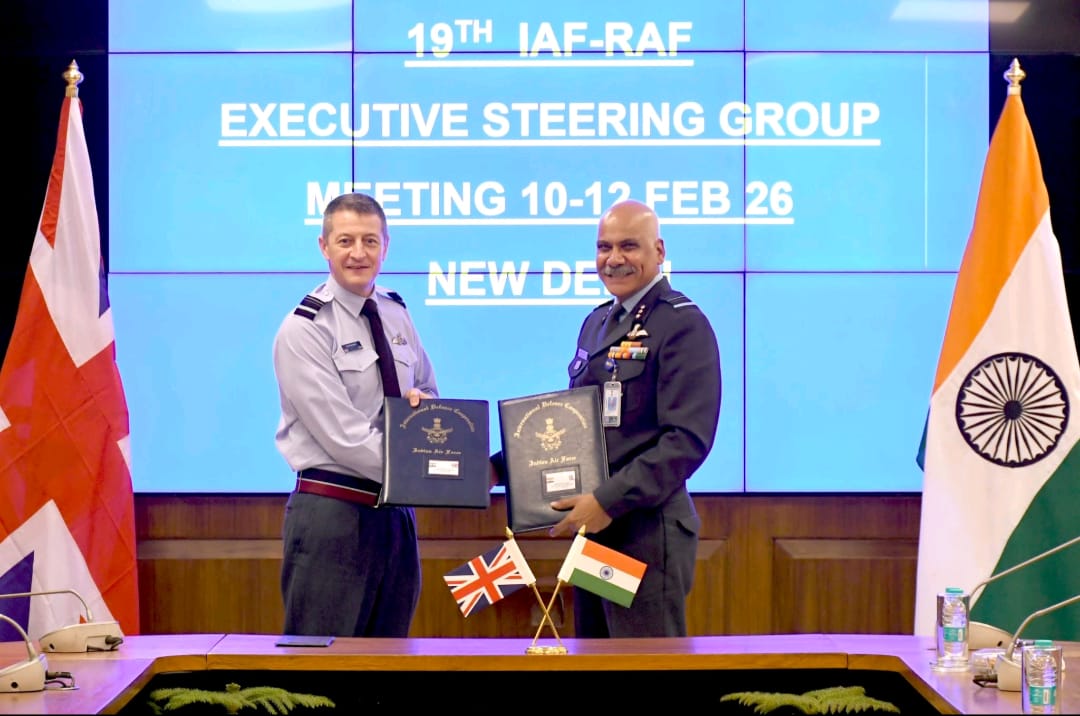
NEW DELHI, The Indian Air Force (IAF) will deploy three Qualified Flying Instructors (QFIs) to the United Kingdom to train Royal Air Force (RAF) fast jet pilots, marking a historic reversal in the military relationship between the two nations.
The agreement, finalized during the 19th UK-India Air Staff Talks in New Delhi on Thursday, aims to address chronic delays in Britain’s military flight training pipeline. For an initial two-year period, IAF instructors will be embedded at RAF Valley in Wales, operating BAE Systems Hawk T2 and Texan T1 aircraft to accelerate the graduation of British fighter pilots.
A HISTORIC SHIFT
The pact was signed following high-level discussions between Air Marshal-level officials in New Delhi. Under the terms of the agreement, the three Indian instructors will remain under IAF command while executing instructional duties for RAF commanders.
This deployment represents a significant milestone in UK-India defence relations. While British instructors historically trained the nascent Indian Air Force in the 1930s and 40s, this is the first time Indian pilots will officially train their British counterparts on UK soil.
“Bringing Indian QFIs into UK Military Flying Training Systems deepens our cooperation, enhances interoperability and reinforces our shared commitment to excellence in aircrew training,” said Air Vice Marshal Ian Townsend, Assistant Chief of the Air Staff (RAF), in a statement.
The move follows the deployment of an IAF officer to the Royal Air Force College Cranwell in January 2026, meaning Indian instructors are now present in all three of Britain’s premier military academies—including the Royal Military Academy Sandhurst (Army) and Britannia Royal Naval College Dartmouth (Navy).
The arrival of Indian expertise comes at a critical juncture for the Royal Air Force. The UK’s Military Flying Training System (MFTS) has been plagued by severe backlogs, leaving hundreds of trainee pilots in limbo.
Key Issues Facing the RAF:
Pipeline Bottlenecks: Recent defence reports indicate that over 350 trainees have been stuck in “holding” patterns, waiting for slots to open on advanced training courses.
Aircraft Availability: The fleet of Hawk T2 advanced jet trainers has suffered from recurring engine issues involving the Rolls-Royce/Safran Adour 951, significantly reducing flight hours available for students.
Instructor Shortage: A “damaging drain” of experienced British flying instructors to the commercial airline sector has left the RAF understaffed.
By bringing in highly experienced IAF instructors, who operate a fleet of over 100 Hawk Mk 132 aircraft in India, the RAF aims to boost its instructional capacity immediately. Indian pilots are renowned for their high number of flying hours and experience in diverse operational environments, from the Himalayan heights to desert borders.
INTEROPERABILITY & DEFENCE EXPORTS
This agreement is more than a stop-gap measure; it is a strategic alignment of operational standards.
1. Standardization of Doctrine:
With Indian pilots teaching British trainees on British hardware, the two air forces will inevitably align their tactical doctrines closer than ever before. This “cross-pollination” is crucial for future joint operations, such as those simulated in recent Exercise Cobra Warrior and Exercise Tarang Shakti drills.
2. Boost for BAE Systems:
The IAF is the largest operator of the BAE Hawk outside the UK. This exchange reinforces the Hawk’s status as the premier trainer platform for both nations, potentially smoothing the path for future upgrades or joint supply chain initiatives for Hawk spares, which have been a pain point for the IAF.
3. Strategic Signal:
The deployment signals London’s increasing reliance on New Delhi as a “net security provider” and equal partner. It operationalizes the “UK-India Vision 2035” partnership launched during Prime Minister Keir Starmer’s visit to Mumbai in October 2025, which called for a “security-economic fusion” between the two powers.
The initial two-year deployment serves as a pilot program. If successful, defence analysts expect the scope to expand, potentially involving more instructors or reciprocal postings of RAF pilots to IAF academies like the Flying Instructors School (FIS) in Tambaram.
For the immediate future, however, the focus is on RAF Valley. As Indian instructors take their seats in the cockpits of British jets over the Welsh coast, they effectively close a century-long circle, transforming from students of the RAF to its teachers.
 Aastha Choudhary
  Martin hope
  Vibhuuti Goyal