


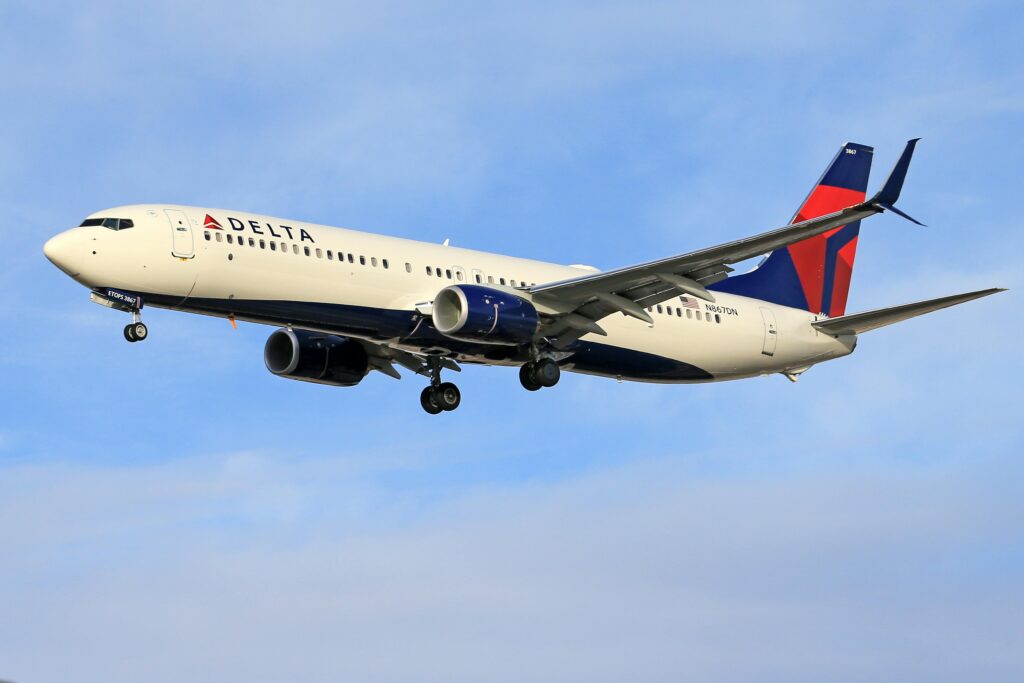
ATLANTA, Delta Air Lines (NYSE: DAL) has concluded its Centennial year with a definitive financial statement, reporting a full-year 2025 pre-tax profit of $5 billion and record free cash flow. In a simultaneous strategic move to secure long-term widebody lift, the carrier confirmed an agreement with Boeing for 30 787-10 Dreamliners, with deliveries commencing in 2031. This dual announcement highlights a stabilization of fleet economics and a return to robust operational margins. The carrier’s performance for the December quarter demonstrated resilience against external variables, delivering $1.5 billion in operating income despite a government shutdown impact.
The aviation sector entered 2026 facing capacity constraints and supply chain bottlenecks. Delta’s strategy has pivoted aggressively toward premium product segmentation and high-yield traffic to offset rising operational costs. The 2025 fiscal year served as a litmus test for this “premium-heavy” revenue model. By decoupling its financial results from standard commodity transport metrics, Delta has focused on leveraging its loyalty ecosystem and co-branded credit card remuneration to drive margin expansion. The results indicate that corporate demand has returned to near-historical baselines, validating the carrier’s intense capital expenditure on cabin interiors and ground experience.
FY2025 AND Q4 METRICS
The following figures represent verified GAAP and adjusted metrics released by Delta Air Lines for the period ending December 31, 2025:
Full Year Pre-Tax Income: $5.0 billion (Non-GAAP).
Operating Revenue (FY2025): $63.4 billion (GAAP).
Free Cash Flow: $4.6 billion.
Profit Sharing Pool: $1.3 billion (payable Feb 2026).
Earnings Per Share (FY2025): $7.66 (GAAP) / $5.82 (Non-GAAP).
Adjusted Net Debt: Reduced to $14.3 billion.
Q4 Operating Margin: 9.2% (GAAP) / 10.1% (Non-GAAP).
Amex Remuneration: $8.2 billion (+11% YoY).
New Fleet Order: 30 Boeing 787-10 (Firm) + 30 Options.
FINANCIAL DURABILITY AND CASH GENERATION
The primary indicator of Delta’s operational health in this report is the $4.6 billion in free cash flow. In an industry notoriously capital-intensive, generating this volume of liquidity allows for aggressive deleveraging. The carrier reduced its adjusted net debt by $3.7 billion in 2025, bringing gross leverage down to 2.4x. This places Delta in a favorable position to regain investment-grade credit ratings, which reduces the cost of capital for future aircraft financing.
The divergence between revenue growth (2.3%) and capacity growth (3%) signals a disciplined yield management strategy. Delta is not flooding the market with seats to capture market share; rather, it is managing capacity to sustain pricing power. The operating margin of 10% (Non-GAAP) confirms that the airline is successfully passing operational cost increases—such as labor and maintenance—onto the consumer without eroding demand.
THE BOEING 787-10 ORDER
The announcement of a firm order for 30 Boeing 787-10 aircraft marks a significant tactical adjustment in Delta’s widebody fleet planning. Historically, Delta has leaned heavily on the Airbus A350 and A330neo for its next-generation long-haul operations. The introduction of the 787-10, scheduled for delivery in 2031, targets the replacement cycle for the aging Boeing 767-400ER and older A330 fleets.
The 787-10 is the largest variant of the Dreamliner family, offering high passenger density with favorable seat-mile economics. By selecting this airframe, Delta is optimizing for high-volume transatlantic and transpacific trunk routes where capacity is paramount. The selection of GE Aerospace GEnx engines further standardizes the propulsion portfolio, likely offering maintenance synergies. This move also provides manufacturer diversification, hedging against potential supply chain delays from a single OEM.
REVENUE DIVERSIFICATION-THE PREMIUM PIVOT
A critical component of Delta’s 2025 success lies in its revenue composition. Premium revenue grew 7% year-over-year, outpacing main cabin growth. Furthermore, diversified revenue streams—including Cargo, MRO (Maintenance, Repair, and Overhaul), and Loyalty—now account for 60% of total revenue. This reduces the airline’s exposure to the volatility of basic economy ticket pricing.
The $8.2 billion generated from the American Express partnership is an operational safeguard. This high-margin income stream effectively subsidizes flight operations, allowing Delta to maintain profitability even when fuel prices or operational disruptions impact the flying margin. The 11% growth in this segment demonstrates that the SkyMiles currency remains a potent driver of consumer behavior, independent of flight activity.
OPERATIONAL RELIABILITY AS A REVENUE DRIVER
Delta’s ranking as the most on-time airline in the U.S. by Cirium for the fifth consecutive year is not merely a vanity metric; it is a core revenue driver. In the corporate travel sector, reliability commands a price premium. Corporate sales improved across all sectors in the December quarter, led by Banking and Media. Recent surveys cited in the dispatch indicate that 90% of corporate accounts expect travel volume to increase or hold steady in 2026.
High completion factors and on-time performance reduce the costs associated with irregular operations (IROPS), such as crew overtime, passenger re-accommodation, and compensation. By maintaining the highest reliability among network competitors, Delta minimizes these “failure costs,” directly protecting the bottom line.
COST CONTROL AND MRO ACCOUNTING SHIFT
Detailed within the report is a modification to how Delta presents its unit costs. The carrier is separating its third-party MRO business from its non-fuel unit cost metric. As the MRO division grows—revenues were up 25% in 2025—the costs associated with servicing third-party aircraft (parts, labor) inflate the airline’s apparent CASM (Cost Per Available Seat Mile).
By isolating MRO data, analysts can better assess the efficiency of the core airline operation. Adjusted non-fuel unit costs grew only 2% in 2025, aligning with the carrier’s long-term target of low-single-digit growth. This discipline is essential. With labor contracts set at higher rates across the industry, non-fuel cost control remains the primary lever for management to protect margins.
2026 OUTLOOK
The guidance for 2026 projects an acceleration of the trends seen in 2025. Delta forecasts earnings per share growth of 20% and free cash flow between $3 billion and $4 billion. The projected Q1 2026 revenue growth of 5-7% suggests that the booking curve is robust through the spring season.
Of particular note is the expected capacity growth of 3%. This conservative expansion rate indicates that Delta will continue to prioritize yield over volume. The carrier plans to reinvest $5.5 billion into the business in 2026, funding the continued retrofit of cabins and the expansion of ground facilities, such as the new Delta One lounges.
OPERATIONAL IMPLICATIONS FOR DISPATCH
For dispatchers and network planners, the continued intake of A321neo and A220-300 aircraft in 2025 (38 deliveries total) requires ongoing adjustments to stage lengths and gate utilization. The A220’s expanding role allows for the right-sizing of markets that are too thin for 737s but require more range than regional jets.
The forthcoming addition of Riyadh and the expansion in Marrakech indicate a strategic push into EMEA (Europe, Middle East, Africa) markets that bypass traditional hubs. Dispatchers must account for the specific overflight complexities and alternate airport limitations inherent in these new routes.
Investors and industry observers reading the latest Airline News will recognize this report as a confirmation of Delta’s maturation from a transportation company into a diversified consumer brand. The heavy reliance on loyalty revenue, combined with a fleet strategy that prioritizes efficiency over raw growth, creates a defensive moat against economic downturns.
The 12% Return on Invested Capital (ROIC) is a metric that stands out in the current economic environment. It signals that the capital deployed in acquiring new metal and upgrading cabins is generating returns well above the cost of capital.
Delta Air Lines enters 2026 with the strongest balance sheet in its history and a clear operational mandate. The $5 billion pre-tax profit validates the premium-centric strategy, while the Boeing 787-10 order secures the necessary hardware to maintain international competitiveness into the 2030s. By balancing strict cost discipline with high-yield revenue generation, Delta has effectively decoupled its financial performance from the volatility that typically plagues the airline industry.
For additional operational briefings and the latest Airline News, monitor our dedicated aviation intelligence category.