

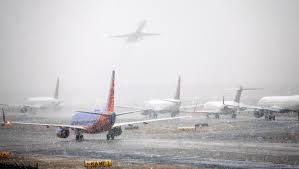
A powerful and wide-ranging storm system has brought significant portions of the American aviation network to a standstill, with ground stops issued at two (Atlanta & Charlotte) of the country’s busiest air traffic hubs and cascading delays rippling across the entire national airspace. The disruption, confirmed at the highest levels of the United States government, represents one of the most significant single-day weather events to impact commercial aviation in recent memory.
The Official Confirmation
On March 16, 2026, United States Secretary of Transportation Sean Duffy took to social media to formally acknowledge the scale of the crisis, confirming that at least 2,000 flights had been canceled and more than 9,500 flights delayed as severe weather systems swept across multiple regions of the country simultaneously.
The intervention of a Cabinet-level official to publicly address the disruption underscores the extraordinary magnitude of the event — a level of governmental visibility that is typically reserved for systemic failures or catastrophic weather episodes affecting millions of travelers at once.
Secretary Duffy’s confirmation also signals that federal aviation authorities, including the Federal Aviation Administration (FAA), are operating in an elevated response posture, coordinating with airlines, air traffic control facilities, and airport operators across the affected regions to manage the collapse in capacity.
Ground Stops: Atlanta and Charlotte
The two airports at the center of the disruption are among the most strategically critical nodes in the entire United States aviation network.
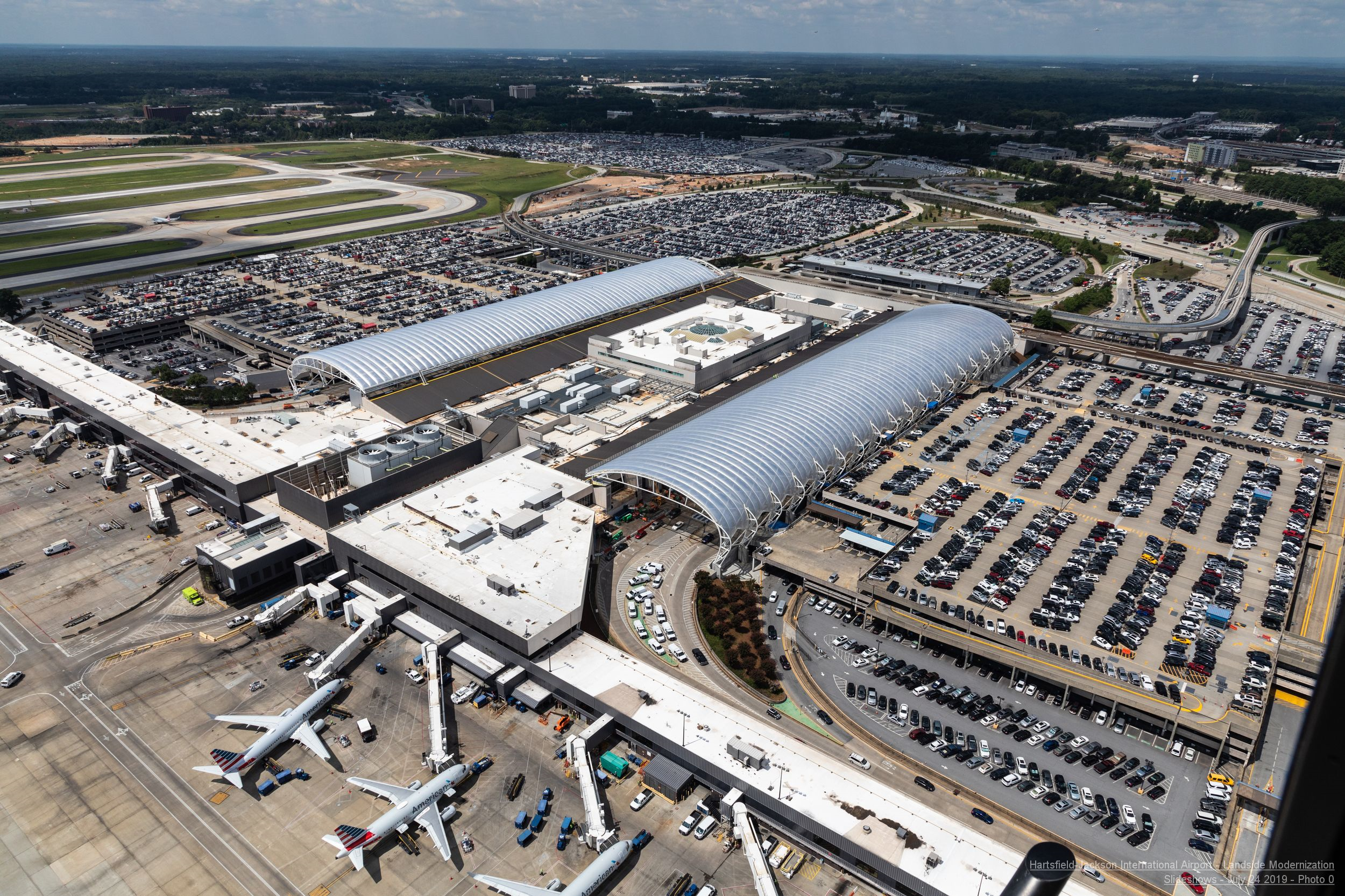
Hartsfield-Jackson Atlanta International Airport (ATL), consistently ranked as the world’s busiest airport by passenger volume, has been placed under a full ground stop due to thunderstorm activity in the immediate terminal area. A ground stop at Atlanta does not merely affect Atlanta — it sends shockwaves through the entire Delta Air Lines hub-and-spoke network, disrupting connections across the Southeast, the Caribbean, Latin America, and transatlantic routes simultaneously.
Atlanta’s role as a super-connector means that a single ground stop here can strand passengers in cities as geographically diverse as Minneapolis, Boston, and Bogotá, all of whom were routing through ATL to reach their final destinations.
Charlotte Douglas International Airport (CLT), the primary hub for American Airlines’ Eastern operations, has similarly been issued a ground stop as thunderstorms batter the greater Charlotte metropolitan area. Charlotte functions as a critical connecting gateway for passengers traveling between the Northeast corridor and destinations throughout the South, the Gulf Coast, and the Caribbean. With CLT effectively offline for departures, American Airlines faces a complex reaccommodation challenge spanning hundreds of inbound and outbound rotations.
Ground Delays: Houston and Washington
Beyond the full ground stops at Atlanta and Charlotte, two additional major airports are operating under ground delay programs — a slightly less severe but still operationally significant restriction that slows the rate of departures to manage traffic flow.
George Bush Intercontinental Airport (IAH) in Houston is experiencing ground delays driven by sustained wind conditions, which are limiting runway throughput and reducing the airport’s effective capacity. As the primary United Airlines hub for Latin American and international operations, delays at IAH carry outsized consequences for connecting itineraries across Central and South America.
Ronald Reagan Washington National Airport (DCA), one of the most politically and operationally sensitive airports in the country due to its proximity to restricted airspace over the nation’s capital, is also under a ground delay program driven by wind. DCA’s notoriously short runway infrastructure and strict weight and performance limitations make it particularly vulnerable to wind-driven operational restrictions, and even modest delays here generate significant disruption for the dense shuttle traffic operating between Washington, New York, and Boston.
The Network Cascade Effect
What makes a weather event of this scale uniquely devastating for the aviation industry is not the local disruption at any single airport — it is the cascade effect that propagates through an interconnected system where every aircraft, every crew member, and every gate assignment is part of a precisely choreographed sequence.
When a plane cannot depart Atlanta, the aircraft that was supposed to arrive in Atlanta from Dallas to then operate a flight to London never boards its transatlantic passengers. The crew that was supposed to pick up that London flight is now out of position. The inbound aircraft at Heathrow waiting for that plane sits idle at the gate. A single ground stop at ATL initiates a chain reaction that, within hours, touches flights on three continents.
With 9,500 flights delayed in a single day, the recovery timeline stretches well beyond the passage of the storm itself. Airlines typically require 24 to 72 hours to fully reposition aircraft and crew back to their scheduled rotations following a disruption of this magnitude — meaning that passengers traveling on March 17 and March 18 may continue to experience residual delays even as skies clear.
Passenger Rights and What Travelers Should Know
For the tens of thousands of passengers caught in the disruption, understanding their rights is critical:
Rebooking — All major U.S. carriers are obligated to rebook affected passengers on the next available flight at no additional charge when cancellations occur, regardless of cause.
Refunds — Passengers who choose not to travel due to a canceled flight are entitled to a full refund to their original form of payment under DOT regulations, even for non-refundable tickets.
Weather Waivers — Delta, American, and United have almost certainly issued travel waivers for the affected airports, allowing passengers to rebook within a flexible window without change fees. Travelers should check their airline’s app or website immediately.
Hotel and Meals — It is important to note that U.S. carriers are generally not legally required to cover hotel or meal expenses when cancellations are caused by weather, as these are classified as extraordinary circumstances outside airline control.
The Broader Significance
This storm event arrives at a moment of heightened scrutiny for the U.S. aviation system. Following years of post-pandemic operational strain, airline staffing challenges, and high-profile meltdowns that triggered Congressional hearings, the industry has worked hard to rebuild its reputation for operational reliability.
A disruption of this scale — 2,000 cancellations, 9,500 delays, ground stops at the world’s busiest airport — will inevitably reignite conversations about the resilience of the national airspace system, the adequacy of airline contingency planning, and the role of federal oversight in protecting the traveling public during extreme weather events.
Secretary Duffy’s early and visible public communication suggests that the current administration is acutely aware of the political and public relations dimensions of large-scale aviation disruption — and is positioning the Department of Transportation as a proactive, visible presence in managing the crisis narrative.
Looking Ahead
As the storm system continues its track across the United States, aviation meteorologists and FAA traffic management units will be monitoring conditions closely at secondary airports that may fall within the storm’s path in the coming hours. Travelers with upcoming flights through Atlanta, Charlotte, Houston, or Washington are strongly advised to monitor their airline’s communications in real time, arrive at airports with significant time buffers, and consider activating travel insurance coverage where applicable.
The skies over America are dark tonight. But the industry’s eyes are wide open.
For additional operational briefings and the latest Airline News, monitor our dedicated aviation intelligence category.
 Shaifali
  Priyanshu Gautam
  Vibhuuti Goyal