


The United States Air Force deliberately destroyed two of its own MC-130J Commando II aircraft on Iranian soil in April 2026 — each valued at over $100 million — to prevent their classified technology from falling into enemy hands. The dramatic decision came during one of the most complex combat search and rescue (CSAR) operations in recent American military history, launched after an F-15E Strike Eagle was shot down over Iran on April 3.
The outcome was remarkable: both crew members came home alive. The price tag was extraordinary.
What Are the MC-130J Commando II Aircraft?
The MC-130J Commando II is not a standard transport plane. Built for US Special Operations Command, it is engineered specifically for covert infiltration and exfiltration deep inside hostile territory. Each airframe carries advanced avionics, electronic warfare suites, and infrared missile countermeasures — classified systems designed to defeat modern air defense networks.
That same sophistication is precisely why their destruction was ordered the moment recovery became impossible. If Iranian forces had captured an intact MC-130J, the intelligence windfall could have compromised future special operations missions for years.
At over $100 million per aircraft, the financial cost exceeded $200 million combined. Military analysts note, however, that the strategic cost of leaving them intact would have been far higher.
The 48-Hour Rescue Operation
Here’s a timeline of how the mission unfolded:

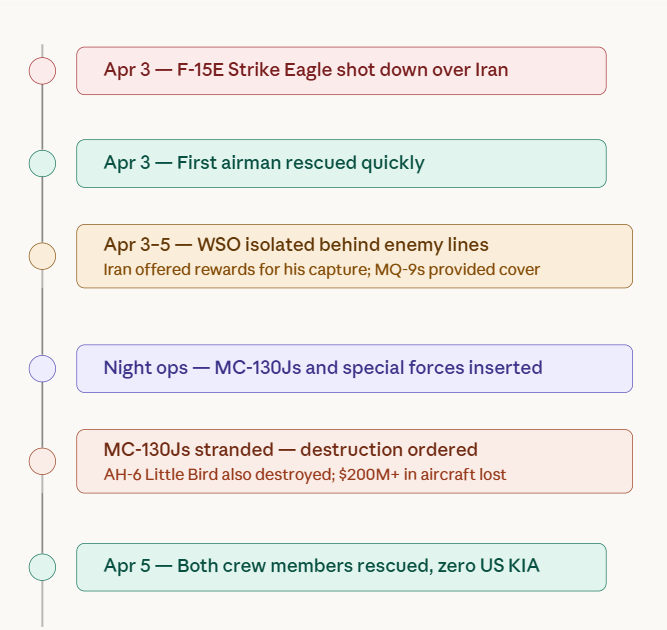
The second crew member — a weapons systems officer (WSO) — spent nearly 48 hours evading Iranian search parties, who were reportedly offering financial incentives for his capture. During this window, MQ-9 Reaper drones provided constant surveillance and engaged hostile forces that closed in on his position. Special operations forces were then inserted under cover of darkness, supported by the MC-130Js.
When the aircraft became stranded in a rapidly deteriorating ground situation — with no viable recovery option — the order was given. The MC-130Js, along with an AH-6 Little Bird helicopter, were destroyed in place.
Why Self-Destruction Was the Only Option
Modern special operations aircraft like the MC-130J are rolling intelligence platforms. Their onboard systems — electronic warfare suites, sensor arrays, and classified communications infrastructure — represent years of R&D and operational methodology.
The US military’s standing doctrine for such situations is unambiguous: classified technology must not be allowed to fall into adversary hands, regardless of cost. Iran, which maintains close intelligence ties with Russia and China, would have had significant incentive and capability to exploit any intact systems.
The loss of the physical airframes, though costly, was the correct call under established military doctrine.
A Mission 46 Years in the Making: Lessons from Operation Eagle Claw
The 2026 operation inevitably draws comparisons to Operation Eagle Claw in April 1980 — the catastrophic failed attempt to rescue American hostages in Tehran. That mission collapsed due to equipment failures, poor inter-service coordination, and inadequate contingency planning. Eight servicemen were killed when a helicopter collided with a C-130 during a desert refueling stop.
Eagle Claw exposed the structural weakness of US joint special operations and directly triggered the creation of the United States Special Operations Command (SOCOM). The reforms that followed — unified command, multi-domain integration, purpose-built aircraft like the MC-130J — are precisely what made the 2026 mission succeed despite losing two aircraft.
Where Eagle Claw failed through fragmentation, the 2026 operation succeeded through integration: real-time space-based surveillance, cyber capabilities, MQ-9 close air support, and joint command all functioning as a single system.
Key Facts
- Two MC-130J Commando II aircraft destroyed, valued at $100M+ each
- One AH-6 Little Bird helicopter also destroyed
- Both F-15E crew members successfully recovered
- Zero US personnel killed in the operation
- WSO spent approximately 48 hours isolated behind enemy lines
- Iranian forces reportedly offered financial rewards for his capture
- MQ-9 Reaper drones provided persistent surveillance and fire support
US Air Force MC-130J Destroyed in Iran: The $200M CSAR Mission That Saved Two Pilots
The United States Air Force deliberately destroyed two MC-130J Commando II aircraft in Iran, each valued at over $100 million, to prevent classified technology from falling into enemy hands during a high-risk combat search and rescue (CSAR) mission in April 2026.
Why Did the US Air Force Destroy Its Own MC-130J Aircraft?
The 48-Hour F-15E Rescue Operation Inside Iran
How MQ-9 Reaper Drones Protected the Downed Airman
MC-130J Mission vs Operation Eagle Claw: How Far Has the US Come?

