

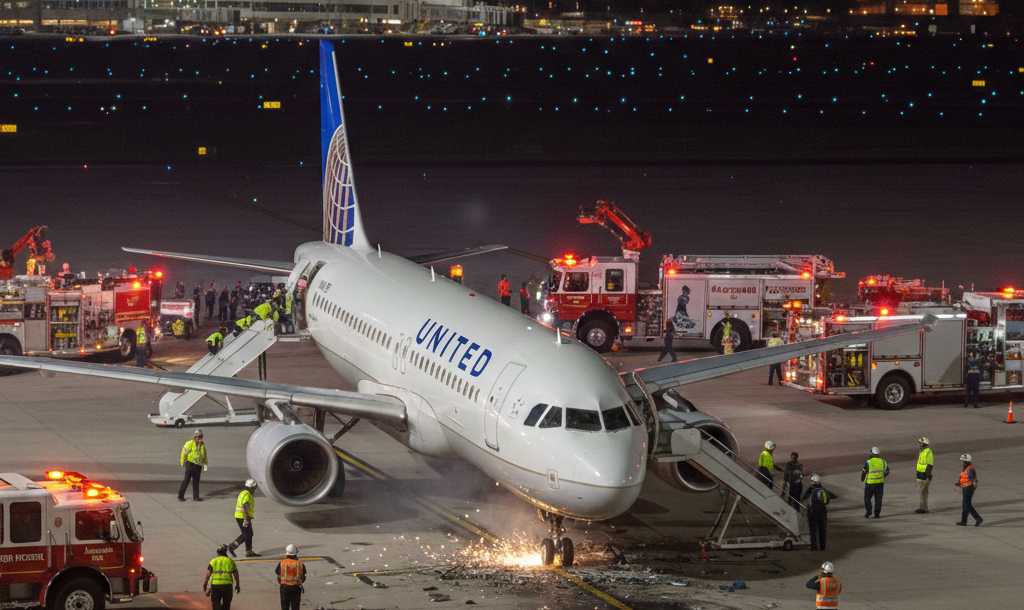
The peaceful conclusion of a routine domestic transit from Chicago O’Hare to Orlando International Airport was shattered on January 18, 2026, when a United Airlines Airbus A321-200neo experienced a catastrophic mechanical failure upon arrival. What should have been a standard touchdown for the nearly 200 passengers and six crew members aboard Flight 2323 transformed into a high-stakes emergency as the aircraft’s landing gear assembly succumbed to extreme physical stress. The incident, captured in chilling detail by amateur videographers and airport surveillance, has sent ripples through the aviation community, forcing a critical re-examination of how modern narrow-body jets handle the intersection of meteorological volatility and structural load limits.
The core of the event lies in the final seconds of the flight’s approach to Orlando’s Runway 36L. At approximately 12:35 PM local time, the aircraft encountered significant atmospheric instability, with reported wind gusts reaching upwards of 54 miles per hour. As the pilot attempted to flare and settle the massive A321neo onto the pavement, the jet was subjected to a violent hard landing. The physics of the touchdown were unforgiving. The initial impact occurred primarily on the main landing gear tires, but the resulting kinetic energy was not dissipated. Instead, the aircraft exhibited a phenomenon known as porpoising, where the force of the initial contact caused the jet to bounce back into the air before slamming its forward weight onto the nose gear assembly with excessive vertical velocity.
The structural consequences were immediate and visible. Upon the secondary compression of the nose gear, the right wheel of the forward assembly separated entirely from its axle. In a startling sequence of events, the detached wheel was seen rolling independently across the asphalt at high speed before coming to rest in a grassy area adjacent to the runway. Simultaneously, the main landing gear system took a massive hit. The sheer force of the descent caused multiple main gear tires to deflate or sustain extensive damage, effectively crippling the aircraft’s ability to move. The A321neo, registration N14502, came to a halt on the active runway, unable to taxi under its own power and necessitating a complete ground stop at Florida’s busiest aviation hub.
The data gathered in the immediate aftermath provides a sobering look at the stresses involved. Early investigative elements from the Federal Aviation Administration (FAA) confirm that the landing gear system was subjected to extensive stress that likely exceeded its original design tolerances. While the A321neo is celebrated for its fuel efficiency and advanced avionics, this incident highlights a potential vulnerability in how its landing gear absorbs high-energy impacts during crosswind or gusty conditions. The fact that the aircraft was only two years old, having been delivered in late 2023, suggests that the failure was not a result of long-term fatigue or aging but was instead a direct consequence of the catastrophic forces applied during that single landing event.
From a human perspective, the experience was harrowing yet professionally managed. Passengers reported a violent jolt and a series of unsettling noises as the gear failed, followed by a tense period of waiting on the tarmac. Because the aircraft was immobilized on an active runway, emergency responders were deployed instantly. Maintenance teams and airport rescue firefighting units secured the scene, ensuring there was no risk of fire or further structural collapse. The decision was made to disembark all 206 individuals via ground vehicles rather than deploying emergency slides, a process that took nearly an hour but ensured zero injuries were reported.
The broader context of this failure cannot be ignored by safety investigators. This event marks a disturbing parallel to a similar incident in April 2025, where a Frontier Airlines A321neo suffered an almost identical nose wheel separation during a landing in Puerto Rico. In that case, the National Transportation Safety Board (NTSB) identified a fracture in the wheel hub following a 2.2g impact. The United incident in Orlando appears to follow a nearly identical failure mode, raising urgent questions for Airbus regarding the resilience of the A321neo nose gear assembly when faced with the high-descension rates typical of a botched landing flare or sudden wind shear.
Stakeholders are now looking for clarity. United Airlines has officially characterized the event as a mechanical issue upon landing, a standard corporate euphemism that downplays the visceral nature of a wheel detaching from a moving airplane. However, the FAA’s probe will be far more surgical. Investigators are currently reviewing the flight data recorder and cockpit voice recorder to determine the exact descent rate and pilot inputs in the moments preceding the failure. They will also examine the maintenance records of N14502 to ensure that the assembly had been correctly serviced.
Looking forward, the implications for the industry are twofold. First, there may be a need for enhanced training protocols specifically focused on the landing characteristics of the A321neo in high-wind environments. If the airframe’s center of gravity and gear geometry make it more susceptible to porpoising during hard landings, pilots must be equipped with the specific skills to mitigate those risks before they reach the point of structural failure. Second, Airbus may face pressure to inspect or even reinforce the nose gear axles and hubs across the neo fleet to ensure that a hard landing, while never ideal, does not result in a catastrophic loss of hardware.
In conclusion, the United flight in Orlando serves as a stark reminder that even the most modern miracles of engineering are subject to the raw laws of physics. While the redundancy of the dual nose wheel design prevented a total loss of directional control, the separation of a wheel and the deflation of multiple main tires represent a serious breach of operational safety. As the FAA continues its investigation, the focus must remain on whether this was an isolated error in judgment or a subtle indicator of a technical threshold that the industry has yet to fully respect. For now, the wheel in the grass at Orlando International Airport stands as a silent witness to a moment when the margin for error in the skies reached its absolute limit.
 Olive Arthur
  Priyanshu Gautam
  Vibhuuti Goyal
[…] travel dominates because of the country’s size and limited high-speed rail […]