

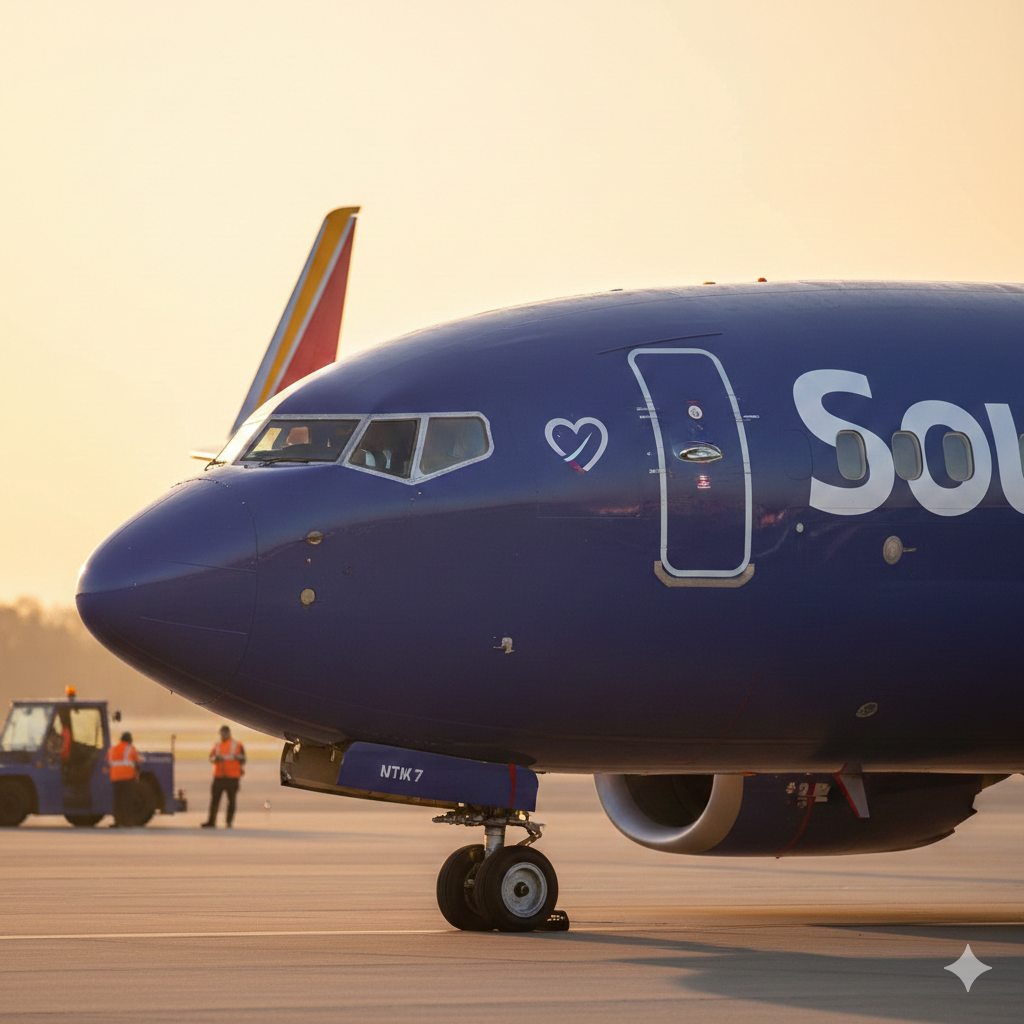
DALLAS, Southwest Airlines finally killed the lights on its daylight-only operating model today. The carrier announced a new overnight service connecting Las Vegas to San José, Costa Rica, marking the first scheduled international red-eye in its fifty-five-year history. This operational pivot shatters the low-cost carrier’s long-standing scheduling dogma and signals a desperate scramble for revenue amid tightening fleet constraints. Management bets that bleary-eyed passengers leaving the Neon City at midnight will pay a premium to wake up in the rainforest, but the implications run deeper than a mere schedule adjustment.
Operations planners at Love Field have circled this move for years, yet legacy IT systems previously held the airline hostage. The antiquated backend simply could not process overnight connections without risking a system-wide meltdown. Those technical barriers have reportedly fallen, forced down by relentless pressure from Wall Street to “sweat the metal.” Leaving a seventy-million-dollar Boeing 737 MAX 8 sitting idle on the tarmac for six hours every night became accounting heresy in a high-interest rate environment. The airline now chases the utilization rates of its rivals, trading operational simplicity for essential seat-mile efficiency.
This squeeze stems directly from production failures in Renton. Southwest needs capacity, and Boeing cannot deliver jets fast enough to satisfy the airline’s growth targets. The irony of American aviation strategy currently bleeds through this schedule change. While Southwest pushes narrowbodies to their absolute limits to squeeze out revenue, the industry watches a massive stalemate in the widebody sector. Boeing finally slated the mammoth 777X for certification later in 2026, yet not a single US carrier has signed an order for the flagship jet. We see domestic carriers sweating assets on four-hour hops while the future of long-haul US aviation sits in a certification purgatory, ignored by the very airlines that once championed global reach.
Executing this Costa Rica route requires more than just a schedule update; the carrier faces a logistical gauntlet. Southwest’s legendary quick turns rely on domestic speed and simplified ground handling. International arrivals involve customs, immigration, and bureaucratic friction. Turning a plane around in San José at 6:00 AM requires a precise ground game the airline has rarely tested outside daylight hours. Labor unions, already wary of fatigue risks, will watch these rotations with hawk-like scrutiny. The airline’s pilots have flagged fatigue calls in recent contract negotiations, and overnight flying adds distinct physiological stressors to the cockpit that Southwest’s safety culture must now address.
The strategic shift also erodes the last vestige of Southwest’s quirky differentiation. It brings them into the direct line of fire against American and United. Those legacy giants built their networks on red-eye banking structures decades ago. Southwest enters this arena not as a disruptor, but as a late adopter playing catch-up. They trade operational simplicity for utilization efficiency. The carrier now flies the same punishing schedules as the rivals it once mocked, effectively admitting that the low-cost model of 1971 cannot survive the operating realities of 2026.
Management views this Las Vegas to Costa Rica route as a trial balloon for a broader overnight network. If the operational metrics hold and the crew scheduling software avoids collapse, expect the floodgates to open on routes to Hawaii and the Caribbean. The distinct culture of Herb Kelleher’s airline fades a little more with every midnight departure, replaced by the cold, hard math of asset utilization.
 Martin hope
  Vibhuuti Goyal
[…] The operational disruption now unfolding at Southwest Airlines was not entirely unexpected. Just three weeks after transitioning from its long-standing open […]