
SYNOPSIS
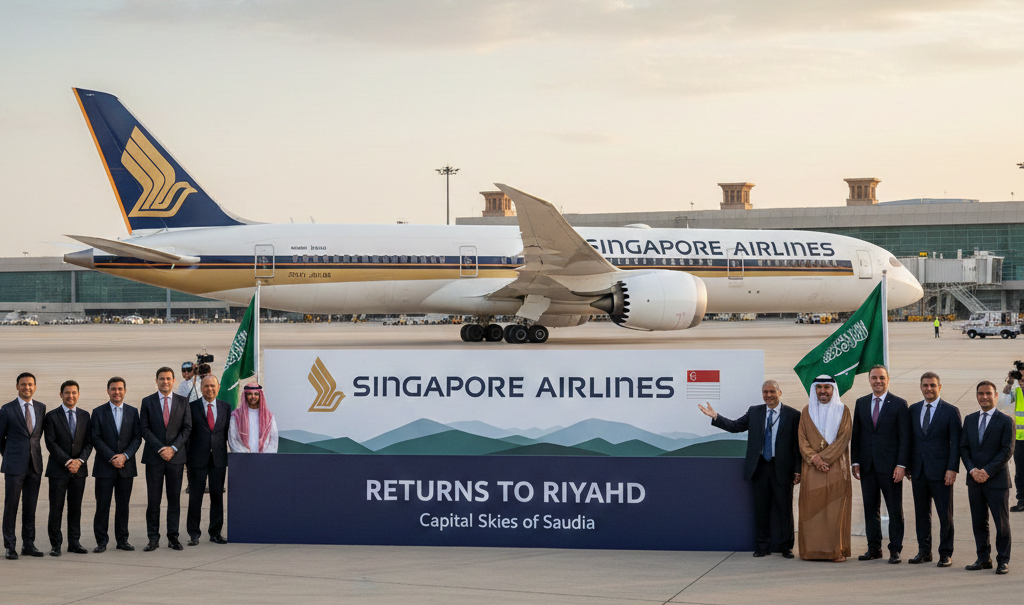
Singapore Airlines will resume non-stop passenger flights to Riyadh, Saudi Arabia, starting in early 2026, marking its return to the Saudi capital after a fifteen-year absence. The carrier plans to operate three weekly flights using its long-haul Airbus A350-900 aircraft to facilitate increased business and religious travel. This resumption aligns with Saudi Arabia’s Vision 2030 initiative to expand international air connectivity and positions Singapore as a primary transit hub for travellers from the Asia Pacific region.
Singapore Airlines (SIA) will launch non-stop flight services between Singapore Changi Airport and King Khalid International Airport in Riyadh starting in the first quarter of 2026. The national carrier of Singapore confirmed the decision following a series of bilateral negotiations aimed at strengthening aviation links between Southeast Asia and the Gulf Cooperation Council (GCC) region. This move signifies the first time SIA has served the Saudi capital since it suspended its Riyadh operations in 2011 due to changing market conditions. The airline will deploy its three class Airbus A350-900 fleet on the route, offering Business Class, Premium Economy, and Economy Class cabins to cater to a diverse range of corporate and leisure travellers.
REGIONAL AVIATION CONTEXT
The return of Singapore Airlines to Riyadh occurs during a period of rapid transformation within the Saudi Arabian aviation sector. The Saudi government is currently investing billions of dollars to establish the Kingdom as a global logistics hub, a strategy facilitated by the Air Connectivity Program (ACP). By re-establishing this route, SIA joins a growing list of international carriers returning to or entering the Saudi market to capitalize on the country’s economic diversification efforts.
The 2026 launch date coincides with the expected operational ramp up of Riyadh Air, the new Saudi national carrier. Industry analysts suggest that SIA’s entry will provide essential competition on the route, which has recently been dominated by Middle Eastern “Big Three” carriers that require passengers to transit through Dubai, Doha, or Abu Dhabi. SIA’s non-stop service will significantly reduce travel time for passengers flying between the two financial centers, cutting several hours off the current indirect flight paths.
SIA intends to utilize the long-haul variant of the Airbus A350-900 for the Riyadh service. This aircraft is noted for its fuel efficiency and advanced cabin pressurized systems which reduce passenger fatigue on flights exceeding seven hours. The configuration typically includes 42 Business Class seats, 24 Premium Economy seats, and 187 Economy Class seats.
The flight schedule is expected to be finalized by mid-2025, with industry sources indicating an initial frequency of three flights per week. This frequency allows the airline to test market demand while providing sufficient capacity for high value belly hold cargo. The cargo capacity is particularly relevant for the transport of electronics, pharmaceuticals, and perishable goods, which constitute a significant portion of the trade volume between Singapore and Saudi Arabia.
STRATEGIC ALIGNMENT WITH SAUDI VISION 2030
The resumption of flights is a direct response to the Saudi Vision 2030 program, which aims to increase the number of annual tourists to 100 million by the end of the decade. Saudi Arabia is currently developing several “giga projects,” such as NEOM and the Red Sea Project, which require a steady influx of international expertise and investment. Singapore, as a global financial hub, serves as a primary source for the professional services and technology sectors currently in high demand within the Kingdom.
Government officials in Riyadh have expressed that increasing direct connectivity with major Asian hubs like Singapore is a priority. The Air Connectivity Program has been instrumental in providing the necessary regulatory support and incentives to ensure the commercial viability of the route. This partnership reflects a shared interest in enhancing the flow of people and capital between the two regions.
CONNECTIVITY AND TRANSIT DYNAMICS
Singapore Changi Airport will serve as a vital gateway for passengers originating from Australia, New Zealand, and Southeast Asia who are traveling to Saudi Arabia. Currently, travellers from Sydney, Melbourne, and Perth often face limited options when flying to Riyadh. The 2026 SIA service will offer seamless connections for these passengers, leveraging SIA’s extensive network in the Southwest Pacific.
For Singaporean travellers, the route simplifies access for the Umrah and Hajj pilgrimages. While SIA currently operates flights to Jeddah, the Riyadh service provides an alternative entry point for those conducting business in the capital or visiting the historical sites in the central region of the Kingdom. The airline is expected to coordinate with local travel agencies to offer integrated packages that include domestic transfers within Saudi Arabia.
ECONOMIC AND TRADE IMPACT
The reintroduction of direct flights is projected to stimulate bilateral trade, which has seen steady growth over the last five years. Singaporean firms are increasingly involved in Saudi Arabia’s infrastructure, water management, and digital security sectors. Direct air access facilitates the rapid deployment of personnel and equipment necessary for these large-scale contracts.
The Saudi Arabian General Investment Authority (SAGIA) has identified Singapore as a key partner for knowledge exchange. By providing a direct link, SIA enables more frequent face to face consultations between sovereign wealth funds, private equity firms, and government agencies. The move is also expected to increase the number of Saudi tourists visiting Singapore and the wider ASEAN region, contributing to the local hospitality and retail sectors.
COMPETITIVE ANALYSIS
The entry of Singapore Airlines into the Riyadh market puts pressure on established regional players. Saudia, the Kingdom’s current flag carrier, has also been expanding its capacity and upgrading its fleet to maintain market share. However, SIA’s reputation for premium service and its robust loyalty program, KrisFlyer, provide a distinct advantage in attracting high yield corporate travellers.
Furthermore, the competition is expected to intensify as Riyadh Air begins its full-scale operations. Market experts believe that the presence of multiple high-quality carriers will lead to more competitive pricing and improved service standards across the board. SIA’s decision to commit to the route in 2026 suggests a long-term confidence in the sustained economic growth of the Saudi capital.
REGULATORY AND LOGISTICAL CHALLENGES
Despite the positive outlook, the resumption of the route involves complex logistical preparations. SIA must secure optimal landing slots at King Khalid International Airport, which is currently undergoing significant expansion to handle increased traffic. The airline also needs to establish local ground handling agreements and ensure that its catering and maintenance standards are met at the Riyadh station.
Regulatory approval from the General Authority of Civil Aviation (GACA) in Saudi Arabia and the Civil Aviation Authority of Singapore (CAAS) is the final step in the process. Both bodies have indicated that the renewed air services agreement will include provisions for code sharing and potential future increases in flight frequency. These administrative hurdles are expected to be cleared well before the first flight takes off in 2026.
As 2026 approaches, Singapore Airlines will likely monitor the geopolitical and economic climate of the Middle East to calibrate its final launch strategy. The airline has a history of cautious but steady expansion, and the Riyadh route represents a significant commitment to its Middle Eastern network. If the initial phase proves successful, there is a strong possibility that the service could move to a daily frequency by 2028.
The return to Riyadh signifies a closing of the gap in SIA’s global footprint. By reconnecting the two cities, the airline reinforces its status as a leading international carrier capable of linking the world’s most dynamic economic zones. The 2026 relaunch will be a closely watched event in the aviation industry, serving as a benchmark for the recovery and growth of long-haul international travel in the post pandemic era.
 Vibhuuti Goyal
[…] Singapore Airlines is renowned for offering one of the widest business class seats in the aviation industry. […]