


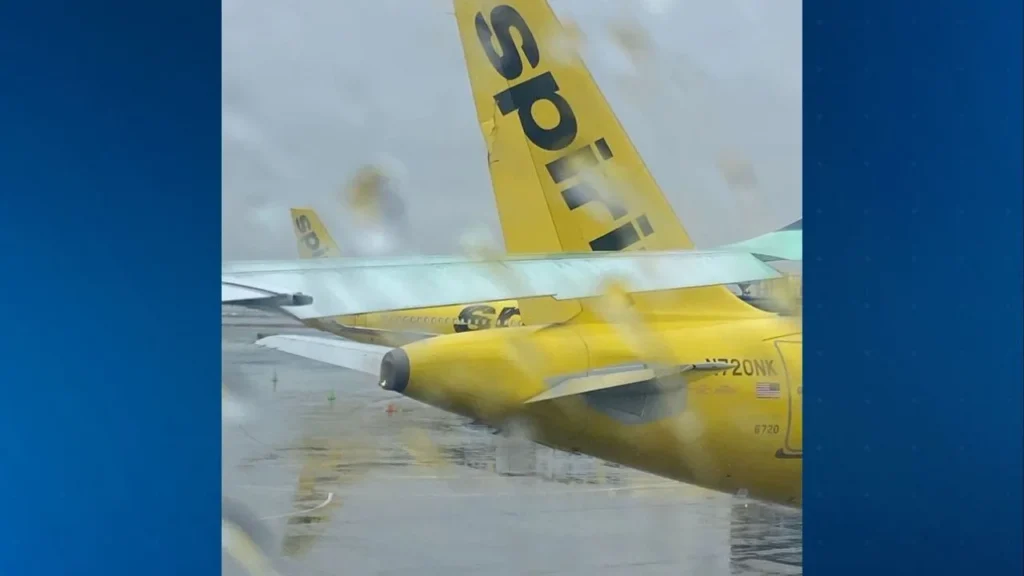
On March 3 at 10:20 a.m., a Singapore Airlines Airbus A350-900ULR, operating as Flight 21, sustained a ground collision with a Spirit Airlines Airbus A321, Flight 992, at Newark Liberty International Airport’s Terminal B. The FAA reports the right wing of the Singapore widebody struck the vertical stabilizer of the stationary Spirit aircraft during the pushback sequence.
While no injuries occurred among the passengers or ground crew, the mechanical consequences for both carriers remain substantial. This incident highlights ongoing concerns regarding apron congestion and the strict adherence to wing-walker protocols during complex maneuvers at high-traffic terminals. The incident occurred as Singapore Airlines prepared for its ultra-long-haul departure to Singapore Changi Airport.
The Airbus A350-900ULR, featuring a wingspan of nearly 213 feet, requires significant clearance during pushback operations from Newark’s congested pier structures. Historical data suggests that Newark’s Terminal B presents a restricted operating environment for widebody aircraft of this scale. The FAA has initiated an investigation into whether the tug operator or the required wing-walkers failed to maintain visual separation during the movement.
Spirit Airlines immediately removed Flight 992 from service for a comprehensive structural evaluation. In a formal statement, the carrier noted that they are working on alternate travel arrangements to move guests to their destinations. This grounding is particularly impactful for Spirit, which operates a high-utilization model where any unplanned maintenance event triggers a cascade of cancellations across the network.
1. Incident Time: 10:20 local.
2. Aircraft Involved: A350-900ULR and A321-200.
3. Injury Count: Zero.
4. Primary Damage: Right wingtip and vertical stabilizer.
5. Regulatory Status: FAA investigation active. Analysis of this event reveals a breakdown in the sterile ramp protocol designed to prevent such incursions.
The observation that a widebody wing could strike the tail of a narrowbody suggests a significant miscalculation of the pushback arc. This development is a critical update in current Airline News for stakeholders monitoring narrowbody capacity and ground safety compliance. Comparing this to similar incidents at JFK and ORD, the financial burden of a tail-strike repair can exceed seven figures depending on the damage to the rear pressure bulkhead.
The operational implications are immediate. Singapore Airlines must now ferry a replacement aircraft or source parts for a winglet repair in a high-cost maintenance environment. For Spirit, the loss of an A321 during a peak travel period represents a direct hit to seat-mile revenue. This is especially true given the current Pratt & Whitney GTF engine issues already sidelining portions of their fleet. Regulatory scrutiny will likely focus on the Ground Handling Manual (GHM) procedures utilized by the third-party contractors involved in the pushback at Terminal B.
The FAA will evaluate if the ramp lighting, markings, or personnel positioning contributed to the lapse in situational awareness. For Spirit, the aircraft must undergo non-destructive testing (NDT) to ensure the integrity of the empennage before returning to revenue service. For additional operational briefings and the latest Airline News, monitor our dedicated aviation intelligence category.
FAQs
1. What caused the Singapore Airlines and Spirit Airlines aircraft collision at Newark Airport?
The collision occurred during pushback at Newark Liberty International Airport when the right wing of a Singapore Airlines Airbus A350-900ULR struck the vertical stabilizer of a stationary Spirit Airlines Airbus A321. The FAA is investigating whether wing-walker guidance or tug operator procedures failed to maintain safe clearance.
2. Were there any injuries in the Newark aircraft ground collision?
No injuries were reported among passengers, crew, or ground personnel. However, both aircraft sustained structural damage, prompting inspections and temporary removal from service.
3. What impact will the Newark ground collision have on airline operations?
Spirit Airlines removed the affected Airbus A321 from service for structural inspection, potentially causing schedule disruptions. Singapore Airlines may require wingtip repairs or a replacement aircraft for its long-haul Newark–Singapore route.