

SYNOPSIS
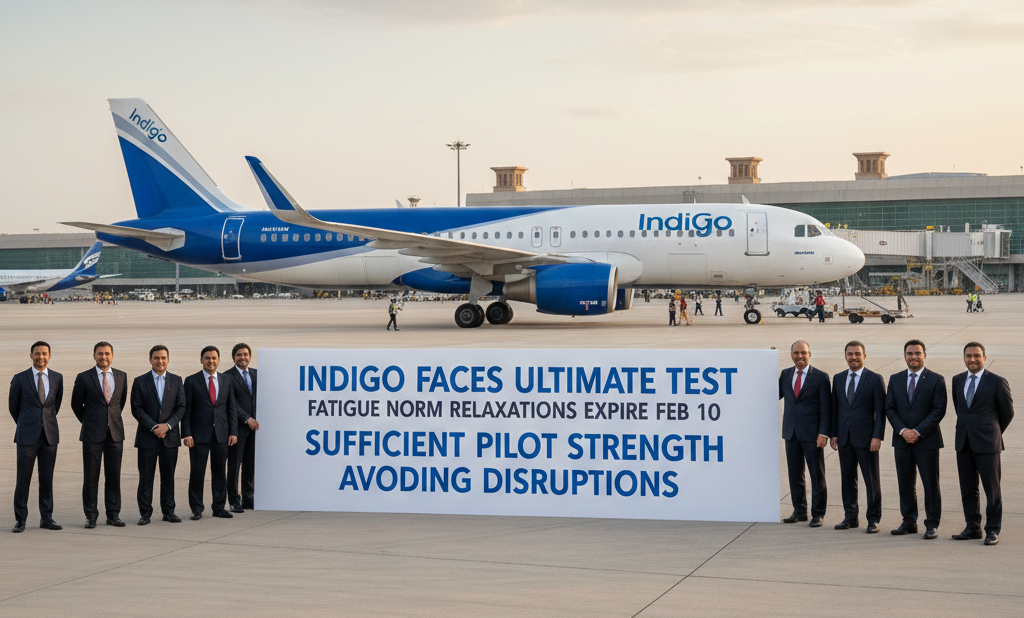
IndiGo is set to complete its transition to the revised Flight Duty Time Limitations (FDTL) by the deadline of February 10, marking the conclusion of its regulatory extension. The airline has formally assured the Directorate General of Civil Aviation (DGCA) that its current pilot strength is sufficient to maintain full operational capacity without further cancellations or delays. This shift necessitates a significant recalibration of crew scheduling and rest protocols to align with new safety mandates aimed at reducing pilot fatigue across the Indian aviation sector.
InterGlobe Aviation Limited, operating as IndiGo, has officially informed the Directorate General of Civil Aviation (DGCA) that it will implement the revised Flight Duty Time Limitations (FDTL) in their entirety starting February 10, 2026. The airline confirmed through a formal communiqué that it will not seek any further extensions for the adoption of these safety standards. In its submission to the aviation watchdog, the carrier emphasized that it now possesses an adequate number of trained cockpit crew members to fulfil the requirements of the updated Civil Aviation Requirements (CAR). This announcement follows a period of administrative grace during which the airline adjusted its automated scheduling systems and expanded its pilot roster to accommodate the enhanced rest periods mandated by the regulator. The airline has stated that the implementation will proceed without any reduction in the current flight frequency or the cancellation of existing routes.
MANPOWER LOGISTICS AND PILOT RATIOS
To meet the requirements of the revised FDTL, IndiGo has undergone a comprehensive expansion of its flight crew department. Industry estimates suggest that the new regulations require a 15 to 25 percent increase in the pilot-to-aircraft ratio to compensate for longer rest intervals and shorter duty windows. As of early 2026, IndiGo operates a fleet exceeding 350 aircraft, primarily consisting of Airbus A320neo and A321neo variants. To maintain its schedule of over 2,000 daily flights, the airline has accelerated its recruitment of both Captains and First Officers. The airline has utilized its cadet pilot programs and lateral hiring strategies to ensure that the total number of active pilots remains above the critical threshold required for the new 48-hour weekly rest mandate. Logistics data indicates that the carrier has successfully integrated hundreds of new flight crew members into its operations over the last two quarters, specifically targeting a buffer that allows for standby duties without violating the revised flight time maximums.
TECHNICAL SPECIFICATIONS OF THE FDTL REVISIONS
The revised FDTL norms introduced by the DGCA focus on three primary metrics: the definition of night duty, the duration of weekly rest, and the maximum number of landings during night operations. Under the new framework, the night duty period has been redefined to cover the hours between 0000 and 0600, a change from the previous 0000 to 0500 window. This one-hour extension significantly restricts the number of consecutive nights shifts a pilot can perform. Additionally, the mandatory weekly rest period has been increased from 36 hours to a continuous 48 hours, providing a 33 percent increase in recovery time for flight crews. The regulations also cap the number of landings during a night duty period to two, which directly impacts the efficiency of short haul domestic “red eye” flights. IndiGo has reconfigured its crew tracking software, utilizing algorithms that monitor cumulative flight hours to ensure that no pilot exceeds the 1,000-hour annual flight time limit while adhering to the more restrictive monthly duty caps.
NETWORK STABILITY AND FLIGHT FREQUENCY
The assurance provided to the DGCA suggests that the airline has resolved the initial scheduling conflicts that led to speculation regarding potential service disruptions. By finalizing the transition on February 10, the airline aims to stabilize its network during the peak travel season. The operational plan involves a decentralized crew basing strategy, where pilots are stationed at multiple hubs including Delhi, Mumbai, Bengaluru, and Hyderabad to minimize the need for deadhead travel, which counts toward duty time. Engineering and logistics teams have synchronized aircraft maintenance schedules with the new crew availability patterns to maximize hull utilization. Data from the airline suggests that the A321neo fleet, which is utilized for longer international routes to Central Asia and Southeast Asia, will see the most significant change in crew rotations. These routes often involve overnight transitions that now require more complex crew pairing to remain within the shortened Flight Duty Period (FDP) limits.
REGULATORY OVERSIGHT AND COMPLIANCE MONITORING
The DGCA has maintained a strict stance on the February 10 deadline, emphasizing that safety protocols regarding fatigue management are non-negotiable. The regulator will employ a digital monitoring system to audit the flight logs and duty rosters of all major carriers, including IndiGo. This oversight includes spot checks of the Fatigue Risk Management System (FRMS) that airlines are required to maintain. If an airline is found to be in violation of the FDTL norms, it faces penalties ranging from financial fines to the suspension of operating licenses for specific routes. IndiGo has responded by establishing an internal compliance unit that conducts real time monitoring of crew hours. This unit is tasked with identifying potential duty period exceedances before they occur, using predictive modelling based on historical weather patterns and Air Traffic Control (ATC) delay data. The carrier has invested in cloud-based reporting tools that allow pilots to report fatigue levels, which are then integrated into the scheduling logic to prevent the assignment of duty to exhausted personnel.
RECRUITMENT PIPELINE AND TRAINING INFRASTRUCTURE
A key factor in IndiGo’s ability to meet the FDTL deadline without further extensions is its robust training infrastructure. The airline utilizes advanced flight simulators at its training centers in Gurugram and Bengaluru to expedite the type rating of new recruits. The throughput of these facilities has been increased to ensure that the pipeline of Junior First Officers (JFOs) remains steady. Furthermore, the airline has engaged with external training providers like CAE to increase the volume of simulator sessions available for recurrent training and command upgrades. This proactive approach to training has allowed the airline to maintain a surplus of qualified pilots, which serves as a hedge against the higher attrition rates seen in the competitive global aviation market. The technical training also covers the specific nuances of the new FDTL rules, ensuring that every crew member understands the legal limits of their duty day and the procedures for requesting relief in cases of unforeseen operational delays.
With the transition period concluding, the focus for IndiGo will shift toward optimizing operational costs in an environment of increased labour expenditure. The requirement for a larger pilot workforce naturally leads to higher personnel costs, which the airline seeks to offset through the high fuel efficiency of its Pratt and Whitney and CFM International engines. The strategic integration of the A321XLR into the fleet later this year will further complicate FDTL management due to the ultra-long-haul nature of the flights, requiring the carrier to develop even more sophisticated crew relay systems. Regarding future operations, the airline expects that the standardization of these norms will level the playing field among domestic competitors, as all carriers must now adhere to the same stringent safety overheads. The successful implementation on February 10 will likely serve as a case study in how large-scale carriers can manage rapid regulatory shifts while maintaining market dominance and operational reliability.
 Vibhuuti Goyal
  Priyanshu Gautam