


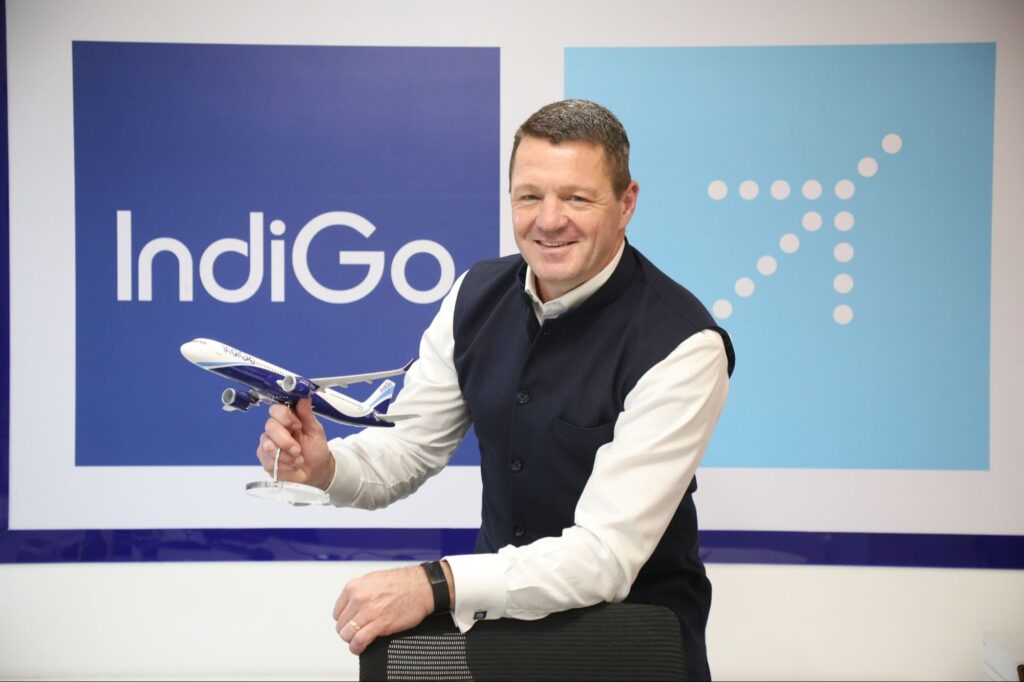
India’s largest airline, IndiGo, is facing a leadership shake-up after CEO Pieter Elbers stepped down months after one of the worst operational disruptions in Indian aviation history.
While the official statement cited “personal reasons” for Pieter Elbers’ resignation, industry observers widely interpret the timing as a response to mounting pressure following the December operational breakdown. Large-scale disruptions of this magnitude typically trigger board-level scrutiny in the aviation sector, where operational reliability is closely tied to leadership accountability.
Several analysts believe the move represents a strategic leadership reset by InterGlobe Aviation’s board, aimed at restoring operational confidence and signalling to regulators, investors, and passengers that corrective action is underway after one of the most disruptive periods in IndiGo’s operational history.

| IndiGo Operational Disruption – December 2025These figures highlight the magnitude of the disruption and its impact on passengers, airport operations, and airline finances. | |
| Indicator | Data |
| Flights Cancelled | 4,000 – 4,500 |
| Peak Daily Cancellations | 250 – 300 flights |
| Passengers Affected | ~500,000 |
| Estimated Refund Liability | ₹800+ crore |
| Airports Most Impacted | Indira Gandhi International Airport (DEL), New Delhi Chhatrapati Shivaji Maharaj International Airport (BOM), Mumbai |
| Main Causes | Pilot shortages, revised duty time regulations, and operational scheduling constraints |
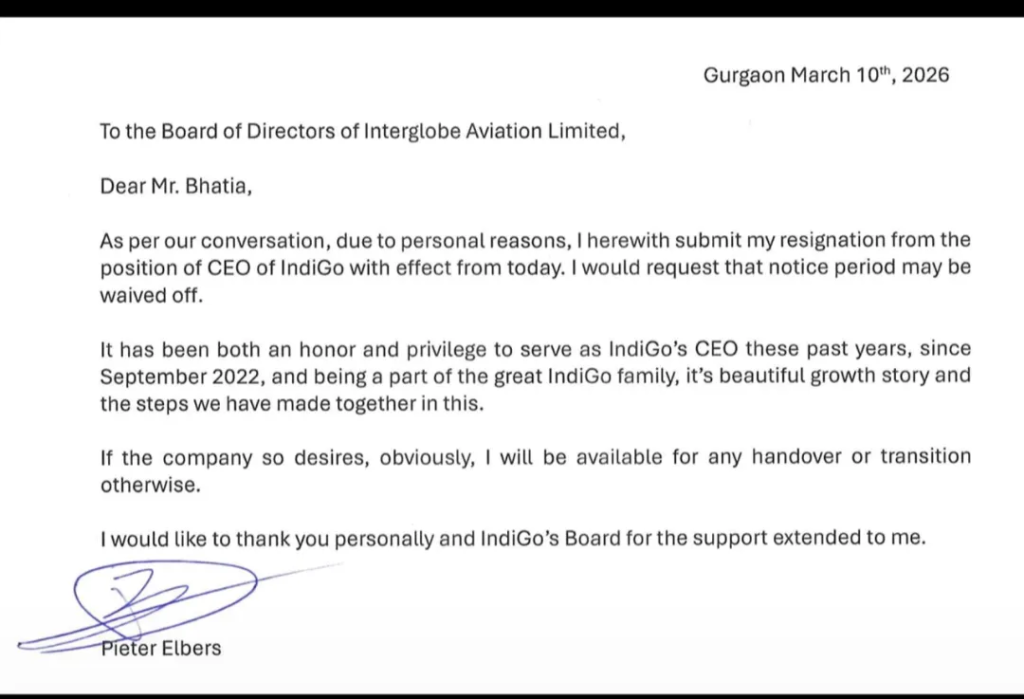
In a resignation letter dated 10th March 2026 from Gurgaon, addressed to the board of InterGlobe Aviation, Elbers wrote that he was stepping down from the position of CEO with immediate effect and requested that the notice period be waived.
The tenure actually began in September 2022, and offered to assist with the transition process if required.
The scale of the crisis also prompted the inspection from the aviation regulator, the Directorate General of Civil Aviation (DGCA), which reportedly examined operational lapses and issued notices to the airline. Industry estimates suggested that the crisis could have resulted in refund liabilities exceeding ₹600 crores+. During the crisis period, IndiGo’s on-time performance also dropped significantly.
An internal communication sent to employees by IndiGo managing director Rahul Bhatia acknowledged the seriousness of the disruption. In the message, he wrote that “what happened last December should never have taken place”, adding that customers did not deserve the disruption and praising frontline staff who worked through sleepless nights to restore operational integrity.
Not only this but the message also emphasised the need to strengthen the airlines culture, as what happened was not a great sign for the whole industry and especially the passengers, half of the population in india depends completely on indigo being the most economically feasible airline, thus to rebuild the customers trust, this was signalling the intense internal pressure that followed the crisis.
Ongoing geopolitical tensions in the Middle East have also added pressure on the aviation sector, the situation is getting worse, operational cost is increasing and at the same time fuel prices have risen by nearly 20–30 percent over the past year, pushing airline operating expenses higher.
Operational risks are often in an aviation industry, that often leads to leadership changes, and Elbers’ exit appears to reflect an effort by the airline to draw a line under the crisis.
Despite the setback, Indigo still remains one of the most significant and dominant player in india’s aviation sector. The airline controls about 60–62 percent of the domestic market, operates a fleet of more than 380 aircraft, and runs over 2,100 daily flights across its expanding network.
the focus will now shift toward stabilizing operations and rebuilding passenger confidence after the December disruption. For an airline that has long positioned itself as the backbone of India’s low-cost aviation market, restoring reliability will be critical not only for customer trust but also for regulatory credibility and investor sentiment.
The coming months will determine whether the leadership reset translates into stronger operational discipline, or whether deeper structural challenges within the airline’s rapid expansion strategy still need to be addressed.
FAQs
1. Why did IndiGo CEO Pieter Elbers resign?
Pieter Elbers officially resigned citing personal reasons. However, the timing of his departure has been widely linked to the major operational disruption IndiGo experienced in December 2025, which resulted in thousands of flight cancellations and significant passenger inconvenience.
2. What happened during IndiGo’s December 2025 operational crisis?
In December 2025, IndiGo faced one of the largest operational disruptions in Indian aviation history. Between 4,000 and 4,500 flights were cancelled over several days, affecting nearly 500,000 passengers. The crisis was primarily caused by pilot shortages, new flight duty time limitation rules, and scheduling challenges.
3. How much did the December disruption cost IndiGo?
Industry estimates suggested that the crisis may have resulted in refund liabilities exceeding ₹600–₹800 crore due to mass cancellations, passenger compensation, and re-accommodation costs.
4. When did Pieter Elbers become the CEO of IndiGo?
Pieter Elbers took over as CEO of IndiGo in September 2022 after previously serving as the President and CEO of KLM Royal Dutch Airlines.
5. How big is IndiGo in the Indian aviation market?
IndiGo is the largest airline in India, holding approximately 60–62% of the domestic market share. The airline operates more than 380 aircraft and runs over 2,100 daily flights across domestic and international routes.
6. Did regulators investigate the IndiGo operational disruption?
Yes. India’s aviation regulator, the Directorate General of Civil Aviation (DGCA), reportedly reviewed the operational issues and sought explanations from the airline regarding scheduling practices and compliance with new pilot duty time regulations.