


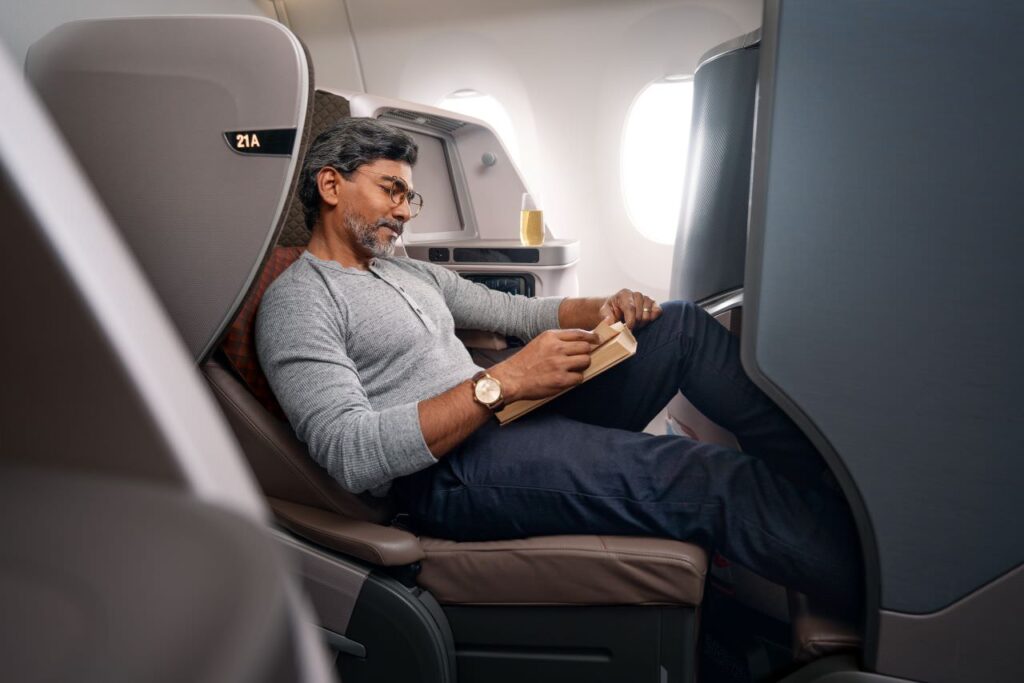
Most passengers assume upgrades are luck. Data from airline loyalty programmes, gate agent behaviour studies, and frequent flyer communities tells a very different story.
Free upgrades don’t happen by accident.
Airlines upgrade roughly 3–8% of economy passengers on any given flight, according to data aggregated across major loyalty programmes. That sounds small — until you understand that every single one of those seats goes to someone who knew exactly what they were doing.
Cabin crew don’t randomly point at passengers and wave them forward. Upgrades follow a hierarchy, a process, and — critically — a set of behaviours that dramatically increase your odds of being selected. This guide breaks down every lever you can pull, ranked by effectiveness and reliability in 2025.
1. Elite Status Is Still the Single Most Powerful Upgrade Tool
Let’s start with the uncomfortable truth: airline elite status accounts for the majority of complimentary upgrades issued globally. IATA data consistently shows that top-tier frequent flyers — those holding Gold, Platinum, or equivalent status — receive priority consideration for operational upgrades before any other passenger segment.
What most passengers don’t know is the order of the upgrade queue:
- Tier 1: Top-tier elite members (Platinum, Executive Platinum, Gold)
- Tier 2: Mid-tier elite (Silver, Gold on partner programmes)
- Tier 3: Full-fare economy ticket holders
- Tier 4: Discounted economy, lowest booking class last
If you fly frequently on one carrier, concentrating your spend on a single airline alliance rather than spreading it across carriers is the fastest route to status — and therefore the fastest route to consistent upgrades.
2. Book the Highest Available Economy Fare Class
Booking class matters far more than most passengers realise. Airlines use letter codes — Y, B, M, H, Q, V — to denote fare buckets within economy. Y-class (full-fare economy) passengers are prioritised for upgrades over discounted fare classes like Q or V, even without elite status.

When upgrade inventory opens — typically 24–72 hours before departure — the system automatically sequences eligible passengers. A full-fare economy ticket puts you near the top of that sequence. A heavily discounted ticket puts you at the bottom, regardless of check-in time.
Practical implication: On short-haul routes where the price gap between Y-class and a discount fare is modest, booking up often makes financial and strategic sense if an upgrade is your goal.
3. Use Miles Strategically — Bid Upgrades Are Underpriced
Complimentary upgrades and miles-based upgrades are different mechanisms. But in 2025, bid upgrade programmes — offered by over 40 airlines including Lufthansa, British Airways, Emirates, and Air New Zealand — represent one of the most underutilised tools available to passengers.
Bid upgrade systems allow economy passengers to offer a cash or miles bid for unsold premium cabin seats, typically 7–14 days before departure. Internal airline data leaked to aviation media over the past two years suggests average winning bids on transatlantic routes run 40–60% below the walk-up business class fare.

Key rules for bidding smart:
- Bid on routes with historically low premium load factors — secondary hub connections, off-peak travel days (Tuesday, Wednesday), and shoulder season dates
- Minimum bids often win on thin routes — airlines would rather fill a seat at 30 cents on the dollar than fly it empty
- Check upgrade auction sites like Plusgrade (the platform powering most airline bid systems) for typical winning bid ranges by route
4. Fly at Off-Peak Times on Underbooked Premium Cabins
Upgrade probability is directly correlated with premium cabin load factor at departure. An empty business class cabin costs the airline almost nothing to upgrade you into — and it avoids the optics of visible empty rows while economy is packed.
Routes and timings with structurally lower premium load factors include:
- Tuesday and Wednesday departures on leisure-heavy routes
- Early morning red-eye flights where premium demand skews corporate and last-minute
- Shoulder season travel (late January–March, October–November for most regions)
- Secondary hub routes vs. primary O&D city pairs
If your schedule has flexibility, choosing a Tuesday 6am departure over a Friday evening flight on the same route can meaningfully shift your upgrade odds without changing anything else about your behaviour.
5. Check In Early — But Not for the Reason You Think
The “check in early to get an upgrade” advice is partially correct but widely misunderstood. Early check-in doesn’t move you up the upgrade queue — the queue is determined by fare class, status, and ticket price, not check-in time.
What early check-in does do is ensure you’re confirmed in the system before gate agents begin processing upgrade decisions, which typically happens 2–3 hours before departure on long-haul flights and 60–90 minutes on short-haul.

Passengers who check in within 30 minutes of departure are sometimes excluded from upgrade consideration entirely — not because of malice, but because their seat assignment has already been reallocated in the system.
6. Ask at the Gate — With the Right Script
Gate agents have discretionary upgrade authority, particularly on flights where premium cabins are undersold. Most passengers never ask. Of those who do, most ask the wrong way.
What doesn’t work: “Is there any chance of an upgrade?” (vague, gives the agent nothing to work with)
What works better: “I noticed the flight has some availability in business class — I’m a [status level] member travelling on [fare class]. Is there anything you’re able to do for seat 14C?”
This approach works because it signals you understand the system, you’re not asking for charity, and you’ve given the agent a specific action to take. Gate agents deal with hundreds of passengers per shift — specificity and politeness cuts through the noise.
Timing matters too. Ask 45–60 minutes before boarding, not at the gate as the jetbridge opens. By then, decisions are largely made.
7. Hold an Airline Co-Branded Credit Card With Upgrade Certificates
Several major airline credit cards — including the United MileagePlus Club Card, Delta Reserve Amex, and British Airways Premium Plus card — issue annual upgrade certificates or companion upgrade vouchers as part of their benefits package.
These certificates typically allow a one-cabin upgrade on select fare classes and routes. The catch: most go unused because cardholders don’t understand the terms. Common restrictions include:
- Valid on published fare classes only (not the cheapest discount tickets)
- Must be applied before the day of departure
- Blackout dates during peak travel periods
- Require a minimum spend threshold to unlock
Read the certificate terms at the start of each card year, identify your eligible trips, and apply the certificate proactively. A certificate sitting unused in your account at renewal is money surrendered.
8. Travel Solo — Upgrade Probability Is Significantly Higher
This is one of the most data-supported but least-discussed upgrade dynamics. Airlines upgrade solo travellers at a far higher rate than couples or groups, for a simple operational reason: a single unsold business class seat is easily filled by one passenger. Finding two adjacent seats is harder, three is rare.
If you’re travelling with a partner and upgrade is a genuine priority, consider booking separate reservations and requesting adjacent seats post-booking. It’s a trade-off — but one that significantly improves your odds on long-haul routes where a business class seat has material comfort value.
9. Dress the Part — It’s Not a Myth, But It’s Misunderstood
The relationship between attire and upgrades is real but overstated in popular media. Gate agents do not upgrade passengers based on appearance alone. However, dress code matters in one specific scenario: when two passengers are equivalent in fare class and status, and a gate agent exercises discretionary judgement.
In that tie-breaker moment, someone in business attire has a marginal advantage over someone in beachwear. The practical advice is simple: don’t dress to impress, dress to not be disqualified. Smart casual is sufficient. The upgrade ceiling is set by your fare class and status — attire only matters at the margins.
The Upgrade Formula: What Actually Moves the Needle
Stacking these strategies compounds your probability significantly. The highest-leverage combination in 2025:
Elite status or full-fare economy ticket + off-peak Tuesday/Wednesday flight + bid upgrade attempt + gate request with specific script = upgrade probability that data suggests exceeds 25–35% on undersold long-haul routes.
No strategy guarantees a seat in 2C. But passengers who treat upgrades as a system to understand — rather than luck to hope for — consistently outperform those who don’t.
The cabin is the same plane. The difference is knowing how the list works.
For more passenger strategy guides, airline loyalty programme analysis, and aviation industry news, explore our full coverage in the Airline News section.