


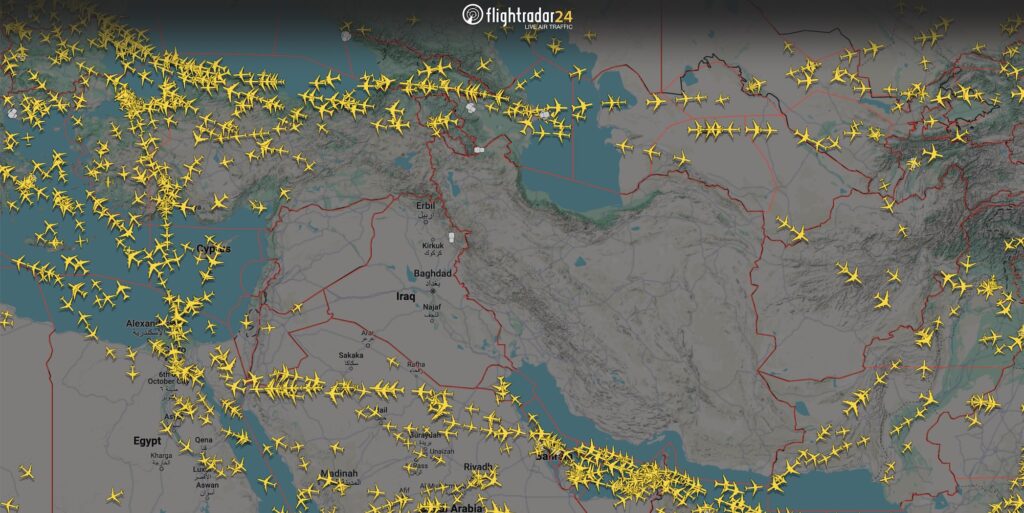
There is a fundamental fracture in the global aeronautical map. The European Union Aviation Safety Agency (EASA) and the Federal Aviation Administration (FAA) have issued urgent NOTAMs banning flight operations within the Tehran Flight Information Region (FIR) in response to confirmed airstrikes by Israeli and American forces. The Iranian corridor, a vital route for trade between Europe and Asia, is effectively closed by this directive. The industry now faces a nearly 3,500-nautical-mile vertical wall of inaccessible airspace due to the four-year closure of Ukrainian airspace and the reciprocal ban on Western carriers in Russian skies.
Global navigation charts have had to be revised since February 2022 due to the exclusion of Ukrainian airspace and the ensuing Russian overflight prohibitions. Carriers adjusted by using a “Southern Corridor” that went through Iran or a “Central Corridor” that went through the South Caucasus. The majority of heavy widebody traffic connecting operational hubs like London, Frankfurt, and Dubai to Southeast Asia was absorbed by the Iranian route, which served as the main backup. The redundancy in the worldwide air traffic network has vanished since this contingency was eliminated. We are living in the most restrictive airspace environment since the end of the Cold War.
Detour Penalty: Flights between London (LHR) and Singapore (SIN) face an additional 90 to 120 minutes of flight time.
Fuel Burn: An estimated 8,000 to 12,000 kg of additional Jet A-1 fuel consumption per rotation for twin-engine widebodies (A350/B787).
Capacity Reduction: Cargo payloads on affected routes are being reduced by approximately 15% to account for extra fuel weight.
Traffic Displacement: The Baku (UBBB) and Ankara (LTAA) FIRs are reporting traffic volume surges exceeding 300% above 2021 baselines.
The immediate consequence of this closure is the eradication of the “Great Circle” efficiency for Eurasian connectivity. Airlines are no longer flying arcs; they are flying right angles. The closure forces a binary routing decision: go North through the heavily congested South Caucasus, or go South via the Arabian Peninsula and Egypt. Both options present severe operational penalties.
The Northern option funnels traffic into a remarkably narrow corridor over Azerbaijan, Turkmenistan, and Kazakhstan. This route, often referred to as the “Trans-Caspian pipeline,” serves as the only viable path remaining between the Russian no-fly zone to the north and the Iranian conflict zone to the south. Operational dispatchers are currently battling for slots in this corridor, which is suffering from acute ATC saturation. The infrastructure in these sectors was never designed to handle the simultaneous arrival of every flagship carrier’s heavy metal from Europe and Asia.
On the other hand, the Southern route compels aircraft to fly through Saudi airspace, down through Turkey, and out across the Arabian Sea. This has a stronger ATC capacity, but there is a significant geometric penalty. This deviation pushes airframes closer to their maximum range limits by adding substantial mileage for a flight from Paris to Bangkok. This is a structural disruption to fleet scheduling and utilization rates, not just a minor annoyance.
FLEET ECONOMICS AND YIELD PRESSURES
The economics of long-haul aviation rely on tight margins and high utilization. The Iranian closure destroys both. Adding two hours to a flight does not just burn fuel; it disrupts the 24-hour rotation cycle of the aircraft. A Boeing 777-300ER that previously completed a London-Singapore-London rotation with sufficient buffer for maintenance and turnaround now faces a schedule deficit. Over a month, these accumulated delays result in the loss of entire return trips, effectively reducing the airline’s available capacity without removing a single seat from the inventory.
Carriers are responding by increasing ticket prices to offset the structural rise in Cost Per Available Seat Kilometer (CASK). However, the more insidious cost lies in cargo displacement. To carry the extra fuel required for the southern detour, dispatchers must limit the payload. In an era where belly-hold cargo is a crucial revenue stream, leaving freight on the tarmac to carry reserve fuel is a direct hit to the bottom line. This reality forces a re-evaluation of the viability of certain ultra-long-haul routes that were marginal even under optimal conditions.
THE CREW DUTY LIMIT WALL
Safety regulations regarding Flight Time Limitations (FTL) are non-negotiable. The extension of flight times due to the Iranian closure pushes many standard pairings into “ultra-long-range” territory, triggering restrictive crew rest requirements. A flight that was once operated by a standard crew complement may now require augmented crews (additional pilots) to remain legal.
This creates a manpower crisis. Airlines must roster more pilots for the same number of flights, depleting reserve pools and increasing crew accommodation costs. In some instances, the flight time extension exceeds the maximum allowable duty period entirely, necessitating a “tech stop” for a crew change in locations like Dubai or Muscat. A tech stop is the dispatch equivalent of a failure; it adds landing fees, cycle wear on the engines, and further delays, destroying the product proposition for business travelers.
THE ASYMMETRIC COMPETITIVE LANDSCAPE
A critical aspect of this crisis is the uneven application of airspace restrictions. While Western carriers are barred from Russian airspace and must now avoid Iran, certain non-aligned carriers face a different matrix of restrictions. Chinese carriers, for instance, maintain access to Russian airspace. This creates a massive market distortion.
A Chinese airline flying Shanghai to London can utilize Russian corridors, flying a direct, efficient northern trajectory. A British or German competitor on the same city pair must navigate the labyrinth of the southern detours. This results in a flight time disparity of up to three hours and a massive divergence in operating costs. Western legacy carriers are effectively competing with one hand tied behind their back, unable to match the cost base or schedule efficiency of their competitors who retain Russian overflight privileges. This geopolitical handicap is reshaping market share on the Europe-Asia axis.
THE BAKU BOTTLENECK
Focus must be directed toward the Heydar Aliyev International Airport (GYD) and the surrounding airspace controlled by Azerbaijan. With Iran offline, the airspace over the Caspian Sea has become the world’s most critical aviation choke-point. Dispatch reports indicate that vertical separation minimums are being tested as controllers stack aircraft into tight columns to thread them between the Russian and Iranian borders.
The risk here is not just delay, but operational safety. In the event of widespread weather systems or turbulence over the Caspian, the lack of lateral room to maneuver forces aircraft to hold or divert. The diversion airports in this region are limited in their ability to handle multiple widebody aircraft simultaneously. A single diversion event could trigger a cascading failure of the corridor, forcing mass cancellations or further, more extreme reroutings.
Operational risk extends beyond navigation. The insurance market for aviation is reacting aggressively to the conflict expansion. Hull war risk premiums are spiking for any operations in the Middle East region, even for those transiting “safe” corridors adjacent to the conflict zones.
Lessors are also stepping in, enforcing strict geofencing clauses in lease agreements. Airlines operating leased aircraft are finding their hands tied by asset owners who refuse to allow their multi-million dollar frames within proximity of the Iranian border. This legal pressure forces operational planners to take even wider berths than regulatory NOTAMs might strictly require, further exacerbating the fuel and time penalties.
ENVIRONMENTAL TARGETS VS. OPERATIONAL REALITY
The industry’s commitment to “Net Zero by 2050” faces a harsh reality check in this environment. The forced inefficiency of these detours generates millions of tons of excess CO2 emissions annually. Sustainable Aviation Fuel (SAF) supplies are nowhere near sufficient to mitigate the burn rates caused by these geopolitical deviations. We are currently observing a regression in flight efficiency that wipes out a decade of technological gains in engine fuel economy. The conflict is not just a humanitarian and geopolitical disaster; it is an environmental one for the aviation sector.
The response to the Iranian airspace closure highlights the fragmentation of global aviation governance. While the FAA and EASA moved in lockstep to prohibit overflight, other regulatory bodies have been slower or more ambiguous in their directives. This leaves dispatchers navigating a patchwork of compliance requirements, where a code-share flight might have different restrictions depending on the operating metal versus the marketing carrier.
For the passenger, this manifests as uncertainty. Flight cancellations, sudden schedule changes, and broken connections are the inevitable downstream effects of this upstream chaos. The reliability of the global network has been compromised, and stability will not return until geopolitical normalization occurs—a prospect that currently seems distant.
The closure of Iranian airspace is not a temporary tactical hurdle; it is a long-term strategic blockade. Airlines must now plan for a prolonged period of high-cost, high-complexity operations. Network planners will likely reduce frequencies to marginal Asian destinations, redeploying assets to transatlantic or intra-regional routes where yields are protected from these specific geopolitical risks.
We expect to see a surge in “technical stops” being scheduled into winter timetables, as headwinds increase effective flight times on westbound returns. Furthermore, the reliance on the Saudi/Egyptian corridor places immense pressure on the stability of that region. Any further expansion of conflict toward the Red Sea or Suez would effectively sever the last viable southern artery, forcing a complete cessation of direct Europe-Asia services for many carriers.
Industry stakeholders must prepare for a recalibration of global air travel economics. The era of cheap, efficient connectivity between Europe and the Far East has been suspended. The map has changed, and the costs have changed with it.
For additional operational briefings and the latest Airline News, monitor our dedicated aviation intelligence category.