

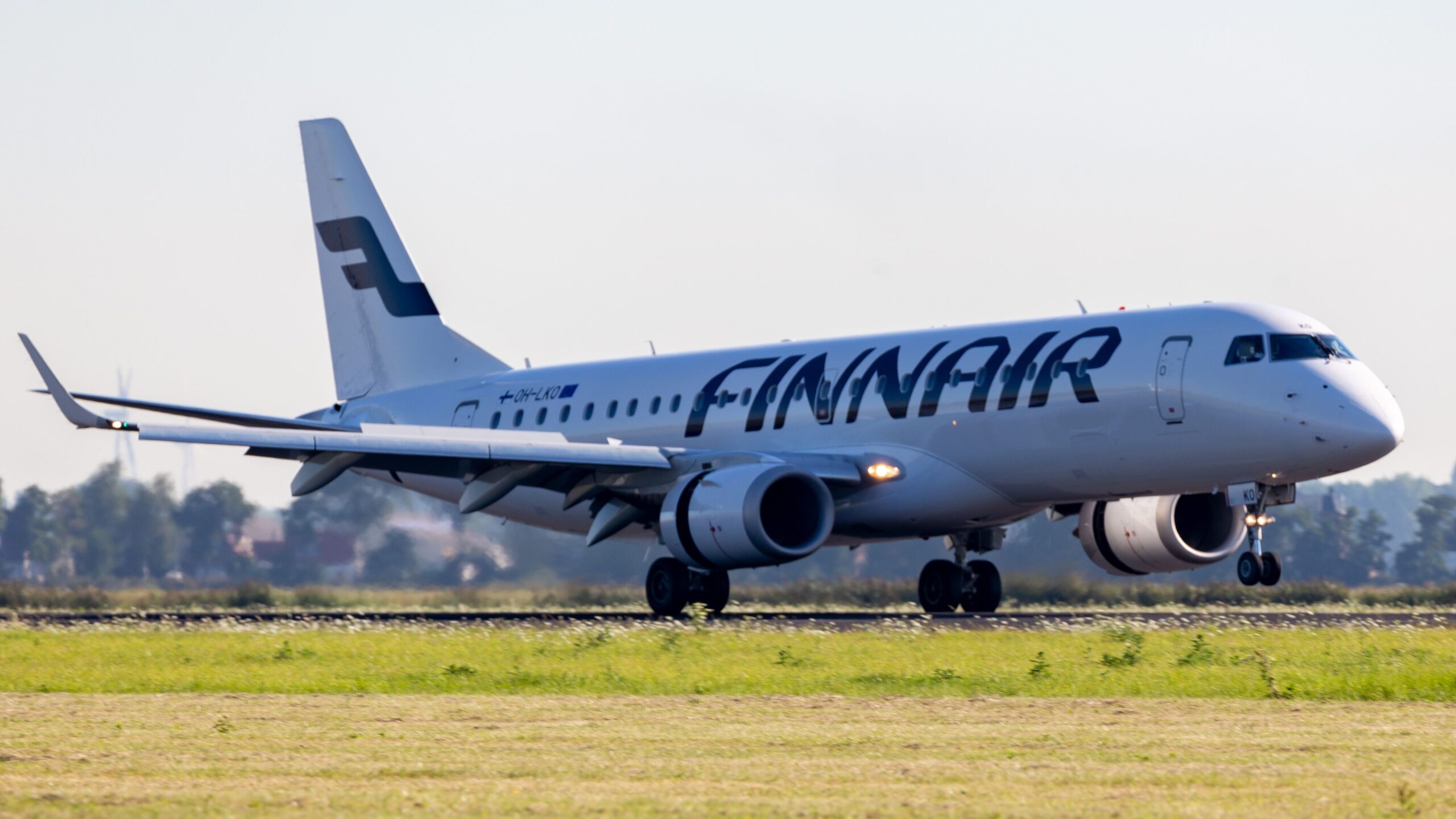
Finnair has finalized a landmark procurement agreement with Embraer for up to 46 E195-E2 jets, signalling a decisive shift in how the Finnish carrier will manage its regional and short-haul network through the end of the decade. Paired with a targeted strategy to acquire used Airbus A320 and A321ceo (current engine option) aircraft on the secondary market, the dual-track Finnair fleet strategy represents one of the most pragmatic procurement blueprints to emerge from a Tier 1 European airline since the pandemic.
1. Why Finnair Is Overhauling Its Fleet: Russian Airspace, Network Disruption, and Competitive Pressure
1.1 The Russian Airspace Closure and Its Impact on Finnair’s Business Model
The closure of Russian airspace to European carriers fundamentally dismantled Finnair’s pre-pandemic competitive advantage. Helsinki Vantaa Airport had served as a uniquely efficient transit hub for European-to-Asia traffic, benefiting from the shortest great-circle routes over Siberia. With those routes gone, Finnair’s Asia-Pacific premium revenue base eroded significantly, forcing a strategic pivot toward North Atlantic connections and Middle Eastern airline partnerships.
The consequence for fleet planning is direct: Finnair now requires greater flexibility on European feeder routes to Helsinki, where yields are more volatile and load factors less predictable. This is the core demand signal driving the Embraer E195-E2 order.
1.2 The Aging A319 and A320ceo Fleet: Maintenance Costs and Efficiency Gap
A significant portion of Finnair’s existing A320 family narrowbody fleet exceeds 18 years of operational age. For a Nordic carrier operating in cold-weather conditions, older airframes carry disproportionate maintenance burdens. Aging CFM56 and IAE V2500 engines require more frequent shop visits, and older airframe cycles erode reliability — a metric Finnair has long treated as a brand pillar.
The airline’s fleet renewal decision is, in part, a direct response to rising cost-per-available-seat-kilometre (CASK) across its legacy narrowbody fleet.
2. Finnair Embraer E195-E2 Order: Specifications, Efficiency Gains, and Regional Network Fit
2.1 Order Structure and Delivery Timeline
The Finnair Embraer E195-E2 agreement covers up to 46 aircraft, structured as a mix of firm orders and purchase options. The aircraft are intended to replace and expand the Nordic Regional Airlines (Norra) E190 fleet, which currently operates thinner regional routes feeding Finnair’s Helsinki hub.
- Total commitment: Up to 46 Embraer E195-E2 aircraft
- Operator: Nordic Regional Airlines (Norra) on behalf of Finnair
- Replaces: First-generation Embraer 190 (E1) fleet
- Seat configuration: Approximately 130–140 seats (vs. ~100 on the E190)
- Capacity uplift on regional routes: ~30% per departure
2.2 E195-E2 Fuel Efficiency and Environmental Performance
The E195-E2 delivers a 25% reduction in fuel burn per seat compared to the first-generation E190, a figure that translates directly into lower CO2 emissions per seat and reduced exposure to carbon pricing mechanisms under the EU Emissions Trading Scheme (EU ETS) and CORSIA. The efficiency gain is attributable to two key technologies:
- Pratt & Whitney Geared Turbofan (GTF) engines — a new gear reduction system allows the fan and low-pressure turbine to operate at different speeds, dramatically improving thermodynamic efficiency
- High-aspect-ratio wing — a longer, narrower wing design reduces aerodynamic drag at cruise altitudes typical for intra-European routes
For Finnair’s sustainability roadmap targeting carbon neutrality by 2045, the E195-E2 is the central decarbonisation instrument on the regional side of the network.
2.3 Fleet Commonality and MRO Advantages
The E195-E2 shares meaningful commonality with Norra’s existing E190 fleet — particularly in terms of cockpit philosophy and ground handling equipment — which reduces type rating conversion costs for pilots and simplifies ground operations. However, the new GTF engines and revised wing design require updated MRO procedures, and Finnair’s technical division is actively preparing for this transition.
3. Finnair A320ceo and A321ceo Secondary Market Strategy: A Pragmatic Narrowbody Bridge
3.1 Why Used Aircraft Instead of New A320neo or 737 MAX?
While peer carriers compete aggressively for OEM production slots on the Airbus A320neo family and Boeing 737 MAX, Finnair’s narrowbody procurement strategy deliberately targets the used A320ceo and A321ceo secondary market. This decision is driven by three converging factors:
- OEM delivery backlogs: Lead times for new narrowbody aircraft now extend into the late 2020s for most buyers, making new orders insufficient to address near-term capacity needs
- Engine reliability concerns: GTF durability issues on certain A320neo variants created schedule reliability risks that Finnair, with its punctuality reputation, is not willing to absorb
- CAPEX discipline: Used aircraft can be acquired or leased at substantially lower capital cost than new deliveries, preserving balance sheet flexibility post-pandemic
3.2 The A321ceo: Secondary Market Dynamics and Strategic Value
The Airbus A321ceo commands particularly strong residual values in the secondary aircraft market because its combination of seat capacity (up to 220 seats in high-density layouts) and range remains highly sought-after — especially as low-cost carriers and charter operators seek to retire older 757s. By securing used A321ceos now, Finnair is acquiring proven, high-capacity narrowbody assets at a point when tightening availability is beginning to push secondary market lease rates upward.
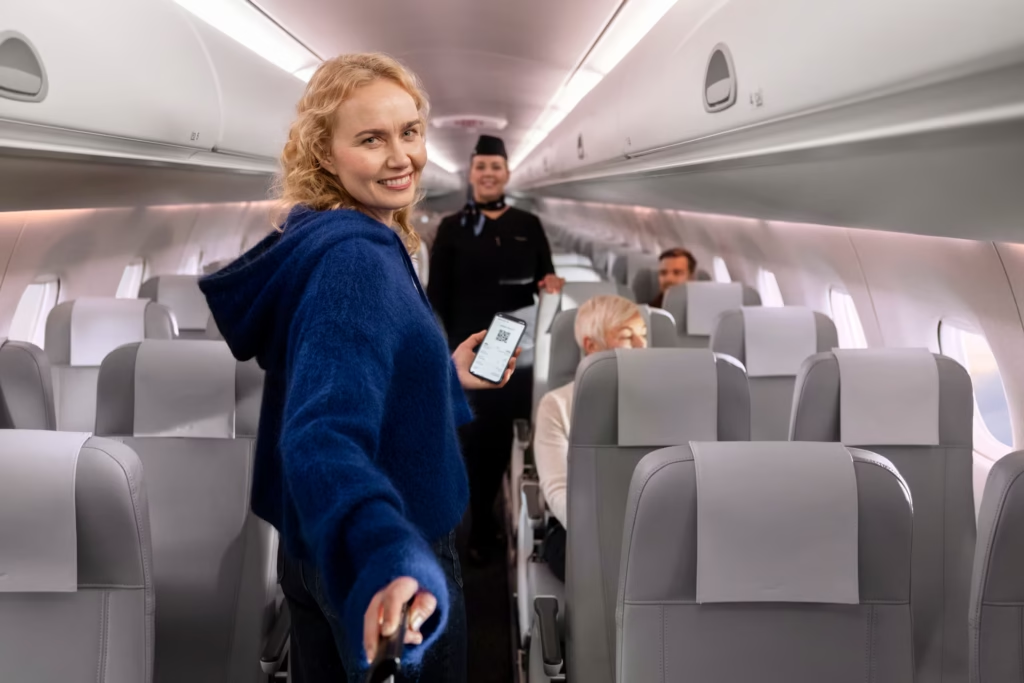
For Finnair’s European trunk routes — particularly dense O&D pairs within Europe and to Mediterranean leisure markets — the A321ceo provides competitive seat-cost economics that the smaller E195-E2 cannot replicate at scale.
3.3 MRO Synergies: Protecting the Cold-Weather Maintenance Edge
Finnair’s technical division at Helsinki Vantaa is fully optimised for CFM56 and IAE V2500 powerplants found on the A320ceo family. Introducing used ceo-family aircraft rather than neo-family jets means:
- No engine type rating transitions required for existing MRO technicians
- Established spare parts pools and component exchange networks remain valid
- Avoidance of GTF cold-weather durability complications that have affected some operators in Nordic climates
In sub-zero temperatures, turbofan engine wear dynamics differ from temperate climates. Finnair’s engineering team has decades of operational data on ceo-generation powerplant behaviour in these conditions — data that does not yet exist at scale for GTF engines in comparable environments.
4. Fleet Economics: CAPEX Strategy, Residual Values, and Right-Sizing the Finnair Network
4.1 Hybrid Procurement and Balance Sheet Optimisation
Finnair’s two-track fleet strategy reflects a sophisticated approach to aircraft economics. The E195-E2 order — secured directly through the Embraer manufacturer relationship — likely includes favourable OEM support packages, training subsidies, and performance guarantees that reduce long-term cost-of-ownership. In contrast, the used Airbus narrowbodies are transactional assets: acquired or leased at market rates to fulfil near-to-medium-term capacity needs, then phased out or remarketed as the airline’s financial position strengthens.
4.2 Right-Sizing: The E195-E2 and A321ceo Toolkit
The combination of the E195-E2 and A321ceo gives Finnair a highly graduated capacity toolkit for its narrowbody network:
- E195-E2 (130–140 seats): Optimal for high-frequency thin routes, secondary European city pairs, and demand-sensitive routes where right-sizing prevents structural overcapacity
- A321ceo (180–200 seats): Optimal for high-density European trunk routes, package holiday markets, and North Atlantic feeder flows to Helsinki from key European gateways
This ‘barbell’ fleet architecture prevents the twin failure modes that plague mid-sized carriers: flying half-empty large aircraft on thin routes, or ceding market share on dense routes due to insufficient capacity.
4.3 Phase-Out of Oldest A319s and A320s
The used ceo acquisitions are also a retirement enabler. By bringing in mid-life A321ceos with lower per-seat trip costs, Finnair can accelerate the retirement of its oldest, most maintenance-intensive A319s without waiting for OEM production slots — improving fleet average age, reducing MRO spend, and lowering the carrier’s overall CASK profile.
5. Finnair Sustainability Strategy: Decarbonisation, SAF Investment, and EU ETS Compliance
5.1 Carbon Neutrality by 2045: Fleet’s Role in Emissions Reduction
Finnair has publicly committed to achieving carbon neutrality by 2045. The E195-E2 is the most impactful single lever in the airline’s near-term decarbonisation plan on the regional network, delivering immediate per-seat fuel burn reductions that flow directly into lower scope 1 emissions and reduced EU ETS liability.
5.2 SAF Investment and Lifecycle Carbon Accounting
The procurement of used A320/A321ceo aircraft — older, less efficient frames — might appear to contradict Finnair’s sustainability commitments. The airline’s strategic logic is that decarbonisation requires capital allocation discipline: by optimising narrowbody fleet spend through the secondary market rather than committing to expensive new-delivery premiums, Finnair preserves liquidity for Sustainable Aviation Fuel (SAF) offtake agreements, carbon offset programmes, and future technology investment.
This lifecycle view of fleet sustainability — balancing operational emissions against financial sustainability — is increasingly endorsed by aviation industry analysts and environmental frameworks such as CORSIA and the EU’s ReFuelEU Aviation regulation.
6. Competitive Benchmarking: How Finnair’s Fleet Strategy Compares to European Peers
Finnair’s hybrid procurement approach — new regional jets from a manufacturer, used narrowbodies from the secondary market — is not unique, but the specific configuration is distinctive among Northern European carriers:
- Lufthansa Group has pursued aggressive new-delivery commitments (A320neo, A321neo, 787) but with significant delivery delay exposure
- SAS (under restructuring) has pivoted heavily toward the A320neo family with sale-and-leaseback structures
- LOT Polish Airlines has balanced 737 MAX new orders with legacy 737 operations
Finnair’s willingness to embrace the secondary market for narrowbodies — while committing to a new-generation regional jet — positions it as a case study in pragmatic fleet management for medium-sized hub carriers with constrained balance sheets.
7. Key Takeaways: Finnair Fleet Strategy Data Block
- E195-E2 commitment: Up to 46 aircraft, replacing first-generation E190 fleet
- Fuel efficiency gain: 25% lower CO2 per seat vs. E190-E1, driven by GTF engines and high-aspect-ratio wing
- Regional capacity uplift: ~30% more seats per departure on replaced routes
- Narrowbody strategy: Targeted secondary market acquisition of mid-life A320/A321ceo aircraft
- Fleet age concern: Significant portion of current A320 family exceeds 18 years
- OEM delay hedge: Avoids 2025–2028 delivery backlog for new narrowbodies
- MRO continuity: Ceo-family maintenance expertise retained; no GTF cold-weather unknowns
- Sustainability target: Carbon neutrality by 2045; E195-E2 is the near-term regional decarbonisation pillar
- Helsinki hub logic: E195-E2 flexibility supports volatile feeder route yields post-Russian airspace closure
A Blueprint for Resilient Fleet Management
Finnair’s 2024 fleet strategy — anchored by the Embraer E195-E2 order and a pragmatic used narrowbody programme — offers a compelling model for medium-sized carriers navigating the current aviation supply chain crisis. By combining long-term technological investment in next-generation regional jets with short-to-medium-term flexibility through secondary market narrowbodies, Finnair is building a fleet architecture optimised for resilience, not just efficiency.
In an industry where OEM delivery delays, geopolitical network disruption, and escalating carbon pricing are now permanent operating conditions, Finnair’s willingness to prioritise schedule reliability and balance sheet strength over the prestige of an all-new fleet may prove to be the most defensible strategic posture of all.
For continuing coverage of Finnair fleet developments, Embraer E195-E2 operator updates, and European airline procurement strategy, monitor our dedicated Airline News and Aviation Intelligence channels.
 Aastha Choudhary