

The Iran-US-Israel conflict has choked off Strait of Hormuz oil supplies, sending jet fuel prices to record highs and forcing major carriers to slash routes worldwide.
What is causing the airline fuel crisis in 2026?
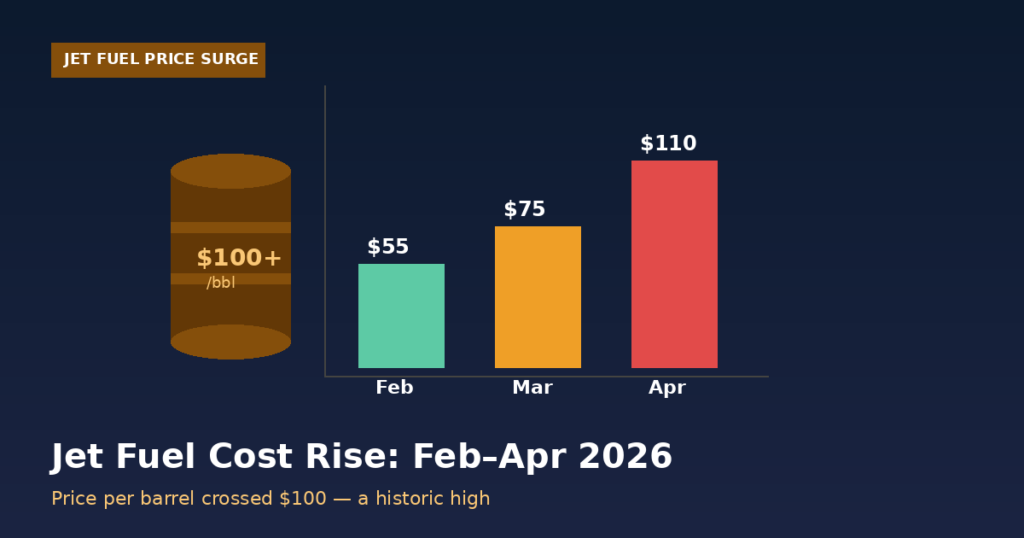
The ongoing military conflict between the United States, Israel, and Iran has severely restricted the flow of crude oil through the Strait of Hormuz — one of the world’s most critical energy chokepoints. As a result, global oil prices have surged to over $100 per barrel, and jet fuel prices have climbed by more than $100 since late February 2026 alone.
The International Energy Agency (IEA) has confirmed that the loss of oil supply is now nearly double what it was just one month ago, signaling the crisis is deepening rather than stabilizing. Countries that do not produce their own fuel domestically are facing the sharpest impact, leaving their airlines particularly exposed.
Which airlines are canceling flights in 2026?
The impact of the jet fuel shortage is being felt across all major regions. Below is a full summary of airline responses to the global fuel crisis:
| Airline | Region | Action Taken |
|---|---|---|
| United Airlines | United States | Cutting off-peak and red-eye flights across Q2–Q3 2026 |
| Air New Zealand | Pacific | Cutting 5% of network — over 1,100 flights from May |
| Scandinavian Airlines (SAS) | Europe | Considering axing 1,000+ flights over coming months |
| Lufthansa | Europe | May ground up to 40 aircraft pending fuel supply |
| Ryanair | Europe | Mulling flight cancellations as fuel sourcing tightens |
| Delta Air Lines | United States | Shelved LAX–Anchorage route for summer 2026 |
| Vietnam Airlines | Asia | Canceling up to 20% of all flights; suspending 7 domestic routes |
| Cathay Pacific | Asia | Introduced temporary fuel surcharges on fares |
How much is the fuel crisis costing airlines?
United Airlines CEO Scott Kirby stated that the airline must tactically prune routes that are no longer profitable under the current fuel cost conditions. The carrier estimates it would need an additional $11 billion for jet fuel expenses alone — a figure that exceeds double United’s best-ever annual profit of $5 billion.
Beyond outright cancellations, airlines are passing part of the financial burden on to passengers through temporary fuel surcharges. Carriers that cannot sustain the losses are opting to ground aircraft entirely rather than continue operating at a loss.
Will the jet fuel shortage get worse before May 2026?
Industry analysts and airline executives widely expect that if the conflict continues through May, the supply chain disruption for jet fuel will intensify significantly. Many carriers are already developing crisis contingency plans, and a wave of mass flight cancellations is considered likely across both short-haul and long-haul networks globally.
Airlines in regions that do not produce their own fuel domestically — particularly those in Australasia, Southeast Asia, and Scandinavia — face the greatest risk of disruption in the weeks ahead.