


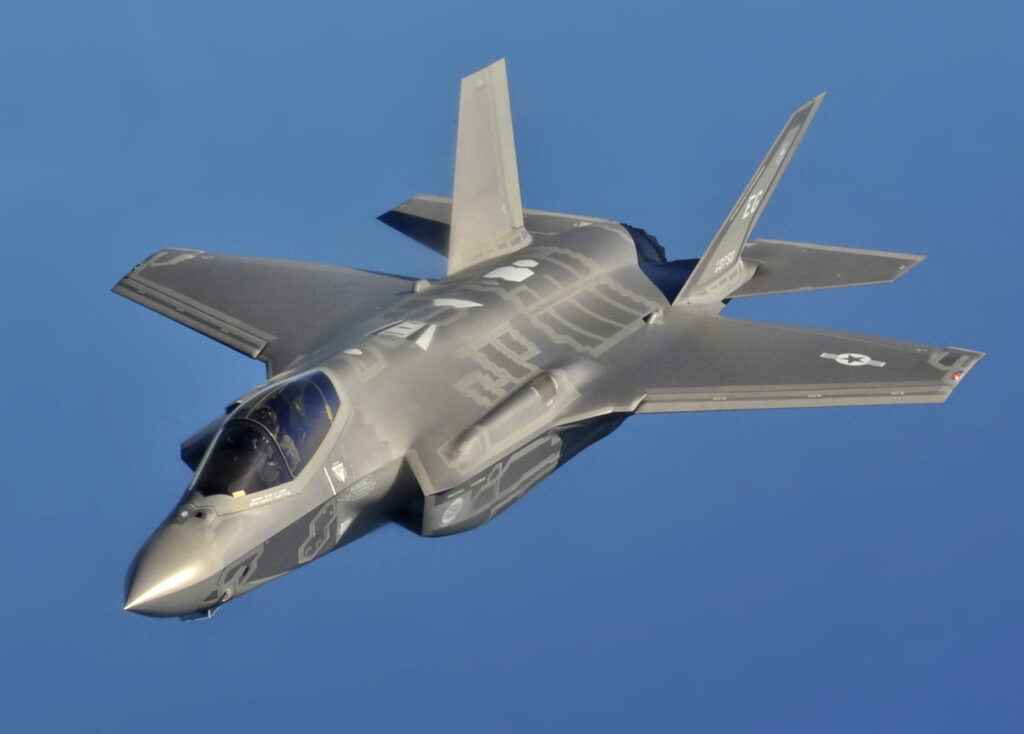
Since its beginnings under the Joint Strike Fighter program in the early 2000s, the Lockheed Martin F-35 Lightning It has been framed as more than just another fighter jet. It was built to replace multiple aging aircraft across U.S. and allied fleets, but more importantly, it was designed around data. Instead of forcing pilots to interpret inputs from separate radar and warfare systems, the F-35 brought everything together into a single, fused operational picture. Over time, with more than 1,300 aircraft now flying across allied nations, it has evolved into a digital backbone of coalition air power. In many ways, that foundation makes the shift toward artificial intelligence not really surprising, but inevitable.
The Lockheed Martin F-35 Lightning II has long been marketed as a “flying computer,” but as of 2026, it is transitioning into an AI-driven node within a decentralized combat system of its flagship fighter, the F-35 Lightning II. Under the internally-branded Project Overwatch, a tactical AI model was integrated into the F-35’s fusion architecture and successfully employed in a real flight test generating independent Combat Identification (Combat ID) outputs on the pilot’s display while airborne.
| Metric | Outcome |
| Platform | F-35 Lightning II |
| AI System | Tactical AI Combat ID model |
| Test Location | Nellis AFB, Nevada |
| First-ever | AI-generated Combat ID in flight |
| AI retraining | Minutes between sorties |
| Fleet size | >1,300 F-35s worldwide |
| Nations operating | 12 + partners |
What makes it stand out in a unique way is not just its use of AI, but the real-time adaptability demonstrated during sortie cycles. Engineers labeled unfamiliar emissions, retrained the tactical model on the ground, and deployed the updated model by the next mission planning window — all within the same operational cycle.
The F-35 already leverages advanced sensor fusion, aggregating radar, electro-optical, and electronic warfare inputs into a coherent tactical picture. By integrating AI models directly, Lockheed Martin aims to compress the decision cycle for threat identification and prioritization.
| Capability | Pre-AI | With AI Integration |
| Sensor sources fused | 10+ | 10+ (AI-assisted interpretation) |
| Time to ID threat | Human-limited | Reduced by model inference speed |
| Unknown emitter classification | Manual | Automated + retrained mid-cycle |
| Pilot workload | High | Lowered by automated assessment |
During Project Overwatch tests, the AI resolved emitter classification ambiguities and presented this intelligence directly on cockpit displays. Although precise delay reductions have not been publicly quantified but the actual implication is clear: aircraft that can autonomously interpret complex signal environments will enable pilots to focus on tactical execution rather than data management.
This reflects that this integration is really going to change the game for the whole aircraft system and let the pilots focus on something necessary.
This overwatch is not just an experiment but rather Martin himself has publicly stated that AI and machine learning (ML) are core enablers of its 21st Century Security vision, encompassing not just aerial combat systems but also sustainment, simulation, autonomous teaming, and logistics.
| Domain | AI Application | Expected Value |
| Combat ID | Real-time tactical assessment | Faster decision cycles |
| Sustainment | Predictive maintenance | Higher readiness, lower costs |
| Simulation | ARISE ® modeling & simulation | Rapid AI agent training |
| Software updates | Over-air software delivery | Continuous modernization |
The F-35 already operates across a multinational fleet surpassing 1,300 aircraft ,a data point reflecting both scale and complexity. Integrating AI into standardized architectures enables faster data dissemination across allied command and control systems, enhancing joint effects and shared situational understanding.
| Parameter | Count |
| F-35s in service | >1,300 |
| Nations operating | ≥12 |
| AI combat trials | Ongoing across partners |
However, the journey from prototype to theatre deployment invites scrutiny. AI models in contested environments present challenges related to data integrity, adversarial spoofing, and trustworthiness ,issues raised by academic research into AI readiness assessments.
In pure quantitative terms, Lockheed’s investments in AI signal both a scaling of aerospace data capabilities and an acknowledgment that future combat environments will be driven by information superiority as much as by kinetic power.
Conclusion
Lockheed Martin’s integration of artificial intelligence into the F-35 is less a technological experiment and more a structural shift in how air combat capability is defined. By baking adaptive AI right into the sensor system, the F-35 program is shifting from “our plane is better” to “our data is better. The real win isn’t just spotting targets quicker or making the pilot’s job easier, it’s about speeding up the whole process fleet-wide across over 1,300 planes.
The future of air superiority will depend not only on speed or firepower, but on how intelligently an aircraft can process information in real time. By embedding AI into the F-35, Lockheed Martin is strengthening the pilot’s edge rather than replacing it. If executed responsibly and securely, this shift could redefine modern air combat.