

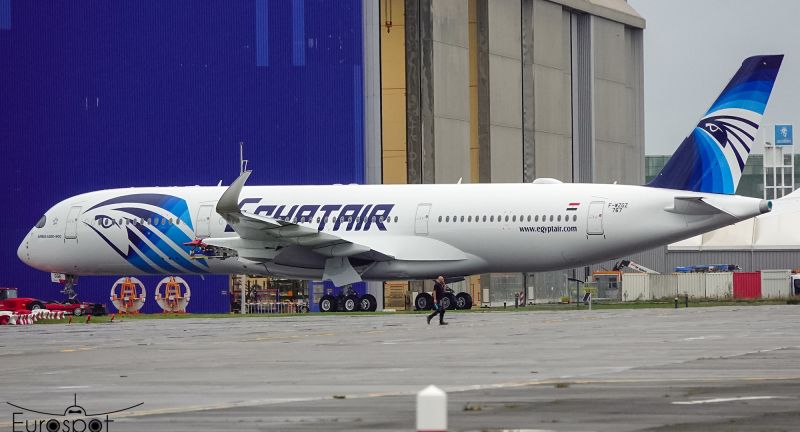
The first Airbus A350-900 bearing the Horus livery lifted off from Toulouse-Blagnac Airport this morning. Its destination is Cairo International Airport. This specific airframe, formerly testing under registration F-WZGZ, now flies as SU-GGE. It represents the first of 16 confirmed A350 orders for the Egyptian flag carrier.
Captain Ahmed Adel, EgyptAir’s Chairman and CEO, accepted the aircraft at the Airbus delivery centre in France. The departure follows a successful maiden test flight conducted on January 22, 2026. That initial sortie validated the airframe’s aerodynamic performance and avionics systems. Today’s flight marks the asset’s formal transfer of title and operational control.
Pilots from EgyptAir’s operations division commanded the delivery leg. They underwent extensive simulator training in Cairo and Toulouse over the last six months. The flight path takes the aircraft across the Mediterranean, a symbolic link between the European manufacturer and its North African operator.
Ground crews at Cairo Terminal 3 have prepared a water cannon salute for the arrival. This delivery kicks off a dense schedule of inductions. Airbus will supply the remaining 15 units gradually through 2028. This rapid intake aims to support the carrier’s summer 2026 schedule.
THE PROCUREMENT STRATEGY
EgyptAir originally committed to 10 A350-900s during the Dubai Airshow in November 2023. Management initially designated these units to augment, not replace, the existing widebody fleet. However, the strategy shifted in June 2025. The airline exercised options for six additional airframes, bringing the total commitment to 16.
This pivot reflects a deeper tactical adjustment. The carrier faces intensifying competition from Gulf rivals and renewed pressure to lower seat-mile costs. The A350’s Rolls-Royce Trent XWB engines offer a distinct advantage here. They burn 25 percent less fuel than the older Boeing 777-300ERs currently servicing EgyptAir’s long-haul routes.
The decision also diversifies the airline’s technical reliance. EgyptAir has historically operated a mixed fleet, but the A350 introduces a new layer of Airbus commonality. It shares type-rating characteristics with the A330, simplifying crew scheduling. Yet, it brings the range capability previously dominated by Boeing.
Financial structures behind the deal involve direct purchase and leasing mechanisms. This hybrid approach preserves capital while ensuring asset ownership. The June 2025 order expansion signalled market confidence. It demonstrated the carrier’s intent to secure delivery slots before supply chain constraints tightened further.
INVESTIGATIVE ANALYSIS: INSIDE THE METAL
The A350-900 introduces the “Airspace” cabin concept to EgyptAir’s inventory. This interior configuration prioritizes passenger volume and humidity control. The cabin altitude remains lower than previous generation aircraft, reducing passenger fatigue on long sectors.
Business Class receives the most significant upgrade. The new layout features direct aisle access for every passenger. This moves away from the 2-3-2 density found on older 777s. Industry analysts confirm the airline selected a staggered 1-2-1 configuration. This aligns the product with global standards set by Star Alliance partners.
Economy Class benefits from the A350’s wider fuselage. The standard nine-abreast layout allows for 18-inch seat widths. Panasonic Avionics provides the Astrova in-flight entertainment system. This hardware supports 4K screens and fast-charging USB-C ports at every seat.
Operational data drove the interior specifications. Route planners specifically requested crew rest compartments suitable for ultra-long-haul missions. This feature enables non-stop service to the U.S. West Coast. Such routes require duty times exceeding 14 hours, necessitating robust crew fatigue management systems.
The arrival of SU-GGE triggers an immediate network review. Planners have identified Los Angeles and Chicago as primary targets for the A350 fleet. These destinations were previously marginally viable with less efficient aircraft. The A350 changes the math.
EgyptAir aims to serve 100 destinations by 2028. The A350 serves as the linchpin for this goal. Its range of 8,100 nautical miles puts nearly any global commercial hub within reach of Cairo. This capability allows the airline to bypass European hubs, capturing direct traffic flows between Africa and North America.
Asian markets also feature heavily in the deployment plan. Shanghai and Tokyo require consistent capacity. The A350 offers the payload flexibility to carry heavy cargo alongside a full passenger load. This dual revenue stream is critical for route profitability in the post-2025 economy.
The fleet modernization plan extends beyond the A350. The airline continues to induct Boeing 737 MAX narrowbodies for regional feed. The A350s will connect this regional traffic to intercontinental trunks. This hub-and-spoke reinforcement is central to the “Vision 2028” strategy.
THE OUTLOOK: SUSTAINABILITY MANDATES
Environmental regulations in the European Union heavily influenced this acquisition. The EU’s “RefuelEU” initiative mandates increasing sustainable aviation fuel (SAF) usage. The A350-900 is certified to operate on a 50 percent SAF blend immediately. Airbus targets 100 percent compatibility by 2030.
EgyptAir has already secured SAF supply agreements. SkyNRG will provide fuel credits covering a portion of the airline’s European operations. The A350’s fuel efficiency compounds these gains. Lower burn rates mean less SAF is required to achieve the same emissions reductions.
Investors view the fleet renewal as a hedge against volatility. Oil prices remain unpredictable. An efficient fleet insulates the carrier’s bottom line from sudden spikes in jet fuel costs. The A350 lowers the break-even load factor on key routes, making the airline more resilient to economic downturns.
This delivery signals the start of a capital-intensive phase. The airline must now execute on the operational promise of these assets. Success depends on maintaining high utilization rates and capturing premium market share. The hardware has arrived; the execution challenge begins now.
 Vibhuuti Goyal
  Anshum Raj
[…] Aviation research indicates hybrid-electric regional aircraft could achieve around 30% CO₂ reduction on typical missions while maintaining […]