

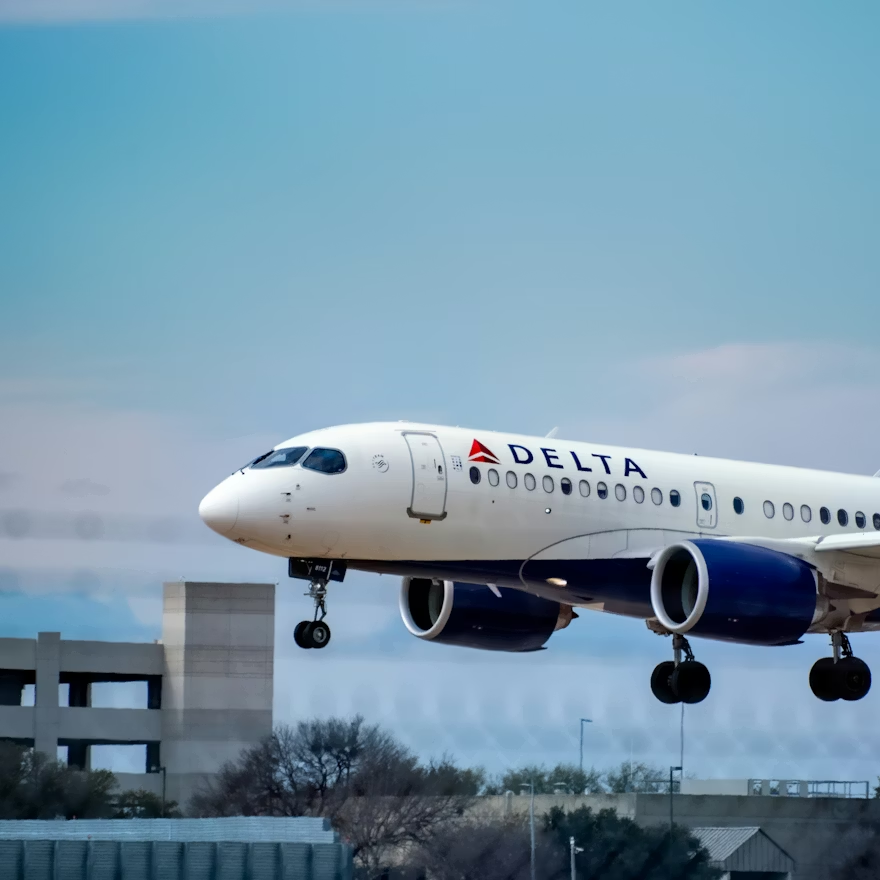
ATLANTA, Delta AirLines CEO Ed Bastian cemented his carrier’s dominance this Valentine’s Day by distributing checks totalling $1.3 billion to 100,000 employees, effectively handing a month’s worth of salary to ramp agents and pilots alike to celebrate a roaring 2025 fiscal performance.
This massive capital injection, representing 8.9 percent of eligible earnings, serves not merely as a reward but as a calculated fortification of the “Delta Difference” culture that keeps organized labour at bay while competitors struggle to match Atlanta’s operational margins. Bastian’s team executed this payout after securing a record-breaking revenue year, driven by an insatiable consumer appetite for premium cabins that defied broader economic gravity.
The arithmetic behind today’s payout reveals a stark divide between Delta and its legacy peers. While United and American grapple with debt loads that would crush smaller nations, Delta generated enough free cash flow throughout 2025 to fund this discretionary bonanza. The 8.9 percent figure translates to a tangible four weeks of pay for ground staff, a metric that resonates far louder on the tarmac than any corporate newsletter. This marks the seventh time since 2015 that the payout has eclipsed the $1 billion threshold.
Management clearly views this expense not as a liability, but as a defensive moat. Every check cashed by a non-union flight attendant or baggage handler weakens the pitch of the International Association of Machinists and the Association of Flight Attendants, both of whom have circled Atlanta with increasing aggression over the last twelve months.
Operational reliability remains the engine room driving this profitability. Delta commanded a pricing premium in 2025 because it completed flights when others cancelled them. The carrier avoided the worst of the technological meltdowns that plagued the sector, allowing them to capture the high-yield corporate traveller who simply cannot afford to be stranded in O’Hare. That reliability acts as a shield, protecting margins even as fuel prices fluctuated wildly last autumn. Yet, insiders know this operational excellence costs a fortune to maintain. The “Delta Premium” depends entirely on the perception that the airline is a cut above, a reputation that requires constant capital expenditure to uphold.
Fleet strategy plays a critical, if quieter, role in this financial success. Delta has long mastered the art of flying older metal longer, squeezing revenue out of paid-off Boeing 767s and 757s while methodically inducting new Airbus A321neos and A350s. This approach shielded them from the worst of Boeing’s production chaos in Renton and Charleston. While Southwest and United scrambled to adjust schedules due to 737 MAX delays, Delta’s heavy reliance on Airbus narrowbodies kept their capacity discipline intact. They controlled their own destiny rather than waiting on a phone call from Arlington.
This divergence in fleet philosophy highlights the most glaring irony in commercial aviation today. The Boeing 777X is finally slated for type certification later this year, a milestone delayed so long it feels mythical. Yet, as 2026 progresses, no US airline has signed an order for the massive twin-jet. Delta, the world’s most profitable airline, has conspicuously ignored Boeing’s new flagship, preferring the economics of used widebodies and factory-fresh Airbus A350-1000s.
It speaks volumes that the largest American aircraft ever built will likely enter service without a single American flag carrier on its launch roster. Bastian’s refusal to engage with the 777X program suggests a deep skepticism about Boeing’s ability to deliver on performance guarantees, a sentiment that evidently paid off in 2025’s bottom line.
Revenue diversification also buffered the airline against the softening of domestic main cabin fares. The loyalty program, tied to their lucrative partnership with American Express, continues to print money almost independently of flight operations. Remuneration from the credit card deal alone contributed billions to the bottom line last year, effectively subsidizing the profit-sharing checks hitting bank accounts today. Delta has evolved into a credit card company that happens to fly airplanes, a structural advantage that purely operational carriers cannot replicate.
However, the path through the remainder of 2026 looks far more treacherous. Labor costs across the industry have reset permanently higher following the pilot contract cycles of 2023 and 2024. Today’s profit share comes on top of those higher base rates, creating a cost structure that demands perfection.
Competitors are not standing still. United remains aggressive on international expansion, and American is slowly repairing its balance sheet. The gap is widening, but the industry has a way of humbling leaders who believe their own press releases. Delta’s profit sharing buys peace and morale for now, but it raises the stakes for 2026 performance. Employees have grown accustomed to these February windfalls. Should the checks shrink next year due to an external shock or a strategic misstep, the very culture Bastian champions could sour, giving the unions the opening they have waited decades to exploit.
Writing a check is easy when the sun shines; keeping the checkbook open when the clouds break over the Atlantic will prove if Delta’s model is ironclad or merely gold-plated.
 Vibhuuti Goyal
  Shaifali
[…] Delta Flight 1067, configured with 179 passengers and six crew members, was cleared for departure to Atlanta at approximately 6:45 p.m. ET. During the initial climb phase, the aircraft’s left CFM56-7B turbofan engine experienced a mechanical malfunction. Witnesses and passengers reported an audible percussive sound followed by a brief exhaust trail of flame, a common symptom of a compressor stall or internal component failure. […]