


Every traveler sitting in economy on a ten-hour overnight flight has had the same thought at least once — what exactly am I missing on the other side of that curtain, and is it worth paying for? In 2026, that question is more layered than ever. Airlines have poured serious investment into both premium economy and business class cabins over the past two years, narrowing some gaps and widening others. The result is a more complicated decision than it used to be, and the right answer genuinely depends on who you are, where you’re going, and what you value at 35,000 feet.
The Price Gap in 2026: What the Numbers Say
Start with money, because that’s where most people start. On a typical transatlantic route, economy fares run roughly $750 to $950, premium economy comes in at $1,200 to $1,600, and business class jumps to $3,500 to $5,000. Those numbers tell the first part of the story clearly — business class isn’t just a step up from premium economy, it’s a different financial category entirely.

At a high level, expect to pay at least 50% more than economy to upgrade to premium economy, and in many cases 75% to 100% more. Moving from premium economy to business class typically costs at least 75% more, with many popular routes doubling in price.
A round-trip business class ticket on British Airways from London Heathrow to New York JFK costs over four times as much as premium economy on the same route. Delta from London to Los Angeles shows business class fares nearly triple those of premium economy, while Singapore Airlines shows a roughly 2.5x price difference on the London–Singapore route.
The math is unambiguous: premium economy typically costs 1.5 to 2 times economy. Business class costs 3 to 5 times economy. That means the gap between premium economy and business class is often larger than the gap between economy and premium economy — a fact that often gets lost when travelers are weighing their options.
The Seat: Where the Real Difference Lives
Seat specs are where the two cabins diverge most sharply and most honestly.
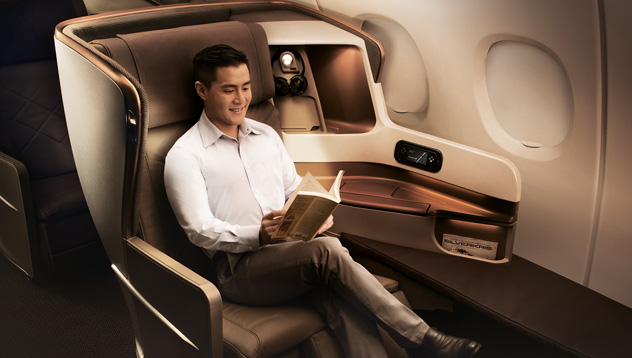
On Singapore Airlines, premium economy passengers on select A350s, A380s, and Boeing 777s enjoy a seat pitch of 38 inches and a width of 18.5 to 19.5 inches. That’s a meaningful step up from the 31–32 inches of pitch in standard economy. But business class on the same airline features fully lie-flat beds in a private suite — a fundamentally different physical experience that no amount of extra pitch can replicate.
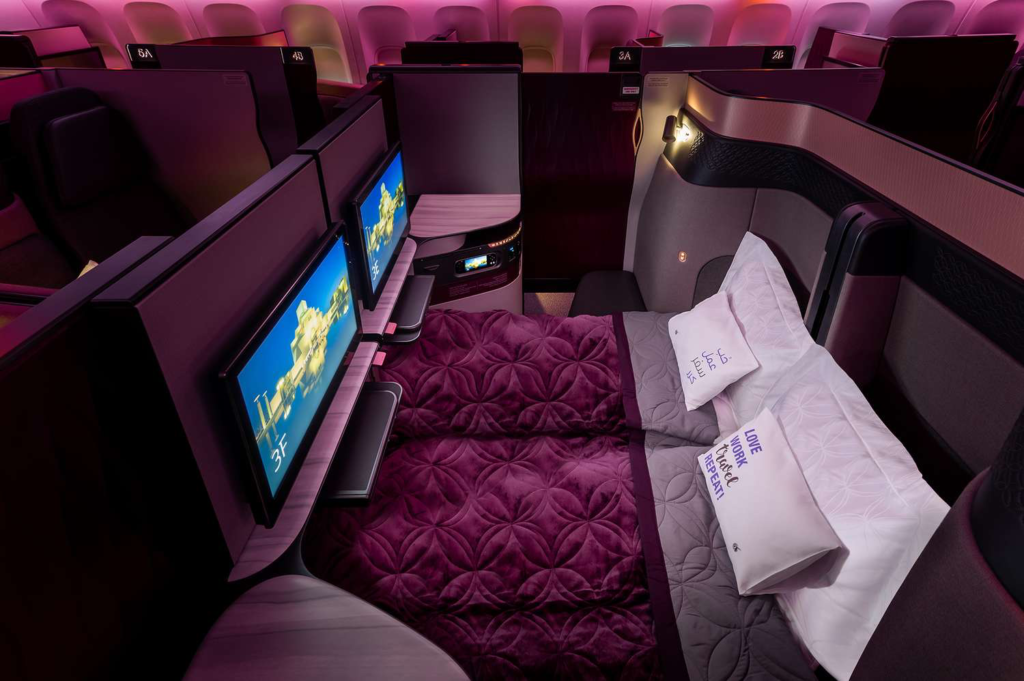
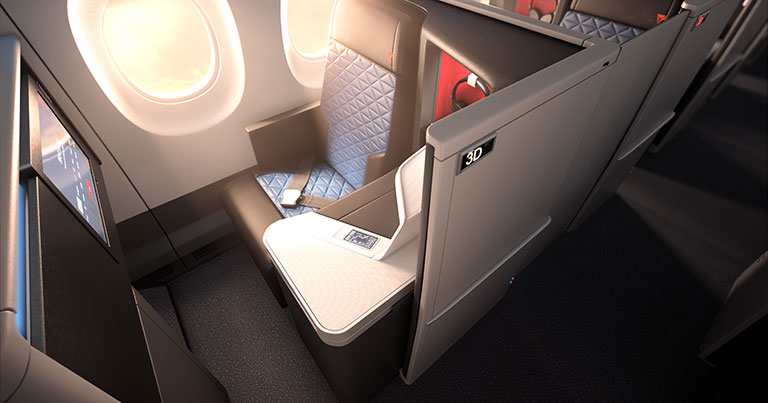
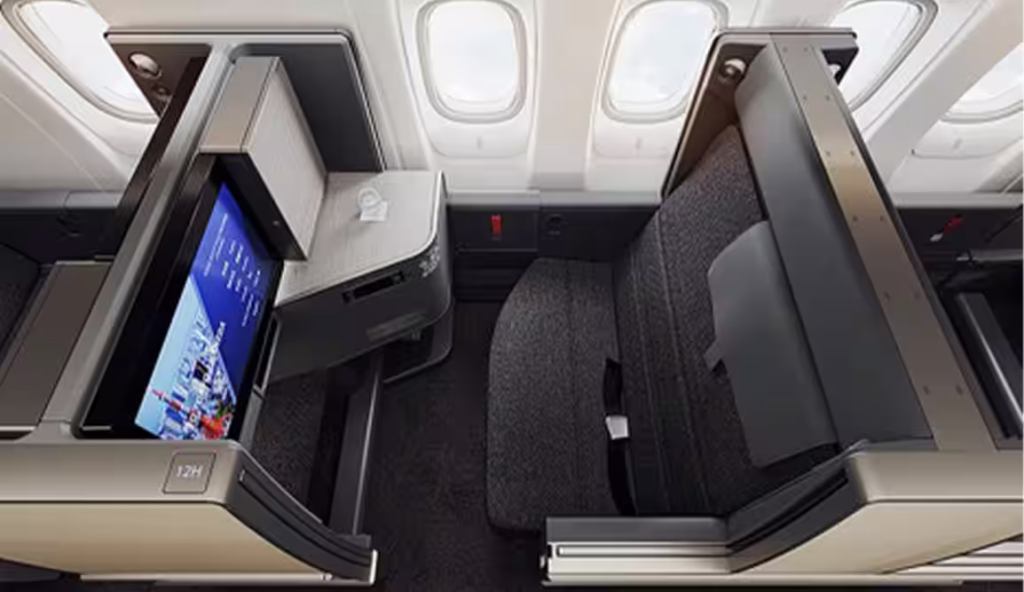
Business class in 2026 has pushed even further into mini-suite territory. The international business class now often features suites with closing doors for privacy, individual storage compartments, and direct aisle access from every seat. Premium economy on the same flights offers an experience closer to what older business class used to look like a decade ago — better than coach, but firmly in a different tier.

According to Skytrax’s most recent rankings, Virgin Atlantic leads the world in premium economy, followed by Japan Airlines, Emirates, and Singapore Airlines. Virgin Atlantic’s product on the 787-9 offers a 21-inch seat width and 38-inch pitch — genuinely impressive numbers that help explain the carrier’s position at the top. But no premium economy seat, regardless of airline, converts to a flat bed. That remains the exclusive domain of business class, and it’s the single biggest practical difference between the two cabins.
For travelers who sleep reasonably well in a reclined position and don’t need to lie fully flat, this distinction matters less. For anyone who has genuinely struggled to sleep upright on a twelve-hour flight, the flat bed in business class isn’t a luxury — it’s a functional necessity.
Service, Dining, and the Soft Product
Beyond the seat dimensions, the service environment in each cabin tells a different story depending on the airline.
Premium economy passengers on carriers like Emirates receive meals on china tableware with stainless-steel cutlery, alongside upgraded beverage selections including sparkling wine. That’s a real and noticeable upgrade over the plastic trays and wrapped utensils in economy — but it’s not the multi-course, chef-curated dining service that business class consistently delivers.
Business class features a dedicated crew focused solely on premium guests, while premium economy attendants may also cover economy passengers during service. The crew-to-passenger ratio difference is real and compounds noticeably over a long flight, particularly in terms of responsiveness and meal timing.

Airport access is another dividing line. Business class passengers universally receive dedicated lounge access, priority check-in, fast-track security, and generous baggage allowances. Some airlines now offer premium economy passengers limited lounge access — but it remains the exception rather than the rule, and when it does exist, it’s typically a basic lounge rather than the full business class facility. Qantas, Cathay Pacific, and a handful of others have made moves here, but most carriers still treat lounge access as a hard boundary between the two cabins.
The Fastest-Growing Cabin in Aviation
One thing both data and airline investment make clear: premium economy is not a passing trend. Emirates is estimated to be adding ten more premium economy routes in 2026, bringing its total network coverage to over 84 routes. United Airlines is upgrading its Boeing 787-9 fleet with a refreshed premium economy cabin, with the first international flights planned from San Francisco to Singapore and San Francisco to London. American Airlines debuted its new premium economy product in late 2025 on new 787-9 Dreamliners and A321XLR aircraft as part of a broader cabin overhaul — the last major U.S. carrier to complete a meaningful premium economy refresh.
EVA Air, widely credited for launching the world’s first true premium economy cabin back in 1992, unveiled its fourth-generation premium economy seats in early 2025. Singapore Airlines and Air France are also rolling out refreshed configurations in 2026. Airlines don’t invest this heavily in a product without demand to sustain it. The growth trajectory confirms that premium economy has permanently established itself as a mature, mainstream cabin class — not a temporary upsell in the making.
Miles and Points: The Loyalty Program Angle
For frequent flyers, the calculus shifts considerably. While premium economy costs more than economy, it remains substantially cheaper than business class — and passengers still earn more miles than they would flying coach, which matters for anyone building toward elite status or a future redemption.
Premium economy award redemptions on programs like ANA Mileage Club, Aeroplan, and Flying Blue frequently fall in the 40,000 to 55,000 mile range for long-haul one-way flights — well below the 70,000 to 110,000 miles business class typically demands on the same routes. For a traveler sitting on a mid-size points balance who can’t swing a full business class redemption, premium economy awards often represent the single highest-value use of accumulated miles, delivering a cabin upgrade that’s tangible rather than marginal.
So Which One Is Actually Worth It?
The honest answer comes down to one question — do you need a flat bed?
Premium economy makes its strongest case on flights over eight hours, for taller passengers who feel genuinely cramped in standard economy, on overnight routes where slightly better recline meaningfully improves rest, and when the fare premium over economy is in the 35–50% range. On shorter flights under five or six hours, the price difference is harder to justify regardless of comfort preferences.
Business class makes its most compelling case on ultra-long-haul routes — transpacific flights of 12 to 16 hours, overnight transatlantic crossings, or any itinerary where arriving functional matters professionally or personally. If you’re heading into a board meeting six hours after landing in Tokyo or Frankfurt, the flat bed in business class stops being indulgence and becomes strategy.
A useful rule of thumb: divide the premium price by flight hours. Under $50 per hour above economy is generally considered reasonable value in premium economy. When that number climbs well above $50, you’re either stretching the budget into business class territory or questioning whether the upgrade is worth it at all.
In 2026, both cabins are genuinely better than they’ve ever been. The gap between them, however, remains exactly what it has always been — one is a significantly more comfortable airplane seat, and the other is a bed.
For additional operational briefings and the latest Airline News, monitor our dedicated aviation intelligence category.