


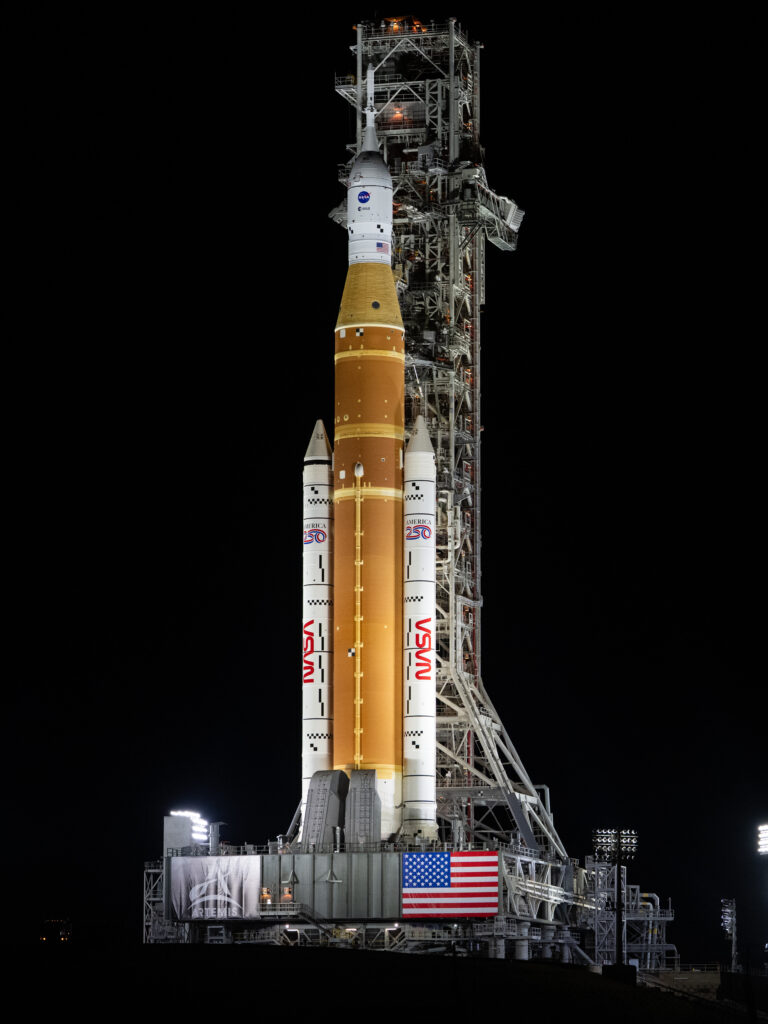
Human space exploration is getting into a new era as the United states plans a historic lunar mission that will send astronauts farther from Earth than any crew has traveled in more than five decades. The upcoming mission is part of the ambitious lunar exploration roadmap led by NASA. This is something really big as on March 12 NAS confirmed that Artemis II crew will lift off from Kennedy Space Center’s Launch Pad 39B in Florida on April 1, pending completion of outstanding technical work.
The Space Launch System is expected to launch the Orion spacecraft into space. Since the final Apollo mission in 1972, this will mark as the first time that humans leave low earth orbit. This signifies the new era of space exploration.
The Artemis program specifically aims to change the way now and take it beyond earth. Let’s look into the metrics of distance and travel data
| Parameter | Value |
| Distance Earth → Moon | ~384,400 km |
| Maximum distance from Earth | ~450,000 km |
| Mission duration | ~10 days |
| Total travel distance | ~1.3 million km |
Most importantly is the aircraft behind the mission, The Orion aircraft is specifically designed for such deep space missions, it is not an ordinary one, rather it features the largest heat shield ever built for a crewed capsule, designed to withstand extreme temperatures during atmospheric re-entrynauts for long-duration travel beyond Earth orbit. All these extra inbuilt specialised features will help and ensure the safety for astronauts.
The most powerful rocket since Apollo is the SLS Space Launch System , the rocket is about 98 metres and generates enormous thrust about 8.8 million pounds allowing it to send heavy spacecraft beyond earth orbit.
| parameter | Value |
| Rocket height | 98 meters |
| Launch thrust | 8.8 million pounds |
| Payload to Moon | ~27 tons |
The Artemis II mission will carry four astronauts representing both the United States and Canada. Moon. The mission commander is Reid Wiseman, a former U.S. Navy pilot with previous experience aboard the International Space Station. The pilot of the mission is Victor Glover, a naval aviator who previously flew on the Crew-1 mission and will become the first Black astronaut assigned to a lunar mission. Christina Koch will serve as mission specialist; she holds the record for the longest single spaceflight by a woman and is expected to become the first woman to travel to the Moon’s vicinity. The fourth crew member is Jeremy Hansen from the Canadian Space Agency, who will assist with mission operations and will become the first Canadian astronaut to participate in a lunar mission.
| Astronaut | Role |
| Reid Wiseman | Commander |
| Victor Glover | Pilot |
| Christina Koch | Mission Specialist |
| Jeremy Hansen | Mission Specialist |
The Artemis II is just the starting, it is the rehearsal for all the space exploration missions planned and needs to be executed. Also it’s not just a mission but more a statement of national capability and integrity as China has publicly stated its intent to land taikonauts on the Moon by 2030.
The program ultimately aims to establish a sustainable human presence on the Moon and use lunar exploration as a stepping stone toward human missions to Mars.
There is a certain bravery to launching humanity’s deepest space journey in half a century on April Fool’s Day. NASA, characteristically, does not appear troubled by the irony.
If this succeeds, this is going to be one of the greatest human missions, by sending humans away from earth that has not happened in the last 50 years it indeed carries the weight of generations thus will prove and start a new chapter of space exploration by humans. and pave the way for the next generation of lunar and interplanetary missions.