

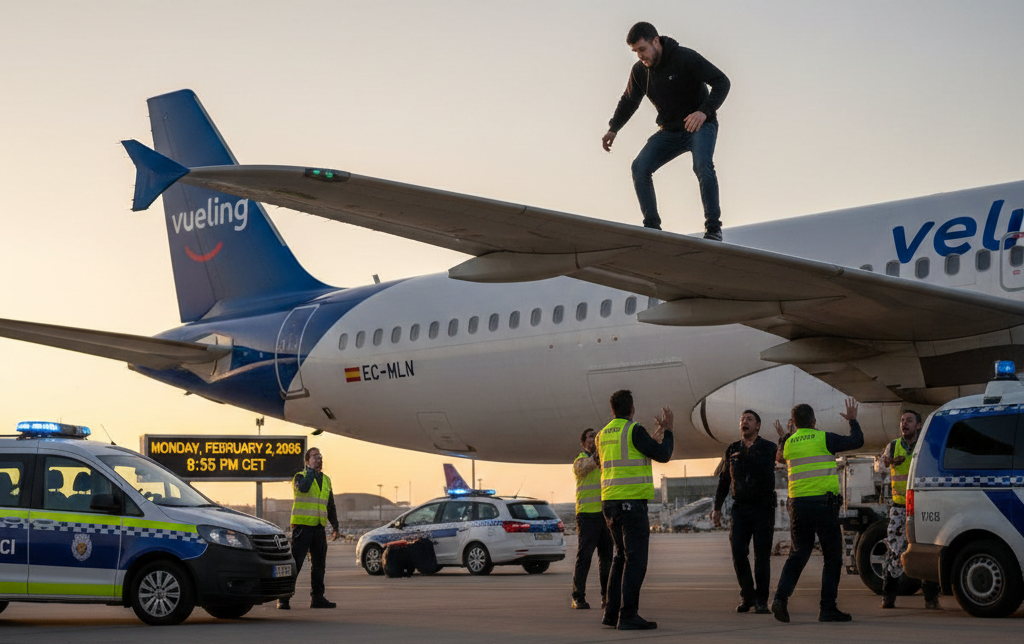
Civil Guard officers arrested a 24-year-old Moroccan national on Monday evening after he breached multiple layers of high-level security at Barcelona-El Prat Airport and scaled the roof of a Vueling Airbus A320. The incident occurred at approximately 21:40 local time at Terminal 1, while the aircraft was being prepared for a scheduled domestic flight to Seville, forcing an immediate suspension of ground operations and the evacuation of the jet bridge.
THE PERIMETER COLLAPSE
The intruder, whose identity is withheld pending formal charges, reportedly gained access to the restricted airfield by scaling a three-meter fence topped with concertina wire near the airport’s southwestern cargo zone. Security footage currently under review by the Spanish airport authority, Aena, indicates the individual navigated several hundred meters of active taxiway before reaching the aircraft at Gate B24. Despite the presence of thermal sensors and motion-detection cameras, the breach was only detected when ground crew members loading luggage onto flight VY2212 observed a man climbing the landing gear assembly and pulling himself onto the wing.
From the wing, the individual transitioned to the top of the fuselage, eventually seating himself on the crown of the aircraft near the communication antenna array. The height of an Airbus A320 fuselage stands nearly four meters above the ground, making the ascent a significant physical feat that suggests the individual acted with intent. Ground controllers immediately halted all nearby taxiing aircraft to prevent any jet blast from endangering the intruder or the responding officers.
A specialized unit of the Civil Guard, supported by airport security personnel, arrived at the gate within four minutes of the initial report. The response team faced the challenge of removing the individual without causing damage to the aircraft’s sensitive external sensors or risking a fatal fall. Negotiators attempted to communicate with the man in Spanish and Arabic, but the intruder remained largely unresponsive, appearing to be in a state of high emotional distress.
After thirty minutes of standoff, officers utilized a mobile passenger stair unit to reach the level of the fuselage crown. The man did not resist when officers moved to detain him. He was brought down from the aircraft at 22:25 and transported to a local medical facility for a psychiatric evaluation before being taken into police custody. Initial searches of the suspect revealed no weapons or hazardous materials, suggesting the motive was likely related to an attempt to hide on the aircraft or a protest regarding his residency status in Spain.
AVIATION SAFETY IMPLICATIONS
The physical presence of a person on the roof of an Airbus A320 presents severe risks to the structural integrity of the airframe. The upper fuselage houses the Emergency Locator Transmitter (ELT), GPS antennas, and various sensors that are essential for safe flight. Vueling technicians pulled the aircraft from service immediately to conduct a thorough inspection for skin indentations or hardware damage.
Passengers who had already begun the boarding process were returned to the terminal lounge. The flight to Seville was delayed by five hours while a replacement aircraft was positioned. The airline confirmed that all safety protocols were followed, noting that the flight crew followed standard emergency procedures by shutting down all auxiliary power units to minimize the risk of fire or injury to the intruder. The financial impact of the grounding, including technical inspections and passenger compensation, is estimated to exceed 50,000 euros.
CRITICAL SECURITY FAILURES
The breach highlights a significant failure in the multi-layered surveillance system at one of Europe’s busiest aviation hubs. Barcelona-El Prat operates under strict European Union aviation security standards, which require continuous monitoring of perimeter fences and the immediate detection of unauthorized personnel. The fact that a lone individual could traverse a substantial distance from the fence to a passenger gate without being intercepted points to potential blind spots in the current sensor array.
Aena has launched an internal investigation to determine why the automated alarm systems did not trigger a more rapid response. Sources within the Civil Guard suggest that the intruder may have utilized a low-profile movement technique, staying close to parked ground support equipment to avoid detection by thermal imaging. This method has been identified in previous security audits as a vulnerability in many international airports. The Ministry of Transport is now facing pressure to review the security contracts of private firms responsible for patrolling the cargo-adjacent perimeters.
The suspect faces multiple charges under the Spanish Penal Code and the Law on Air Safety. These include unauthorized entry into a restricted area and interference with civil aviation operations, which can carry heavy fines and prison sentences. Given the suspect’s nationality, the Spanish Ministry of Foreign Affairs may coordinate with Moroccan consular officials, particularly if the investigation reveals the incident was part of a wider attempt to bypass border controls.
Spanish authorities are also examining if the individual had assistance from anyone inside the airport. While there is currently no evidence of an insider threat, the precision with which the suspect navigated the airfield has raised concerns among counter-terrorism units. The incident serves as a reminder of the persistent difficulties in securing vast airport boundaries against determined individuals.
REGULATORY REFORM AND FUTURE MEASURES
This event is expected to accelerate the implementation of more advanced surveillance technologies at Spanish airports. Aena had already been planning to integrate new software into its video feed analysis to better identify human movement patterns that differ from standard ground crew activity. This security breach will likely serve as a catalyst for the immediate deployment of these systems at Barcelona and Madrid-Barajas.
Industry experts suggest that the focus will now shift to active perimeter defence, where drones or autonomous ground vehicles provide a secondary layer of mobile surveillance. For now, security at El Prat has been heightened, with increased patrols by the Civil Guard’s Rapid Action Group. The Airbus A320 involved in the incident has been cleared for return to service after a full inspection confirmed no damage to its pressurized hull or communication systems. The suspect remains in custody awaiting a court appearance scheduled for later this week.
 Vibhuuti Goyal