

India’s aviation market is growing faster than almost anywhere in the world. Airlines are adding routes, airports are expanding, and regional connectivity is finally becoming a reality. In this changing landscape, a lesser-known aircraft is now drawing attention , the Superjet SJ-100.
Backed by Hindustan Aeronautics Limited (HAL), the SJ-100 could play a role in reshaping India’s regional aviation and aircraft manufacturing ambitions.
What is the Superjet SJ-100?
The Superjet SJ-100 is a 100-seat regional jet aircraft developed in Russia. It is designed for short- to medium-haul routes and sits between turboprops and larger narrow-body aircraft like the Airbus A320.
The aircraft is meant to serve routes where passenger demand is too high for turboprops but not large enough for bigger jets. This makes it suitable for tier-2 and tier-3 city connections, which are becoming increasingly important in India.
The latest version, called the SJ-100, uses more domestically produced systems and engines. This change was made to reduce dependence on Western suppliers and ensure better long-term availability of parts.
In simple terms, the SJ-100 is built to be:
- Smaller than an A320
- Faster and more comfortable than turboprops
- Suitable for regional and short-haul operations
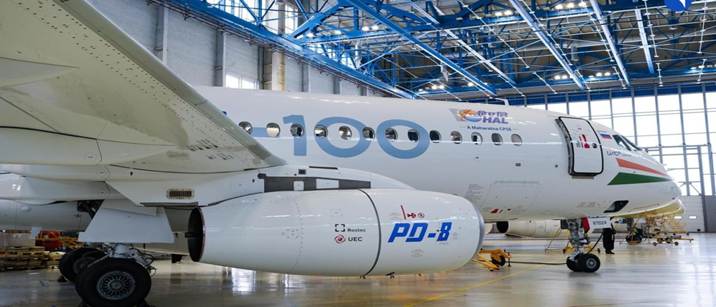
Photo: Wings India
Why HAL is Interested in the SJ-100?
HAL has traditionally focused on defense and military aviation. Civil aviation, however, is now a major growth opportunity.
HAL’s interest in the SJ-100 is driven by three clear reasons.
First, India lacks a domestically assembled civil aircraft in the regional jet category. The SJ-100 gives HAL a chance to enter this space quickly without starting from scratch.
Second, regional aviation demand is rising. Airlines need aircraft that can operate efficiently on thinner routes. A 100-seat jet fits well into this gap.
Third, the project supports the “Make in India” vision. HAL plans to begin with leasing aircraft and later move towards assembly and localization in India.
This step-by-step approach reduces risk while allowing HAL to build experience in civil aircraft manufacturing.
HAL’s Plan for India
HAL’s strategy is practical rather than aggressive.
The plan begins with leasing a small number of SJ-100 aircraft to Indian operators. This helps airlines test the aircraft without committing to large purchases.
In the next phase, HAL aims to assemble the aircraft in India using semi-knocked-down kits. Over time, more components could be sourced locally.
Alongside assembly, HAL is also expected to develop maintenance, repair, and overhaul (MRO) capability for the SJ-100. This is a critical factor for airlines, as strong local MRO support reduces downtime and operating costs.
If executed well, this could create:
- Skilled aviation jobs
- A local supplier ecosystem
- Reduced dependence on foreign MROs
- Impact on Aircraft Manufacturers
The SJ-100 will not directly replace aircraft from Airbus or Boeing. Instead, it targets a different segment of the market.
Most Indian airlines operate large narrow-body fleets. These aircraft are ideal for high-demand routes but not always efficient on smaller regional sectors.
A 100-seat jet gives airlines another option.
If HAL offers attractive leasing terms and reliable support, some airlines may consider the SJ-100 for:
- New regional routes
- High-frequency short sectors
- Capacity-controlled expansion
This does not threaten Airbus or Boeing immediately, but it adds competition and reduces dependence on a single aircraft category.
Boosting Regional Aviation in India
Regional connectivity is one of the biggest challenges in Indian aviation.
Many smaller airports struggle because airlines cannot deploy the right aircraft size. Turboprops are sometimes too small, while larger jets are too costly to operate.
The SJ-100 could help bridge this gap.
With around 100 seats, airlines can:
Connect underserved cities
Increase flight frequency
Improve passenger comfort compared to turboprops
This aligns well with India’s regional aviation goals and could strengthen air links between smaller cities and major hubs.
Challenges and Risks
Despite its potential, the SJ-100 program is not without challenges.
One key concern is reliability and supply chain stability. Earlier versions of the Superjet faced issues related to spare parts and support. HAL will need to ensure strong local support to build airline confidence.
Another challenge is airline acceptance. Indian carriers prefer fleet commonality to reduce training and maintenance costs. Introducing a new aircraft type is a major decision.
Certification and long-term support will also be closely watched. Airlines need assurance that the aircraft will remain viable for decades.
The Bigger Picture
The SJ-100 is not just about one aircraft.
For HAL, it represents a step into civil aviation manufacturing, something India has long aspired to achieve. Even limited success could open doors for future aircraft programs.
For airlines, it offers another tool to grow regional networks efficiently.
For India, it supports broader goals of connectivity, industrial growth, and reduced dependence on foreign suppliers
 Vibhuuti Goyal