

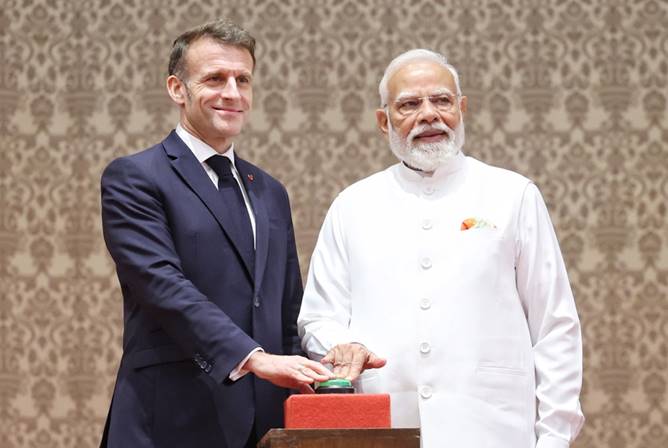
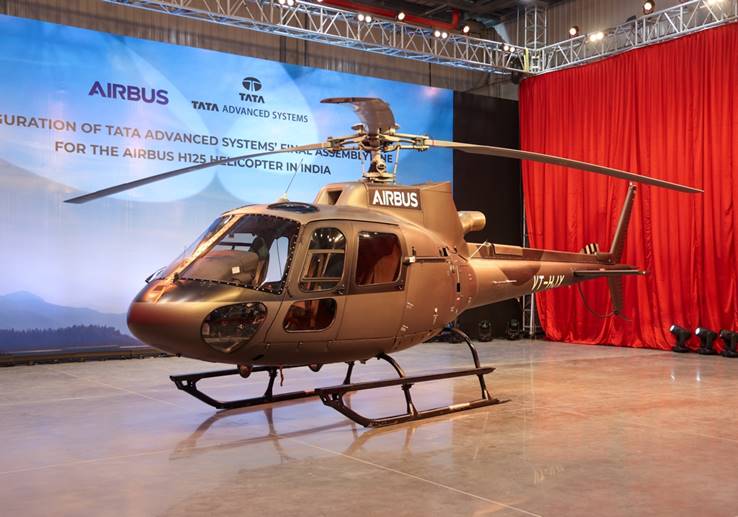
VEMAGAL, Tata Advanced Systems Limited (TASL) and Airbus inaugurated India’s first private helicopter assembly line in Vemagal on February 17, 2026.
Prime Minister Narendra Modi and President Emmanuel Macron virtually launched the facility to produce civil and military H125 choppers. Defense Minister Rajnath Singh attended the physical event alongside top French and Indian aviation officials. This facility shatters the long-standing state-run HAL monopoly on rotary-wing manufacturing. Private capital now dictates the speed of India’s vertical-lift roadmap.
STRATEGIC SIGNIFICANCE
This partnership represents a definitive shift in Indian aerospace strategy. TASL is no longer just a component supplier. The company now acts as a prime integrator for complex flying platforms. This Vemagal facility mirrors the C295 transport assembly line established in Vadodara. Together, these hubs form a comprehensive private defense ecosystem. India is transitioning from a passive buyer to an active global manufacturing node.
THE MACHINE: H125
The H125 dominates high-altitude operations globally. It remains the only helicopter to ever land on the summit of Mount Everest. That 2005 feat proves its unique viability for the Himalayas. No other single-engine platform matches its performance ceiling in high-and-hot conditions. Indian operators require this specific capability for border logistics and mountain rescue.
PRODUCTION TARGETS
TASL targets early 2027 for the first “Made in India” delivery. The site handles manufacturing, assembly, integration, and testing. It will initially produce ten units annually. Capacity will scale rapidly to meet regional demand. This facility will eventually serve as an export hub for South Asia.
The industry notes the disciplined execution of this joint venture. Competitors face severe headwinds elsewhere. Boeing continues to struggle with certification delays for the 777X widebody. Fresh durability issues with GE9X engines have pushed 777X deliveries into 2027. Supply chain fractures continue to plague those massive programs in Seattle. In contrast, the Tata-Airbus roadmap remains strictly on schedule. This reliability appeals to operators tired of indefinite delays.
Domestic demand drives the immediate production schedule. The UDAN regional connectivity scheme requires robust rotary-wing assets. H125s will bridge last-mile gaps for religious tourism and remote travel. Emergency medical services also lack dedicated air ambulances. This production line fills that critical infrastructure void. Operators can finally access localized maintenance and lifecycle support.
MILITARY APPLICATION: H125M
The facility also supports production of the H125M military variant. This platform excels in tactical reconnaissance roles. Its low acoustic and thermal signatures provide an edge in surveillance missions. High-altitude forward posts require reliable supply drops. The H125M offers a cost-effective solution for these light utility requirements. It serves as a force multiplier for the Indian Army.
Airbus currently sources $1.5 billion annually from Indian suppliers. This number is projected to hit $2 billion by 2030. The Vemagal FAL significantly deepens this procurement network. Complex aerostructures and avionics will now be sourced locally. This creates high-value engineering jobs within Karnataka.
FUTURE OUTLOOK
TASL now commands a complete aerospace manufacturing capability. They build transports in Vadodara and helicopters in Vemagal. Control over the supply chain reduces operator downtime significantly. Sovereignty in aerospace manufacturing is no longer a theoretical concept. The Tata-Airbus alliance has operationalized “Make in India” for the world to see.
 Vibhuuti Goyal