

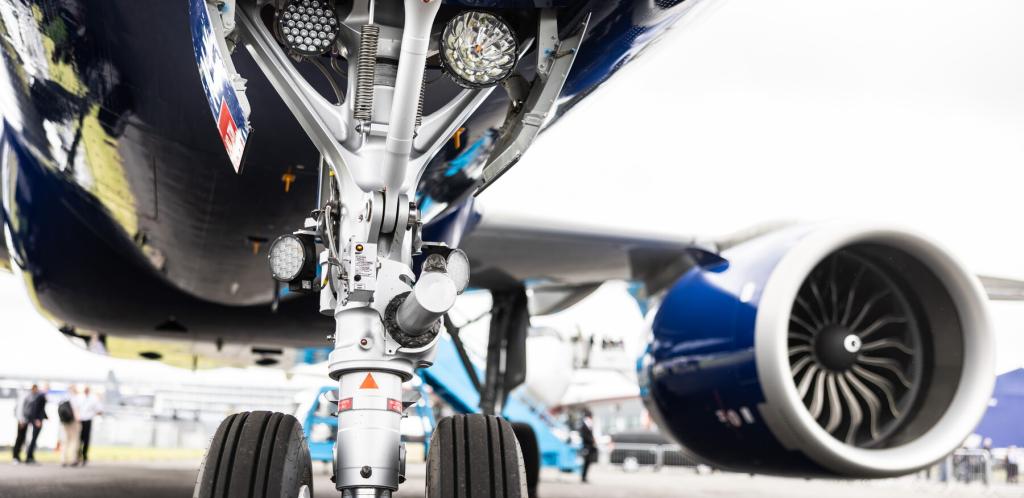
CASABLANCA, The champagne remains on ice in Toulouse, but the real party is happening 1,200 miles south, under the Moroccan sun. Safran, the French propulsion and equipment titan, has driven a new stake into North African soil, committing over €280 million ($332 million) to a landing gear manufacturing facility in the Casablanca airport zone.
The move, announced this week amidst the pomp of a Royal visit, is not merely an industrial expansion; it is a frantic attempt to feed the voracious, starved assembly lines of the Airbus A320neo.
This facility, spanning 26,000 square meters, promises to churn out landing gear components and hydraulic systems for the single-aisle workhorse that currently dominates global order books. Safran CEO Olivier Andriès and Chairman Ross McInnes stood shoulder-to-shoulder with King Mohammed VI to seal the deal, a tableau that underscores how critical the Maghreb has become to European aerospace survival. But look past the ribbon-cutting optics, and the timeline reveals a desperate disconnect.
Airbus CEO Guillaume Faury has staked his reputation on hitting a monthly production rate of 75 A320s by 2027. Yet, Safran’s new Moroccan jewel won’t be fully operational until 2029.
The arithmetic is brutal. The supply chain is already snapping under the tension of current rates, hovering in the mid-50s. Safran’s decision to break ground in Casablanca, adding to its existing LEAP engine ecosystem announced last October- is a long-term hedge, not a short-term fix. It signals that the “temporary” supply chain crunch is now viewed as a structural permanence.
By offshoring heavy machining and assembly to a region where energy costs are decoupled from European volatility and labor remains abundant, Safran is admitting that the old industrial hubs in France and the UK can no longer support the volume required by the duopoly’s next phase.
While Airbus frantically reinforces its supply nodes to secure a future of high-volume delivery, its American rival remains trapped in a certification quagmire. The industry watches with a grim fascination as the Boeing 777X, the widebody that was supposed to redefine long-haul economics, inches toward a type certification slated for later this 2026. The irony is thick enough to choke on: despite the jet’s imminent technical clearance, not a single US passenger airline has signed a firm order. The domestic carriers—United, American, Delta—are voting with their wallets, leaving the 777X to rely on Middle Eastern and Asian champions while they refurbish aging 777-300ERs or flirt with the A350.
Boeing’s stagnation highlights the brilliance, and the risk, of the Airbus-Safran play in Morocco. The Casablanca facility is designed to be a “dual-expertise” shop, handling both the heavy metal of landing gear modules and the delicate precision of hydraulic systems. Integrating these two distinct manufacturing streams under one roof is an aggressive efficiency play, intended to cut the handoff delays that have plagued the A320 program since the pandemic.
However, the skepticism among veterans on the Renton and Toulouse lines is palpable. A greenfield site in North Africa takes years to spin up to the quality standards required for flight-critical hardware like landing gear. Safran plans to hire 500 workers, but the transfer of tribal knowledge, the “black art” of metallurgy and hydraulic tolerances cannot be downloaded via a fiber optic cable. If this facility stumbles, or if the training curve for the local workforce proves steeper than the PowerPoint decks suggest, the A320 ramp-up could hit a hard ceiling just as airlines are screaming for capacity.
Geopolitically, this cements Morocco’s status as the new “Golden Triangle” for aerospace, stealing thunder from Querétaro, Mexico, and frantic expansion zones in Southeast Asia. The Kingdom offers decarbonized electricity—a crucial metric for European ESG compliance—and a government that moves faster than the sclerotic bureaucracies of the EU. For Safran, it is a safe harbor. For Airbus, it is a lifeline thrown three years into the future.
The industry is witnessing a fundamental decoupling of design and build. The brains may remain in Paris and Seattle, but the muscle is migrating south. As Boeing fights to certify a plane its home market won’t buy, Airbus and Safran are betting the farm that the future of aviation manufacturing lies not in the hands of third-generation machinists in Ohio or Nantes, but in a dusty, sun-drenched industrial park in Casablanca.
The center of gravity has shifted, and it is not coming back.
 Vibhuuti Goyal
[…] have scheduled a block of Airbus A320neos, some delivered as recently as late 2022, for immediate teardown in Arizona, marking the […]
[…] JetBlue Airbus A320 declared an emergency shortly after takeoff and returned to Newark Liberty International […]
[…] absence of the Airbus A380 from U.S. carrier fleets stands as one of the most significant strategic divergences in modern […]