

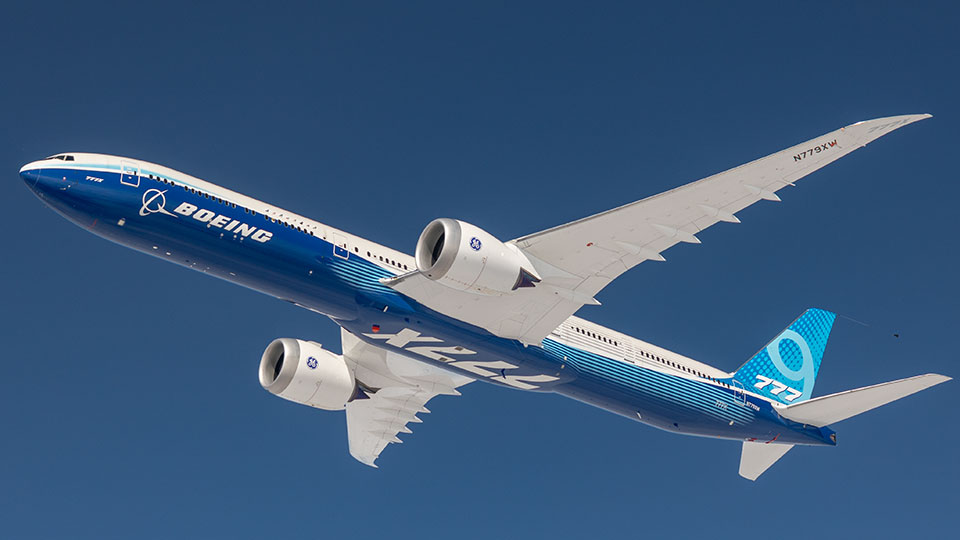
SEATTLE, Boeing’s long-delayed 777X is finally on track to receive Federal Aviation Administration (FAA) certification in the second half of 2026, yet the aerospace giant faces a stark commercial reality in its home market: not a single U.S. passenger airline has ordered the $442 million super-jumbo, signalling a historic divergence between American fleet strategies and Boeing’s largest commercial aircraft.
Despite entering the final phases of flight testing this week, the Boeing 777-9, the largest twin-engine jet ever built remains absent from the order books of United Airlines, American Airlines, and Delta Air Lines. While certification is now projected for Q3 2026 following a six-year delay, the “Big Three” U.S. carriers have firmly rejected the 400-seat behemoth in Favor of smaller, more flexible widebodies like the Boeing 787 Dreamliner and Airbus A350. This lack of domestic support leaves the program almost entirely dependent on Middle Eastern and Asian operators, marking the first time a Boeing flagship has failed to secure a launch order from a U.S. passenger carrier.
THE END OF THE JUMBO ERA IN AMERICA
The absence of U.S. orders is not merely a sales slump; it represents a fundamental shift in transatlantic and transpacific network planning.
Capacity vs. Frequency: U.S. airlines have pivoted away from the “hub-and-spoke” super-connectors that require aircraft the size of the 777X. instead, they are prioritizing frequency and point-to-point connections using the 787-9 and A350-900.
Fleet Commonality: Delta has committed its future widebody operations to Airbus (A350/A330neo), while United and American have standardized their long-haul fleets around the 787 Dreamliner family to reduce pilot training and maintenance costs.
Risk Aversion: The 777X’s tortured development timeline-originally slated for 2020 delivery has eroded confidence. U.S. carriers, unwilling to risk schedule disruptions, have opted for proven platforms.
BACKGROUND CONTEXT: A TROUBLED TIMELINE
The 777X program has been plagued by setbacks since its launch in 2013.
Certification Delays: heightened FAA scrutiny following the 737 MAX crisis forced Boeing to redesign critical flight control redundancies.
Engine Issues: The GE9X engines, while 10% more efficient than their predecessors, faced durability challenges during testing phases in 2023 and 2024.
The Order Book: As of February 2026, the program holds approximately 480 orders. The backlog is heavily concentrated among three carriers: Emirates (205 orders), Qatar Airways (74 orders), and Singapore Airlines (31 orders). The launch customer, Lufthansa, expects its first delivery shortly after certification later this year.
WHY THIS MATTERS? THE FREIGHTER FACTOR
While U.S. passenger carriers have shunned the jet, the cargo sector remains Boeing’s last hope for domestic 777X adoption.
FedEx and UPS: Both logistics giants are currently evaluating fleet renewals. With the ICAO emissions standards forcing the retirement of older MD-11 and 767 freighters by 2028, the 777-8 Freighter variant is the logical successor.
Competition: However, Airbus has aggressively marketed its A350F, securing orders from major global logistics players. If Boeing fails to lock in a U.S. cargo carrier for the 777-8F in 2026, it risks ceding its traditional monopoly on American air freight.
FUTURE OUTLOOK
Boeing Commercial Airplanes CEO Kelly Ortberg has reiterated that 2026 is a “year of execution,” with the primary goal being the safe certification of the 777-9. However, aviation analysts warn that without a U.S. marquee customer, the secondary market value of the aircraft could suffer.
“The 777X is an engineering marvel built for a market that no longer exists in the United States,” said an aviation analyst at Teal Group. “Unless we see a radical shift in United or American’s strategy regarding ultra-high-density routes to Asia, the 777X will remain an export-only product for the foreseeable future.”
For now, the skies over America will remain devoid of Boeing’s folding-wing giant, even as it prepares to enter service globally.
 Anshum Raj
  Vibhuuti Goyal
[…] certification delays for the 777X widebody. Fresh durability issues with GE9X engines have pushed 777X deliveries into 2027. Supply chain fractures continue to plague those massive programs in Seattle. […]
[…] persistent propulsion challenges with the 777X program continue to pressure the manufacturer’s delivery timelines and cash flow […]