

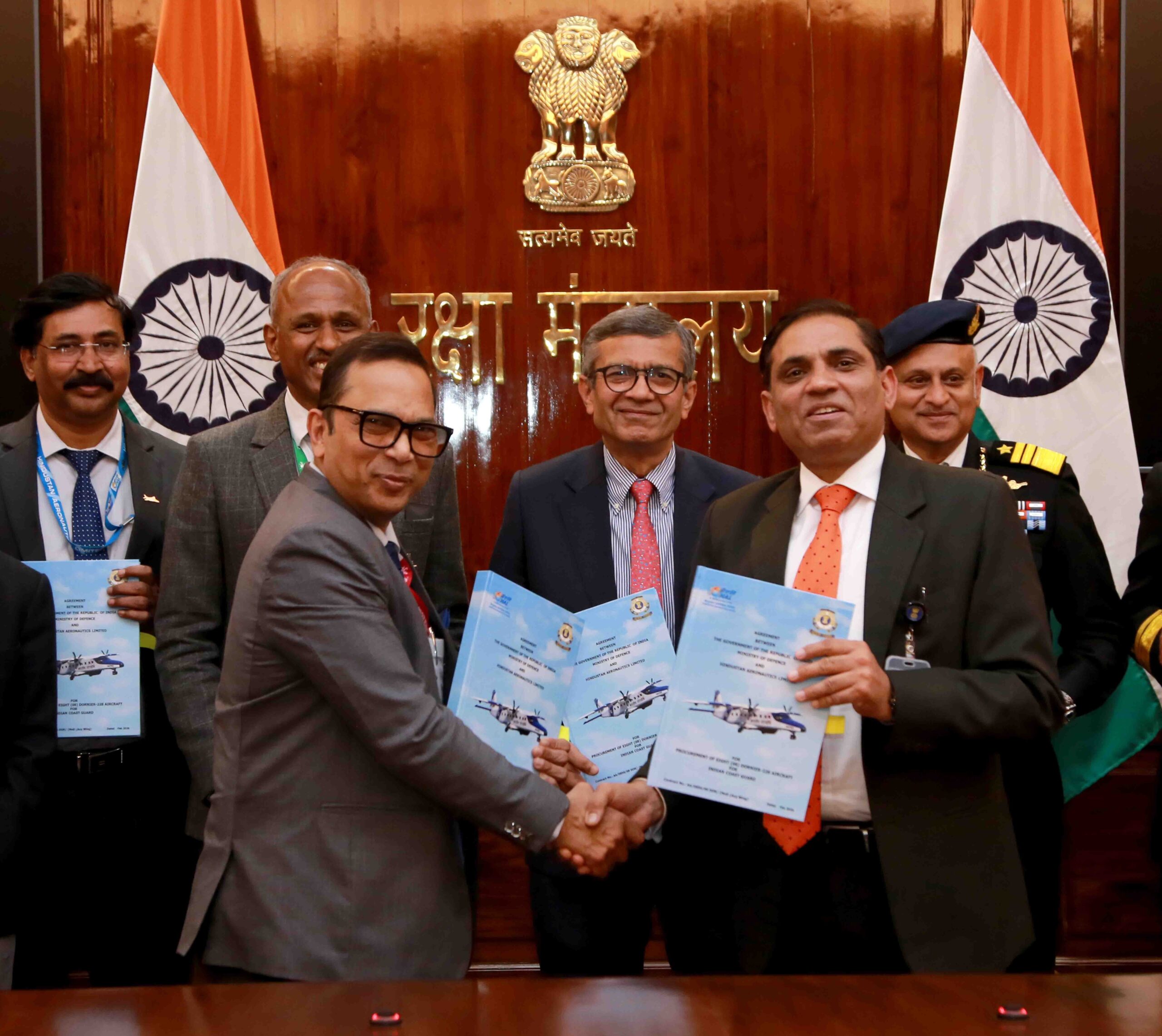
NEW DELHI, The Indian Ministry of Defence (MoD) signed a Rs 2,312 crore contract with Hindustan Aeronautics Limited (HAL) on Thursday.
The deal secures eight Dornier-228 aircraft for the Indian Coast Guard (ICG) to bolster maritime surveillance capabilities.
This procurement falls under the “Buy (Indian)” category, reinforcing the government’s Aatmanirbhar Bharat initiative for indigenous defence manufacturing.
CONTRACT SPECIFICATIONS AND FLEET EXPANSION
The agreement was formalised in New Delhi between the MoD and HAL’s Transport Aircraft Division, Kanpur.
These eight new platforms will join the ICG’s existing fleet of approximately 38 Dornier-228 aircraft.
The contract value includes the aircraft frames, associated engineering support, and specific “Operational Role Equipment” for maritime missions.
Official releases state the project will generate sustained employment across the domestic aerospace supply chain.
This includes work for Micro, Small, and Medium Enterprises (MSMEs) involved in avionics and structural components.
HAL’s Kanpur division will handle the complete manufacturing, assembly, and flight testing of the airframes.
TECHNICAL CONFIGURATION AND AVIONICS
The Dornier-228 is a twin-turboprop short take-off and landing (STOL) utility aircraft optimized for coastal patrol.
It is powered by two Garrett/Honeywell TPE331-5-252D engines, delivering reliable performance in tropical maritime environments.
Each engine drives a four-bladed constant-speed propeller, ensuring high fuel efficiency during long-endurance surveillance sorties.
The aircraft features a rectangular fuselage cross-section, allowing a comfortable 19-seat configuration or rapid cargo conversion.
For the ICG, these platforms are equipped with a glass cockpit and advanced maritime patrol radars.
The sensor suite typically includes the EL/M-2022A multi-mode radar or indigenous equivalents for 360-degree surface detection.
Electro-Optical/Infra-Red (EO/IR) turrets provide day-night visual identification of targets at extended standoff ranges.
The ICG will deploy these aircraft for 24/7 surveillance of India’s Exclusive Economic Zone (EEZ).
Primary missions include Search and Rescue (SAR), marine pollution monitoring, and anti-smuggling operations.
The aircraft’s high-wing design offers excellent downward visibility, a critical factor for visual surface searches.
Its STOL capability allows operations from semi-prepared runways in island territories like the Andaman and Nicobar chain.
Pollution control variants can carry spray pods to disperse oil slicks during environmental contingencies.
The platform also supports medical evacuation (MEDEVAC) roles, bridging the gap between remote coastal stations and mainland hospitals.
INDIGENOUS MANUFACTURING ECOSYSTEM
This contract underscores a strategic shift towards reducing import dependence for critical utility aircraft.
HAL has manufactured the Dornier-228 under license since 1983, achieving high levels of indigenisation.
Recent variants feature composite materials in secondary structures to reduce weight and improve corrosion resistance.
The deal also covers Maintenance, Repair, and Overhaul (MRO) support, ensuring high fleet availability rates.
Lifecycle technical support will be provided entirely within India, reducing downtime associated with foreign OEM dependance.
STRATEGIC MARITIME IMPLICATIONS
India’s 7,516 km coastline requires a dense aerial surveillance grid to monitor non-traditional security threats.
The Dornier-228 acts as the “eyes in the sky” for the ICG, directing surface vessels to intercept targets.
Increased fleet strength allows for more frequent sorties and tighter coverage of shadow zones in the Indian Ocean Region.
This procurement aligns with the broader defence objective of securing sea lines of communication (SLOCs).
The addition of these eight aircraft will significantly reduce the response time for maritime distress calls.
 Aastha Choudhary
  Martin hope
  Shaifali