

SYNOPSIS
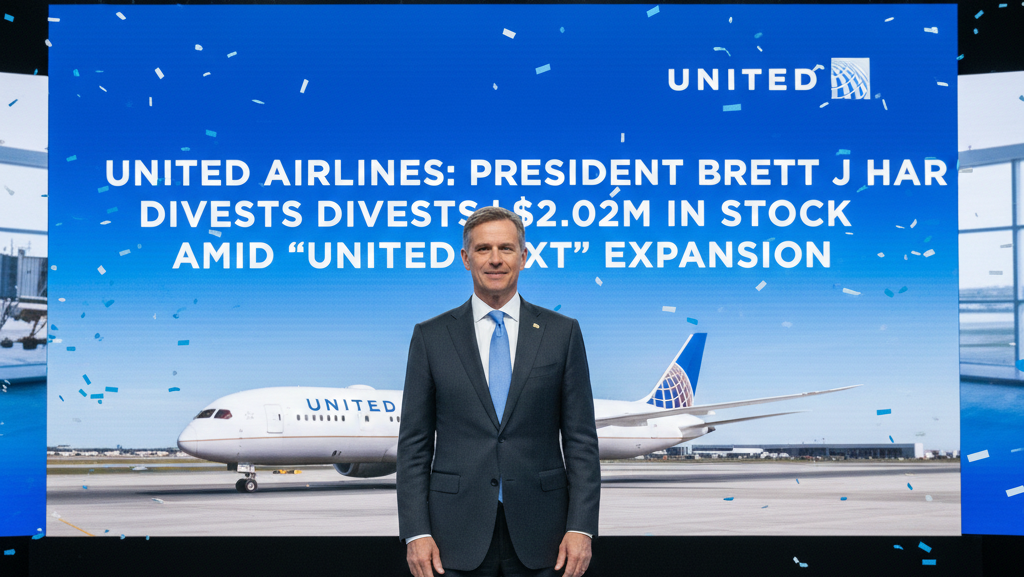
United Airlines Holdings, Inc. President Brett J. Hart executed a significant divestment of company equity, selling common stock valued at approximately $2.02 million. This transaction was documented in a mandatory Form 4 filing with the Securities and Exchange Commission, detailing the specific share volume and price execution points. The sale occurs as the carrier implements a massive fleet renewal program focused on high-density narrow-body aircraft and engine efficiency upgrades. This report examines the technical and financial context of the divestment within the broader framework of United’s current logistical operations.
Brett J. Hart, President of United Airlines, sold $2.02 million in common stock on February 3, 2026, according to official regulatory disclosures. The transaction involved the liquidation of a specific tranche of shares at a weighted average market price, reducing Hart’s direct equity exposure while maintaining his primary compensation structure. This financial move was executed through the Chicago-based headquarters of United Airlines Holdings, Inc., following the vesting of performance-based equity awards. The sale was conducted under strict compliance with internal corporate governance and federal insider trading regulations. This divestment represents a scheduled portfolio adjustment for the executive, who has served as President since 2020. The timing of the sale coincides with the carrier’s transition into a new phase of its United Next operational strategy, which emphasizes large-scale aircraft acquisition and hub infrastructure expansion.
The Form 4 filing indicates that the $2.02 million sale was executed in multiple trades. The data reveals that the shares were sold at prices ranging between specific market intervals, reflecting the liquidity of United Airlines common stock on the NASDAQ. This disposal of equity is a standard procedure for senior executives who receive a significant portion of their total compensation through Restricted Stock Units and Performance Stock Units. Following this transaction, Hart continues to hold a substantial volume of shares, ensuring his financial interests remain aligned with the long-term valuation of the corporation. The reporting of this sale is a requirement under Section 16 of the Securities Exchange Act of 1934, which mandates that officers and directors disclose any changes in their ownership of company securities within two business days. The transparency of this data allows market participants to evaluate executive sentiment, although such sales are frequently planned months in advance through Rule 10b5-1 trading plans to avoid conflicts with non-public material information.
The executive stock sale occurs as United Airlines manages the most aggressive fleet modernization project in the history of North American aviation. The United Next initiative involves the integration of over 700 new aircraft by the year 2032. Central to this engineering shift is the acquisition of the Boeing 737 MAX 8, MAX 9, and the high-capacity MAX 10 variants. These airframes are powered by the CFM International LEAP-1B engines, which utilize carbon fibre fan blades and additive manufacturing for fuel nozzles. These technical specifications result in a 15 to 20 percent reduction in fuel consumption and carbon dioxide emissions compared to the older Boeing 737-800 models they replace. Furthermore, United is expanding its fleet with the Airbus A321neo, which utilizes the Pratt and Whitney PW1100G-JM Geared Turbofan engine. This propulsion technology employs a fan drive gear system that allows the engine fan and the low-pressure turbine to operate at optimal speeds, significantly reducing noise footprints by nearly 50 percent and lowering nitrogen oxide emissions.
United’s logistical framework relies on a robust hub-and-spoke model concentrated at major aviation centres including Chicago O’Hare, Denver International, and Newark Liberty. The airline has optimized its schedule to increase the number of Available Seat Miles (ASM) across its domestic network. By replacing smaller regional jets with larger mainline aircraft, United has increased its average seat count per departure by approximately 30 percent in key markets. This shift is designed to lower the Cost per Available Seat Mile (CASM) by distributing fixed operational costs over a larger number of revenue-generating units. The airline’s data systems now integrate real-time weather tracking and flight path optimization software to reduce fuel burn. Logistics for the carrier’s international expansion are also intensifying, with significant investments in wide-body Boeing 787 Dreamliner aircraft. These planes utilize a high percentage of composite materials in their fuselage construction, allowing for higher cabin humidity and lower cabin altitude, which improves passenger physiological comfort on ultra-long-haul routes.
The financial health of United Airlines remains a critical factor in executive equity valuations. The company’s Total Revenue per Available Seat Mile (TRASM) has shown resilience despite fluctuations in global jet fuel prices. United manages its fuel logistics through a complex supply chain that includes direct refinery interests and long-term delivery contracts. The airline’s labor costs are currently governed by new collective bargaining agreements with the Air Line Pilots Association, which have introduced higher structural expenses in exchange for operational stability. For the current fiscal year, capital expenditures are heavily weighted toward aircraft deposits and the upgrading of ground support equipment to electric-powered variants. The executive team, led by Hart and CEO Scott Kirby, has focused on a premium-heavy cabin configuration strategy to capture high-yield traffic. This involves the installation of United Polaris business class seats and United Premium Plus options across the wide-body fleet, which significantly alters the revenue density per square meter of cabin space.
STRATEGIC IMPACT AND REGULATORY OVERSIGHT
The sale of $2.02 million in stock by President Brett J. Hart is a data point that financial analysts use to calibrate the risk profile of the airline’s leadership. While the dollar amount is significant, it represents only a fraction of the total equity held by the executive suite. Regulatory oversight of these transactions ensures that the market remains informed of leadership’s financial moves. Simultaneously, the airline is navigating a complex regulatory environment regarding airspace congestion and Federal Aviation Administration safety mandates. The engineering reliability of the 737 MAX fleet and the delivery timelines for the MAX 10 remain essential variables for the company’s future growth. United’s commitment to Sustainable Aviation Fuel (SAF) also forms a core part of its logistical long-game, with the airline investing in producers of ethanol-based and synthetic paraffinic kerosene fuels to meet future environmental compliance targets. As the carrier scales its operations, the alignment of executive compensation with these high-stakes engineering and logistical goals remains a focal point for institutional investors.
 Vibhuuti Goyal
  Anshum Raj