

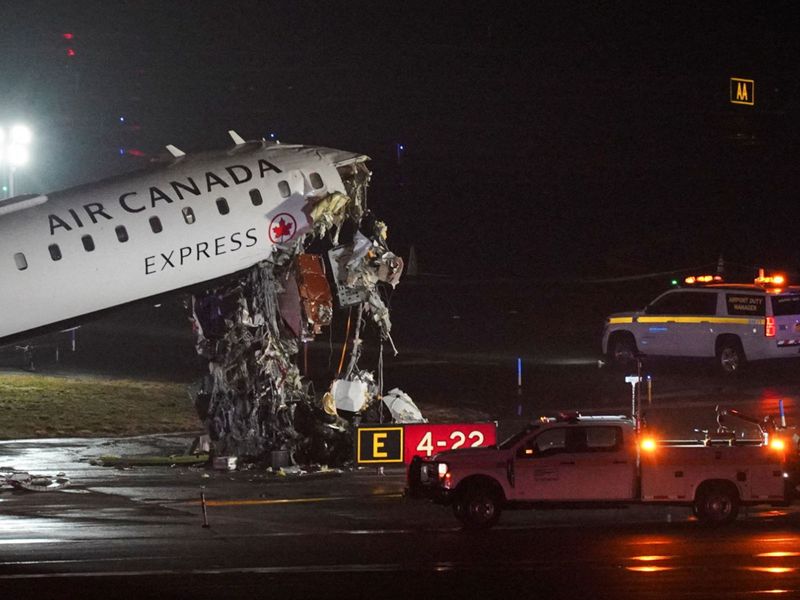
In a recent incident an aircraft operated by Air Canada was involved in a collision with a ground service vehicle while taxiing on the airport tarmac. The event, though not resulting in major injuries, has once again drawn attention to the complexities and risks associated with ground operations in modern aviation.
- Aircraft: Bombardier CRJ-900
- Flight: Air Canada Express (operated by Jazz Aviation)
- Route: Montreal → New York (LaGuardia)
The collision reportedly occurred during the taxi phase, a critical yet often underestimated segment of flight operations. Even minor lapses in coordination can lead to incidents such as this.
- Speed at impact: ~24 mph (≈39 km/h)
- Time of incident: ~11:38–11:40 PM (local time)
- Location: Runway 4, LaGuardia Airport
Leaked Air Traffic Control (ATC) recordings from LiveATC.net have provided a chilling look into the moments leading up to the crash. The audio reveals that the tower controller had initially cleared “Truck 1 and Company” to cross Runway 4 at Taxiway Delta.
This isn’t the first time, many incidents have been occurring since last year, thus there is a need for my precautions for all the risks involved.
A comparable incident highlighting the risks of ground operations occurred in 2024 at Tokyo’s Haneda Airport, where a Japan Airlines Airbus A350 collided with a Coast Guard aircraft on the runway.
Japan Airlines managed to avoid a greater tragedy due to swift emergency response.
Much like the recent Air Canada ground collision, the Haneda incident reinforces the importance of strict coordination between the pilots and ground control.
However such incidents are relatively rare, but can typically occur due to a combination of human error or communication gaps or sometimes low visibility. lapses. Aviation authorities and airlines maintain strict Standard Operating Procedures (SOPs) to minimize these risks, but the increasing density of airport traffic continues to challenge operational efficiency.
The National Transportation Safety Board (NTSB) and the FAA have confirmed they are launching a joint investigation into the “runway incursion.” Investigators will focus on the breakdown in communication between the control tower and the ground vehicle, as well as the visibility conditions at the time of the landing.
From an operational standpoint, even minor ground incidents can have cascading effects. Aircraft involved in such events must undergo thorough inspections before being cleared for further flights.
- Full airport shutdown (ground stop issued)
- Flights:
- Diverted to other airports
- Some returned to origin
- Diverted to other airports
- Possible closure window: until ~18:00 GMT (initial estimate)
Thus leading to flight delays, flight rescheduling, and logistical disruptions across the airline’s network.
This is a nightmare scenario for any pilot or controller,” said one aviation analyst. “To have a vehicle cleared onto an active runway while an aircraft is in its landing roll points to a catastrophic failure in standard operating procedures.”
Now to take precautions and decrease such incidents, modern aviation has started taking steps. Advanced systems such as surface movement radar, automated vehicle tracking, and improved communication protocols are being deployed at major airports worldwide. These measures aim to create a more controlled and predictable ground environment, reducing the likelihood of such collisions.
Incidents like this serve as a reminder that safety in aviation is not limited to the skies, it begins on the ground. Thus one should not take risks till the end. Anything can happen at anytime and incidents like these remind us of the importance of attention spans.
People Affected
- Passengers onboard: ~100 passengers
- Total injuries: 70+ injured
- Critical injuries: ~5 (including firefighters)
- Ground injuries: ~4 firefighters injured
- Fatalities: At least 2 reported
Also one thing to see is there is no serious injury involved as for passengers, this underscores the effectiveness of emergency preparedness and response mechanisms.
As investigations continue, more details are expected to emerge regarding the exact sequence of events.
 Aastha Choudhary
  Martin hope