

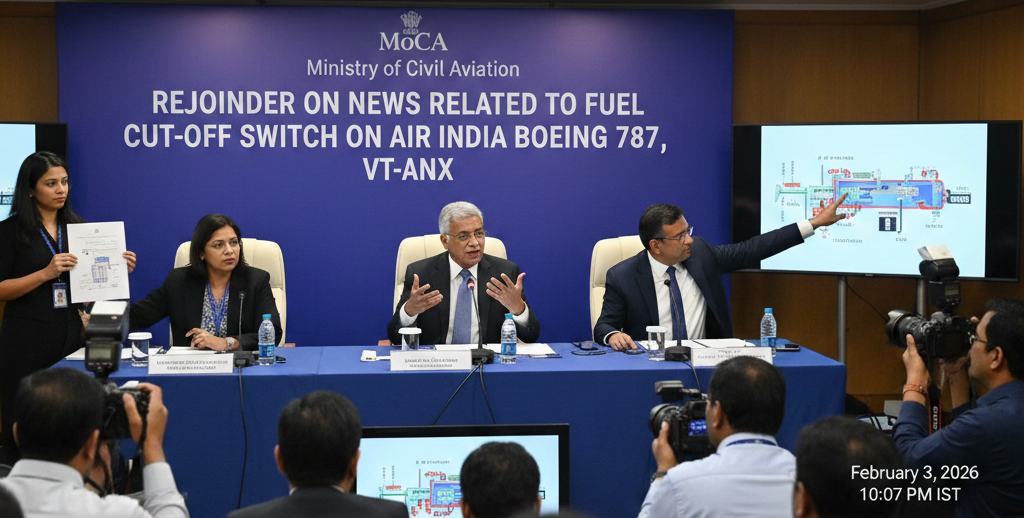
The Ministry’s rejoinder addressed a video currently circulating on social media platforms, which purportedly showed the switch malfunctioning. The Ministry of Civil Aviation and Air India engineers analysed the footage in the context of official Boeing maintenance manuals. The analysis concluded that the procedure demonstrated in the video was fundamentally incorrect and did not represent the approved method for operating or testing the Fuel Cut Off Switch.
The dissemination of such unauthorized demonstrations can create unnecessary alarm regarding aviation safety. By releasing this rejoinder, the government aims to suppress speculative narratives that deviate from established aeronautical engineering facts. The incident underscores the challenges modern carriers face in the era of viral digital content, where a lack of technical context can lead to the misinterpretation of standard cockpit ergonomics as systemic safety risks.
Operational Chronology of Flight AI 132
On the afternoon of February 1, 2026, Air India flight AI 132, a long-haul service from London Heathrow to Bangalore, encountered a non-routine observation during the pre-departure engine start sequence. According to the Ministry’s technical summary, the flight crew observed that the fuel control switch failed to remain positively latched in the “RUN” position on two initial attempts when light vertical pressure was applied.
Adhering to standard operating procedures, the flight crew successfully engaged the switch on the third attempt, confirming a stable latch. To ensure the highest safety margins, the crew performed a manual physical verification to guarantee the switch was fully seated. Throughout the engine start and the subsequent long-haul flight, no abnormal engine parameters, caution messages, or system warnings were recorded. The crew maintained heightened vigilance, avoiding unnecessary contact with the control pedestal, and the aircraft arrived in Bangalore without further incident. This disciplined execution of safety protocols highlights the efficacy of current pilot training modules regarding cockpit switch ergonomics and monitoring.
Technical Analysis and Boeing Consultation
Upon arrival at Kempegowda International Airport, the defect was formally logged in the Pilot’s Flight Report (PDR). In alignment with international safety standards, Air India engineering consulted M/s Boeing for specific technical guidance to evaluate the serviceability of the component. The subsequent inspection, conducted under the direct oversight of DGCA officials, involved a comparative analysis of the involved fuel control switch against new units and switches installed on other aircraft in the fleet.
The engineering findings were conclusive. The Boeing 787-8 fuel control switches, both left and right, were found to be fully satisfactory. The locking tooth and pawl mechanisms were confirmed to be fully seated, with no evidence of slipping from the “RUN” to “CUTOFF” positions when force was applied parallel to the base plate. The technical report clarified that the perceived “slipping” only occurred when external force was applied in an incorrect, off-axis direction. The angular design of the base plate allows for movement if pressed improperly with a finger or thumb, a design characteristic rather than a mechanical failure.
Furthermore, the “pull-to-unlock” force a critical metric for preventing accidental engine shutdowns was measured using Boeing’s recommended procedures. In every test, including those performed on the switch from VT-ANX, the force required to move the switch remained strictly within the manufacturer’s specified limits. These results effectively negate claims of a widespread mechanical malfunction within the Air India Dreamliner fleet.
Strategic Regulatory Directives and Safety Oversight
In response to these findings, the Ministry of Civil Aviation has issued a directive to Air India to reinforce operational discipline. The airline is mandated to circulate the Boeing recommended procedure for the operation of the Fuel Cut Off switch to all flight crew members immediately. This proactive measure ensures that all pilots are briefed on the specific directional force required to operate the switches, thereby preventing future reports of “slippage” caused by improper handling.
This regulatory intervention is consistent with the Aircraft Rules, 1937, which empower the DGCA to oversee all aspects of aircraft maintenance and pilot proficiency. The transparency displayed by the MoCA in this instance reflects a strategic commitment to maintaining India’s high standing in global aviation safety rankings. As Air India continues its massive expansion and fleet modernization under the Tata Group, maintaining the integrity of its Boeing 787 operations remains a cornerstone of its international strategy.
Strategic Implications for the Boeing 787 Fleet
The Boeing 787-8 is a technologically advanced aircraft that relies on fly-by-wire systems and sophisticated human-machine interfaces. The fuel control switch is a vital interface between the pilot and the Full Authority Digital Engine Control (FADEC). Any report of instability in these switches is treated with the highest level of priority by global regulators.
The findings that the switches on VT-ANX were functioning as designed, but were sensitive to incorrect directional force, provide a valuable data point for Air India’s Safety Management System (SMS). It suggests that while the hardware is robust, the “human factor” element specifically the ergonomics of switch manipulation requires continuous emphasis during simulator sessions and line training. This incident will likely lead to updated training bulletins across all Indian operators of the Dreamliner, ensuring that the nuances of cockpit hardware are fully understood by all flight deck personnel.
The definitive rejoinder from the Ministry of Civil Aviation effectively closes the case on the purported malfunction of VT-ANX. By providing a transparent, evidence-based account of the London-Bangalore flight and the subsequent engineering inspections, the Ministry has reaffirmed the airworthiness of the Air India fleet. The collaboration between Air India, Boeing, and the DGCA serves as a template for rapid response to safety concerns, ensuring that technical facts prevail over social media speculation.
The resolution of the VT-ANX switch issue demonstrates that India’s aviation safety infrastructure is capable of high-precision investigations that align with global aerospace standards. Moving forward, the emphasis will remain on disciplined execution of procedures and the continuous refinement of crew training to match the sophistication of modern aviation technology.
 Vibhuuti Goyal